
Evaluating The Superintendent One Year In
After being hired without any public input, LAUSD Superintendent Carvalho needed to win over the community. How has he done so far?


“Who would ever hire this guy again?”
- Eric Phillips,
Speaking about Carvalho
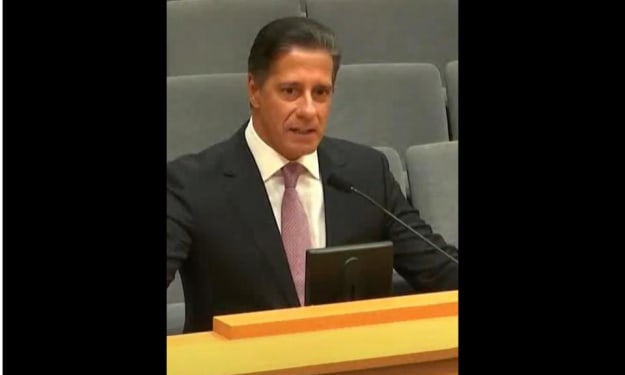
As the Los Angeles Unified School District’s (LAUSD) Superintendent gets ready to start his second year on the job, it is a good time to evaluate how he has done at leading the bureaucracy of the country’s second-largest school district. Before the School Board disappeared into closed session at Tuesday’s meeting with an agenda that included “Superintendent’s Evaluation,” I took the opportunity to provide my perspective:
Last weekend I was doing research on the Board’s refusal to renew the charter of the North Valley Military Institute. Before the computer hack, I could have navigated to that Board meeting on the calendar and found all of the materials that were presented. Unfortunately, the Board’s website is still labeled “temporary” and no longer includes access to these documents. In fact, all of the information about charter schools that used to reside here has disappeared.
If there is one defining moment in the tenure of the Superintendent, it is the computer hack. From the beginning of the attack, teachers, parents, and students have been largely kept in the dark. When the district has provided any information, much of it contradicted what the community was experiencing. The Superintendent himself insisted that there was only one attack and the district quickly shut it down. He even threatened anyone who contradicted this information with an investigation by authorities. It has since been revealed that this statement was completely incorrect and the hackers had actually entered the system more than a month earlier.
The public still needs a complete picture of what information was exposed. Without it, they are left unable to protect themselves from the results.
This lack of transparency is typical of how the District has operated under Superintendent Carvalho. Instead of providing useful data, the district presents splashy presentations, marketing materials, and a new logo. Before carefully orchestrated visits in front of the press, schools are given a makeover so that they no longer represent the facilities that our students attend on a day-to-day basis. At one school the district installed new furniture in classrooms and placed new bark in the planters in preparation for the visit. Afterward, they removed it all. How does this help the children?
“Extra Learning Days” are another issue. First, they were placed on the calendar without any public discussion or buy-in from either parents or teachers. These were replaced with “Acceleration Days” which were so heavily promoted that many parents complained about the volume of recorded phone calls that they received. After the first two days of this program, the District hyped the fact that 71,000 students had registered. It was only after pressure was applied from the public that Carvalho was forced to admit that only 36,486 showed up.
Those two days of learning cost the district $36 million. Would the district have achieved a better return on investment if there had been a discussion of what should be done with the money before the program was announced? Shouldn’t teachers have been consulted to find out what they needed? After all, they are the classroom experts. Great leaders work to build teams that they work with to find solutions, they don’t issue orders from their offices and just expect them to be blindly followed.
This lack of transparency also appears to apply to his dealings with the Board. How is it that a district that has a history of supporting marginalized groups ended up signing a contract with the Florida Department of Education? Florida’s Governor has used this department to attack the LGBTQ community, ban books from the classroom, threaten teachers who don’t conform to his bigotry and ban the teaching of AP African American Studies. Why are we sending them any money? Have any safeguards been put in place to ensure that our online students are not having their rights denied? The public doesn’t know because of a lack of transparency. Does the Board?
If I had not been cut off, I would have concluded with:
While the Superintendent reports to the board, there has been no indication during the past year that he is being held accountable for his actions. When you retire to a closed session to review the Superintendent’s performance, you need to remember that the board is supposed to set policy, and he is supposed to implement it. It is time for you to insist that transparency is expected from him.

Carvalho was hired by the previous iteration of the board behind closed doors and without any input from the board. I noted at the time that this would mean that he would have to convince all seven board members that he would have to start his job winning over stakeholders the way that he convinced all seven board members that he was the right person to take over the district’s massive bureaucracy. The Superintendent's propensity for secrecy has prevented him from accomplishing this task. If he continues along this path, he may meet the same fate as his most infamous predecessor, John Deasy.
____________________________
Carl Petersen is a parent advocate for students with special education needs and public education. He was elected to the Northridge East Neighborhood Council and is the Education Chair. As a Green Party candidate in LAUSD’s District 2 School Board race, he was endorsed by Network for Public Education (NPE) Action. Dr. Diane Ravitch has called him “a valiant fighter for public schools in Los Angeles.” For links to his blogs, please visit www.ChangeTheLAUSD.com. Opinions are his own.
About the Creator
Carl J. Petersen
Carl Petersen is a parent advocate for students with SpEd needs and public education. As a Green Party candidate in LAUSD’s District 2 School Board race, he was endorsed by Network for Public Education (NPE) Action. Opinions are his own.
Keep reading
More stories from Carl J. Petersen and writers in Education and other communities.
The LAUSD Superintendent Vs. Transparency
“We were attacked one time, not more than one time, despite what some folks out there are saying. In fact, what they are saying out there has garnered the attention of federal authorities.” - LAUSD Superintendent Alberto Carvalho
By Carl J. Petersen3 years ago in Education
Smart Steps to Finance and Manage a New Construction Spec Home
A spec home is short for "speculative home." It means a house built without a specific buyer in mind. Builders construct it based on what they believe buyers want. This type of home can be profitable, but it needs careful planning. The goal is to build it, sell it quickly, and make a solid return. To succeed, you must understand your costs, timeline, and market.
By Ruvim Khemchan6 days ago in Education
Can Light Be Slowed Down or Stopped?
How Fast Does Light Normally Travel? In a perfect vacuum, light travels at a constant speed known as c, approximately 299,792 kilometers per second. This speed is a fundamental constant of nature and represents the maximum speed at which information can travel.
By shahkar jalal5 days ago in Education


Comments
There are no comments for this story
Be the first to respond and start the conversation.