
How to Hire an App Developer: Step-By-Step Guide for 2026
A Practical 2026 Roadmap to Choosing the Right Mobile App Development Partner for AI-Driven, Secure, and Scalable Success

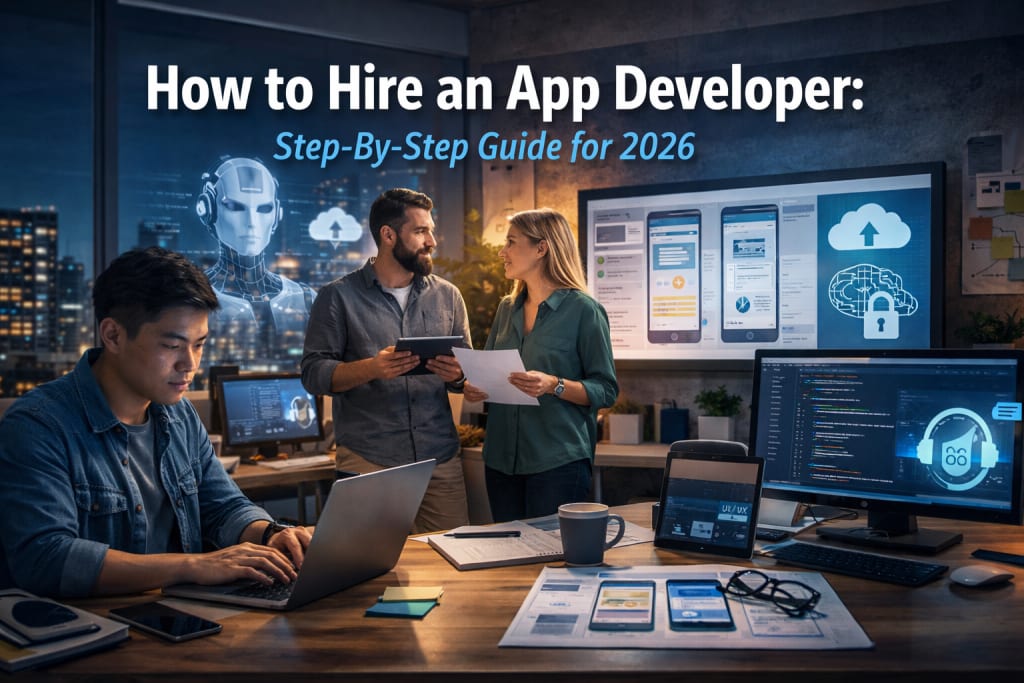
Hiring an app developer in 2026 is no longer just about writing code. It is about choosing the right mobile app development company or expert. Who understands AI integration, scalability, security, and product strategy better. From day one, users expect personalization, instant performance, and intelligent features. If your app feels outdated, they will leave your app quickly.
According to Statista, global mobile app revenue is projected to exceed $600 billion in 2025. At the same time, Data.ai reports that users spend more than five hours daily on mobile devices worldwide. That level of engagement creates opportunity but also intense competition. If you want to hire the right app developer, follow this structured approach.
Step 1: Define Your App Vision Clearly
Before you start searching, document your idea properly. Many projects fail because founders skip this step.

Clarify:
- The problem your app solves
- Your target audience
- Core features
- AI-powered capabilities (chatbots, predictive analytics, personalization)
- Revenue model
According to McKinsey & Company’s 2023 Global AI Survey, 55% of organizations use AI in at least one business function. That means intelligent features are becoming standard, not optional.
When your requirements are clear, developers can estimate timelines and costs more accurately. It also prevents expensive scope changes later.
Step 2: Choose the Right Hiring Model
In 2026, you typically choose between freelancers, in-house developers, or agencies.
Freelancers work well for simple MVPs but may struggle with scalability. In-house developers give you control but increase long-term overhead. Agencies provide a complete team, including designers, QA engineers, and AI specialists.

If your app requires machine learning models or automation systems, work with experts who offer integrated AI development services alongside mobile expertise. AI features require structured data pipelines, cloud infrastructure, and proper testing. Not every developer has that experience. Your choice should depend on complexity and growth plans, not just cost.
Step 3: Review Portfolio with a Critical Eye
A portfolio should show more than screenshots.
Look for:
- Published apps on App Store or Google Play
- Real client testimonials
- Case studies explaining business challenges and measurable outcomes
Download and test previous apps. Check speed, usability, and feature stability. Real-world testing often reveals more than presentations. Strong developers explain what they built, why they built it, and what results it achieved.
Step 4: Evaluate Technical Skills Strategically
In 2026, technical evaluation goes beyond programming languages.
A qualified app developer should demonstrate:
- Experience with cloud platforms like AWS or Google Cloud
- Strong API architecture knowledge
- Secure data handling practices
- AI framework familiarity (TensorFlow, PyTorch, or similar tools)
- Performance optimization expertise
According to Gartner, generative AI will influence 80% of software development lifecycle processes by 2026. Developers who understand this shift can build future-ready applications.
Also, confirm they provide complete Android and iOS app development services to ensure smooth cross-platform functionality.
Step 5: Understand Their Development Process
Professional developers follow a structured workflow. Typically, this includes discovery, design, development, testing, deployment, and maintenance.

Ask specific questions:
- How do you test AI models for accuracy?
- How do you handle data privacy?
- How do you manage updates after launch?
Clear, confident answers indicate experience. Vague responses signal risk.
Step 6: Discuss the Budget Transparently
According to Clutch, mobile app development costs typically range from $10,000 to $250,000, depending on complexity. AI-powered applications often require higher investment due to model training and cloud infrastructure.
Instead of asking, “What is the cheapest option?”, ask:
- What value does this investment create?
- How scalable is the architecture?
- What long-term maintenance costs should I expect?
Smart budgeting prevents expensive corrections later.
Step 7: Prioritize Security and Compliance
AI-driven apps process user data. That increases responsibility.
Ensure the developer implements:
- Data encryption
- Secure APIs
- GDPR and CCPA compliance
- Regular security audits
Security builds long-term brand trust. One data breach can damage years of effort.
Step 8: Secure Legal Agreements
Before development begins, finalize:
- Scope of work
- Timeline
- Milestones
- Payment structure
- Source code ownership
Always retain intellectual property rights. Never assume ownership — confirm it contractually.
Common Mistakes to Avoid
Many businesses rush into development and regret it later. Hiring the wrong app developer can delay your launch, increase costs, and damage user trust. Avoid these common mistakes:
1. Choosing Based Only on Price
Low-cost development often leads to poor architecture, weak security, and expensive rework. According to Clutch, mobile app development can range from $10,000 to $250,000 depending on complexity. If a quote seems unrealistically low, it usually hides future costs.
2. Ignoring AI Strategy Early
AI should not be an afterthought. Adding machine learning or automation later can require major structural changes. Define AI use cases, such as personalization or predictive analytics, from the beginning.
3. Skipping Technical Due Diligence
Many founders do not verify technical depth. Always review real case studies, ask about cloud infrastructure, and understand how developers handle data security.
4. Overlooking Post-Launch Support
An app requires updates, bug fixes, and performance optimization. Without a maintenance plan, user retention drops quickly.
5. Not Clarifying Ownership Rights
Failing to secure intellectual property rights can create legal issues later. Always confirm that you own the source code.
Avoiding these mistakes protects your investment and positions your app for long-term success.
Why AI Matters in App Development in 2026
AI is no longer a futuristic feature. It is a competitive requirement. According to McKinsey & Company’s 2024 Global AI Survey, 65% of organizations now use generative AI in at least one business function. That figure shows how quickly adoption has accelerated across industries. Meanwhile, PwC estimates that AI could contribute up to $15.7 trillion to the global economy by 2030. Businesses that integrate AI effectively gain measurable advantages in efficiency and user engagement.
In mobile apps, AI improves:
- Personalized recommendations
- Smart search functionality
- Automated customer support via chatbots
- Predictive user behavior analysis
- Fraud detection and risk management
Users now expect apps to “understand” them. Streaming platforms recommend content. E-commerce apps predict purchases. Fitness apps adjust plans dynamically. These experiences rely on AI models working behind the scenes.
Developers who understand machine learning frameworks, cloud infrastructure, and responsible AI practices can build applications that scale intelligently. Ignoring AI in 2026 means limiting your app’s growth potential. AI does not replace great UX. It enhances it.
Final Checklist Before You Hire an App Developer
Before signing any agreement, review this final checklist carefully. It helps you validate both technical readiness and strategic alignment.
- You have a clearly defined app vision and business goal
- AI features are planned strategically, not randomly
- The developer has verified case studies and real app deployments
- Security and data compliance standards are clearly explained
- The development process follows structured methodologies (Agile or similar)
- Budget breakdown is transparent with no hidden costs
- Intellectual property ownership is clearly defined in the contract
- Post-launch maintenance and AI model optimization are included
If you cannot confidently check each point, pause and reassess. Hiring an app developer is not a small decision. It shapes your product quality, user experience, and long-term scalability. When you approach it strategically, you reduce risk and increase your chances of building a successful, future-ready application.
Final Thoughts
Hiring an app developer in 2026 demands research, strategic thinking, and technical awareness. The market rewards intelligent, secure, and scalable applications. AI has transformed expectations, and users now demand smarter digital experiences.
Choose a developer who understands both innovation and long-term sustainability. Verify their expertise, review their work, and prioritize transparency. Do your research. Ask the right questions. Focus on long-term growth, not short-term savings.
About the Creator
Tom Jhonny
I'm a profesional blog writer
Keep reading
More stories from Tom Jhonny and writers in Education and other communities.
10 Key Reasons Mobile Apps Struggle in the App Store
Launching a mobile app today is exciting, but it is also highly competitive. As of 2024, the Apple App Store hosts more than 1.8 million apps, and Google Play lists over 3.5 million apps, according to Statista. Millions of apps compete for the same users every single day.
By Tom Jhonny2 days ago in Education
William Harry Barnes
Byline: LEAVIE SCOTT Dateline: February 19, 2026 In the bustling corridors of early‑20th‑century American hospitals—long before advanced imaging systems, computerized surgical instruments, or modern endoscopic tools—stood a physician whose ingenuity quietly shifted the boundaries of what medical professionals could do. Dr. William Harry Barnes (1887–1945), an accomplished ENT (Ear, Nose, and Throat) specialist at Frederick Douglass Hospital in Philadelphia, was one of those rare individuals whose curiosity and craftsmanship converged in perfect alignment. His invention, the hypophysoscope, gave doctors a safer and more accessible way to reach one of the most vital, yet deeply hidden structures of the human body: the pituitary gland.
By TREYTON SCOTTabout 8 hours ago in Education
Part IV : Snippets of Somers Teachers
Click link for Photos from the 1970s https://rmonetti.blogspot.com/2022/11/somers-in-70s.html Mr. Carr. I never had the pleasure of going into Mr. Carr’s inner sanctum and receive introduction to his paddle. That said, as Junior High students we did all we could to not get to know Mr. Carr any better than you did. But he knew you. In transit, he’d look you in the eye, call you by name and always asked how you were doing. In other words, he gave us the respect we were due, and the sincerity had a message that was clear as day. Mr. Carr cared about every single one of us and that was really the foundation of the pulpit he sat on for the students of Somers Junior High.
By Rich Monetti2 days ago in Education
Diaries to Nietzsche
Quotation from Friedrich Nietzsche "He who wrestles long with monsters should beware lest he himself become a monster. And if you gaze long into an abyss, the abyss also gazes into you. Man is not destroyed by suffering, but by the meaning he makes of it."
By LUCCIAN LAYTH7 days ago in Critique



Comments
There are no comments for this story
Be the first to respond and start the conversation.