
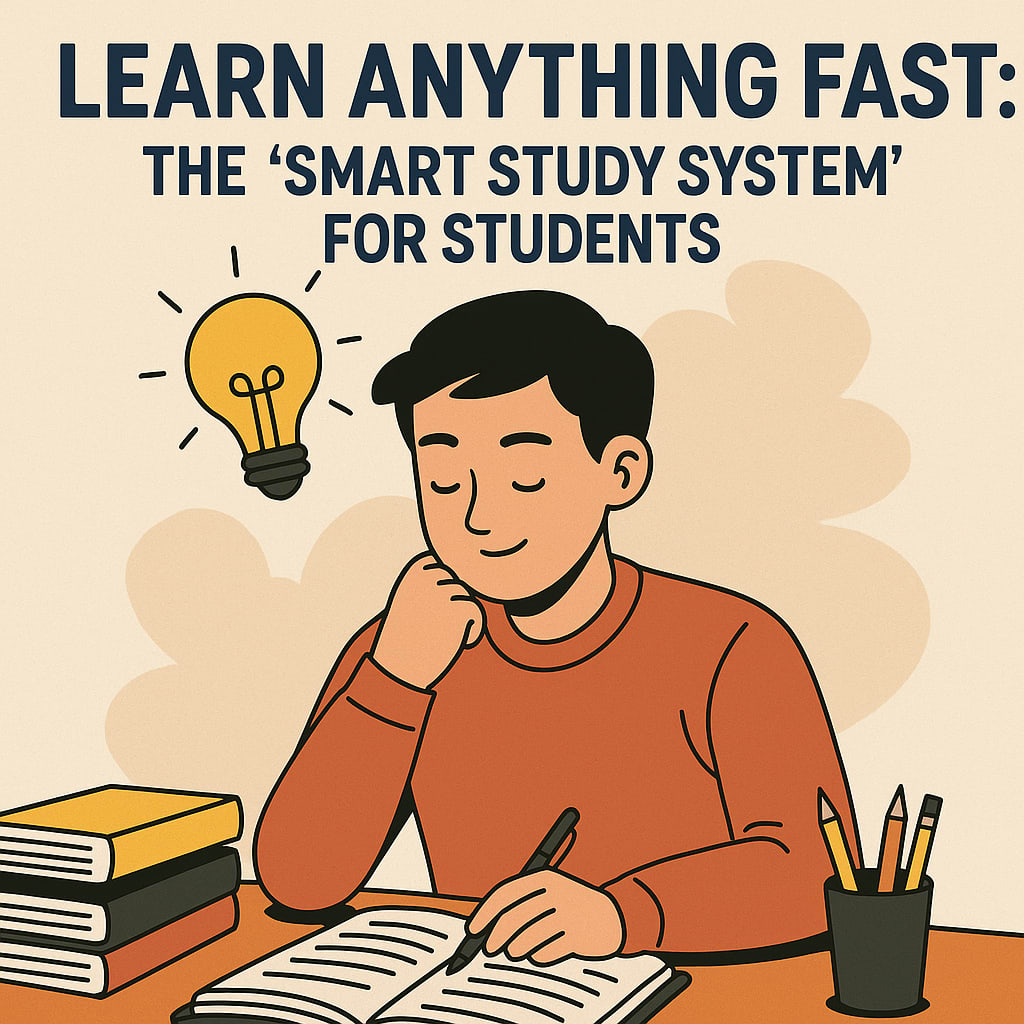
Learn Anything Fast: The ‘Smart Study System’ for Students
A step-by-step method to boost learning, memory, and confidence — whether you're a student or lifelong learner.

Introduction:
Struggling to remember what you study? Wasting time rereading notes with no results?
You’re not alone — and the problem isn’t you. The way we study is often outdated. In this article, you’ll discover a proven system designed to help you learn faster, remember more, and stay focused — even during exam stress.
This guide is perfect for:
School & college students
Competitive exam aspirants
Professionals learning new skills
Anyone passionate about self-education
Step 1: Set Clear Learning Goals
Before you open a book — ask yourself:
“What exactly do I need to learn?”
Break down subjects into micro-goals.
Example: Instead of “Learn biology,” try “Understand how the human heart works.”
Tool: Use Google Docs or Notion to list 3 goals per study session.
Step 2: Use the Feynman Technique
Teach what you learn — in your own words.
If you can’t explain a topic simply, you don’t know it well enough.
How to apply:
Learn the topic
Write it in your own words as if teaching a friend
Identify gaps and review them
Repeat until it's clear and simple
Bonus: Use voice notes to teach yourself — great for memorization.
Step 3: Use Active Recall, Not Passive Reading
Don’t just reread — test yourself.
Try:
Flashcards (with apps like Anki or Quizlet)
Writing summaries from memory
Self-quizzing after each topic
This forces your brain to retain what matters.
Step 4: Apply the 50/10 Rule (Pomodoro Upgrade)
Study for 50 minutes, rest for 10 minutes — one topic at a time.
Avoid multitasking. Keep your phone on airplane mode or in another room.
Use tools like Focus Keeper or a basic timer.
Step 5: Space Your Revisions (Spaced Repetition)
Instead of cramming, revise the same topic:
Day 1: Learn it
Day 2: Review it
Day 4: Quiz yourself
Day 7: Teach it or test again
This builds long-term memory instead of temporary recall.
Step 6: Use Digital Tools the Smart Way
You don’t need to rely only on books anymore — there are amazing free tools that can make your study process easier and more effective.
Start with tools like Notion, Anki, or Quizlet to create digital notes and flashcards. These platforms help you revise actively and organize topics without getting overwhelmed.
For visual learners, YouTube channels like Crash Course or Khan Academy are gold mines — they simplify tough topics through animations and real examples. Watching these videos is like having a personal tutor at home.
If you love seeing things visually, try Canva, Miro, or XMind to create colorful mind maps. Turning complex chapters into visual diagrams can help you remember things faster.
Prefer speaking or listening? Use Google Docs or Otter.ai to convert your spoken thoughts into text. This is perfect for revising on the go or making summaries with your voice.
Smart Hack: Use Canva to turn textbook chapters into visual notes — it makes studying fun and much easier to recall.
Step 7: Use Audio Learning to Reinforce
Convert notes into audio or use educational podcasts during walks or breaks.
Tip: Record yourself reading key concepts — play during chores or rest.
Step 8: Prioritize Sleep, Not Cramming
No more all-nighters. Your brain consolidates memory during sleep.
Aim for 7–8 hours of sleep
Avoid screens before bed
Review notes briefly before sleeping (this helps memory lock-in)
Step 9: Manage Stress Before It Manages You
An anxious mind can't learn effectively. Try:
5-minute deep breathing
Quick walks
Journaling after study sessions
Listening to calm music while reviewing
Apps like Calm or Headspace can help you reset between study sessions.
Step 10: Customize & Stick to Your Plan
No one study method works for everyone. Create your own study template based on:
What time of day you learn best
Whether you prefer videos, notes, or practice problems
Which subjects you struggle with most
Start small. Keep it flexible. And track your progress weekly.
Final Thoughts:
Your brain is powerful — it just needs the right technique.
You don’t need to study harder, just smarter. The Smart Study System helps you study with purpose, recall with ease, and walk into exams with confidence.
Learning is not a race — it’s a strategy.
#SmartStudy #StudyTips #LearningHacks #StudentSuccess #StudyMotivation #ProductiveLearning #StudyWithMe #ExamPreparation #SelfStudy #AcademicSuccess #MindMapping #StudyTools #DigitalLearning #StudyBetter #NotionForStudents #AnkiCards #QuizletFlashcards #VisualLearning #StudyPlan #StudyGoals
Disclaimer:
This article is intended for educational and motivational purposes only. The study tips and digital tools mentioned are shared based on personal experience and general research to help students improve their learning methods. Results may vary based on individual learning styles. Always choose tools and strategies that suit your personal study preferences.
If AI assistance was used in writing:
This article was created with the assistance of AI and reviewed by the author to ensure originality, clarity, and accuracy.
About the Creator
KAMRAN AHMAD
Creative digital designer, lifelong learning & storyteller. Sharing inspiring stories on mindset, business, & personal growth. Let's build a future that matters_ one idea at a time.
Keep reading
More stories from KAMRAN AHMAD and writers in Education and other communities.
How to Earn Money Online Using AI Tools (Step-by-Step Guide for Beginners in 2025)
Earn Money Online with AI Tools: A Beginner’s Guide for 2025 Welcome to the New Era of Digital Earning We’re now living in a world where a laptop or smartphone can become your income source. You don’t need a degree in tech or expensive software — all you need is curiosity, consistency, and the right tools. Thanks to Artificial Intelligence (AI), anyone can start building an income stream from home, with little to no experience.
By KAMRAN AHMAD7 months ago in Education
The Logistics of Flavor Chile Food Delivery Revolution in 2026
Chile, a country of extremes and culinary delights, has experienced a deep digital transformation in the past few years. As we move through the world of 2026, the classic view of dining out in the bustling streets of Santiago or the colourful alleys of Valparaíso is being supplemented and, in many cases, replaced by a high-tech, high-speed food delivery system. What began as a convenience-driven niche has grown into a multi-billion-dollar backbone of the Chilean economy. With a tech-savvy middle class, an unprecedented explosion in mobile penetration, and an urban population that prizes time above almost everything else, the food delivery market in Chile is no longer simply about delivering a pizza to your doorstep; it is about a complex system of AI-powered logistics, cloud kitchens, and a new "On-Demand" lifestyle that is redefining the very fabric of Chilean society.
By Neeraj kumar4 days ago in Education
Living in a hemp house
Hemp, a multi-purpose crop that delivers fibres, shivs, seeds, and pharmaceuticals is currently used in insulation materials and bio-composites for a more sustainable construction industry. Russ Martin and his wife Karon Korp tell their story as owners of the first hemp house in the U.S.
By Susan Fourtané 7 days ago in Interview


Comments
There are no comments for this story
Be the first to respond and start the conversation.