
Momotaro: The Hero Born from a Peach and the Enduring Spirit of Japan
The Classic Japanese Folk Tale and the Timeless Lessons It Teaches Children About Courage and Teamwork

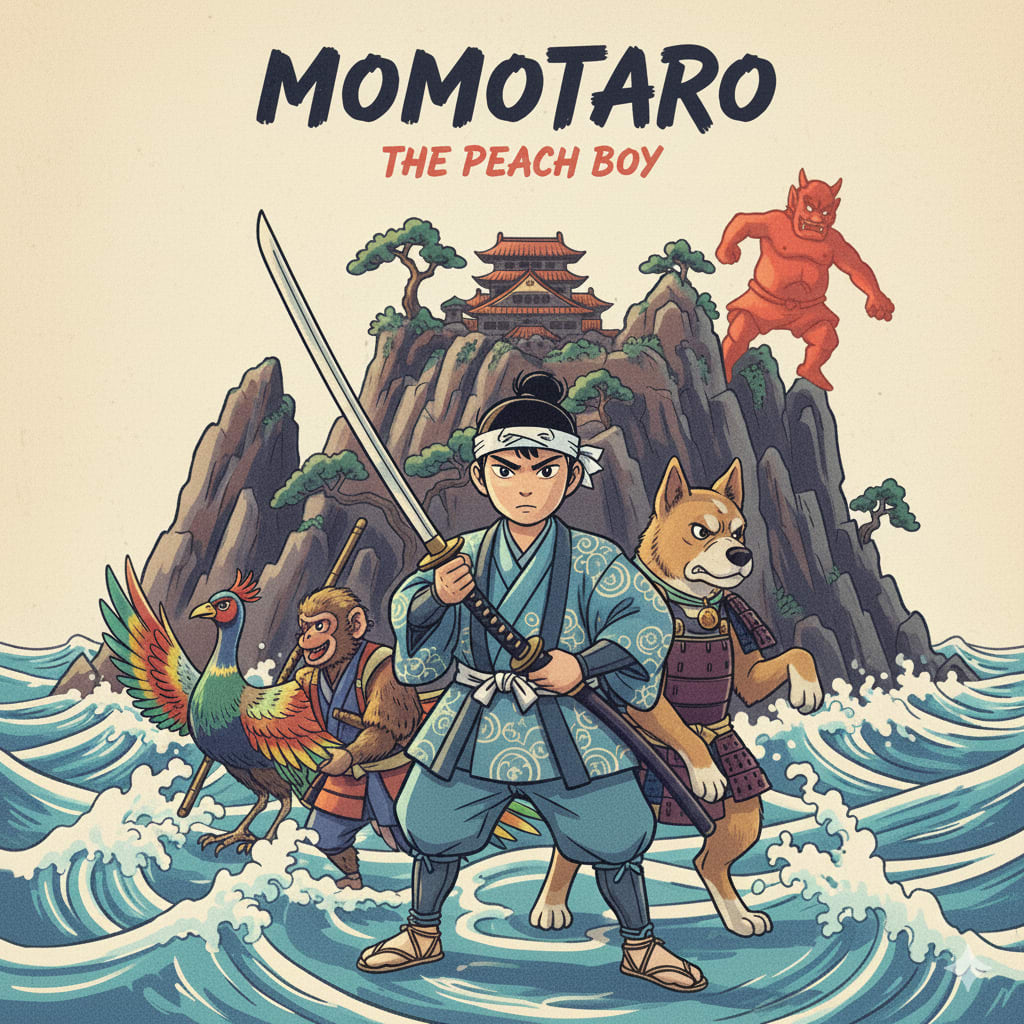
If you were to ask any person in Japan, regardless of age, to name their country's most famous folk hero, you would receive the answer almost instantly: Momotaro, the Peach Boy.
I grew up hearing his tale countless times, not just as a bedtime story, but as a fundamental lesson in morality and teamwork. It’s more than just a fairy tale; it’s a cultural touchstone that defines certain Japanese values, much like King Arthur or Robin Hood might for Western audiences.
The story is deceptively simple: A magical baby boy is found inside a giant peach floating down the river. Raised by an elderly, childless couple, Momotaro eventually grows up to be a handsome and incredibly strong young man. He never forgot the kindness of the couple who raised him, but his peaceful life was soon shattered by disturbing news.
The Terror of the Oni and the Call to Adventure
The region was plagued by creatures called Oni (ogres or demons) residing on a distant volcanic isle known as Onigashima. These were not harmless monsters; they were brutal raiders who continuously descended upon the villages, pillaging rice stores, stealing family treasures, and instilling absolute terror. The elderly villagers were powerless, and their constant suffering stirred a fierce sense of justice in Momotaro’s heart.
Determined to end the suffering, Momotaro announced his departure. His adopted mother, with tears in her eyes, prepared him a batch of the finest kibidango (millet dumplings)—legendary sweets that could grant strength and unwavering loyalty to whoever ate them.
The Pact of the Kibidango: Building an Army of Allies
Momotaro knew he couldn't face the legion of demons alone. As he walked toward the coast, his journey became one of recruitment, all centered on the simple act of sharing.
His first ally was a Dog (Inu). The dog, initially skeptical of the young man, demanded sustenance. Momotaro offered him one of the precious kibidango. The moment the dog ate it, he pledged his loyalty, saying, "I shall be your retainer. Let me share your path, and I shall fight for you."
Next, a mischievous Monkey (Saru) appeared in a tree, challenging Momotaro. Again, the hero offered the sweet dumpling, recognizing the monkey's agility and keen eyes would be invaluable. The monkey joined, promising to use his climbing skills for scouting and battle.
Finally, just as they reached the sea, a majestic Pheasant (Kiji) flew down from the sky. The pheasant, known for its ability to fly high and see far, was offered the last of the kibidango. With his bird's-eye view secured, the final piece of Momotaro's unlikely army was in place. His strategy was clear: to win by cooperation and generosity, not just raw might.
Assault on Ogre Island: A Masterclass in Teamwork
Upon reaching the forbidding black shores of Onigashima, the team put their pact into action. The Pheasant, flying high above, located the Oni fortress and served as the initial distraction, swooping down and pecking the faces of the guards.
As the gates burst open, the chaotic battle began. The Monkey, agile and fast, scaled the walls, stealing keys and distracting the larger demons. The Dog, sturdy and fierce, engaged the Oni on the ground, biting at their ankles and holding the line.
Momotaro, with his strength and sword, focused on the main threat: the fearsome leader of the ogres, who wore massive iron armor. It was a fierce fight, but the coordinated attacks proved overwhelming. While the Monkey retrieved a crucial piece of stolen treasure, and the Pheasant kept the lesser demons at bay, Momotaro used the Dog's ground support to finally subdue the Oni chieftain.
The four allies, combining their unique talents, completely routed the demons and returned all the stolen riches to the grateful villagers.
The Enduring Lessons: What Japanese Children Learn from the Peach Boy
Beyond the adventure of monster-slaying, Momotaro's story serves as a powerful moral compass. This is how the tale is really taught in Japanese schools and homes:
1. Kibidango and Generous Leadership: Momotaro teaches kids that true leadership is gained through trust and generosity, not force. Sharing his kibidango shows that valuing your team (the animals) and making sacrifices for them is how you build a powerful, united front.
2. Strength in Unity: His ultimate success in defeating the terrifying Oni at Onigashima is impossible alone. The Dog, Monkey, and Pheasant—each with their distinct strengths—must work as a coordinated unit. This reinforces the core Japanese value of kyōchō (cooperation): you can achieve monumental goals by harmonizing diverse talents.
3. The Courage to Stand Up for the Weak: Momotaro's motivation is pure: he seeks to stop the oppression of the villagers. He models ethical action and the conviction to act as a protector, even when facing a powerful enemy.
4. Gratitude and Filial Piety: The story concludes with Momotaro returning the treasure and showing devotion to the elderly couple who raised him. Success, the tale insists, is meaningless unless you show lasting gratitude to those who nurtured you.
Momotaro is more than just a boy with a sword; he is an embodiment of the perfect, ethical Japanese hero. His story continues to inspire young hearts to be brave, to share, and, most importantly, to work together.
Which part of Momotaro's tale do you find the most fascinating, the magic peach or the alliance with the animals?
About the Creator
Takashi Nagaya
I want everyone to know about Japanese culture, history, food, anime, manga, etc.
Keep reading
More stories from Takashi Nagaya and writers in Education and other communities.
Kaguya-Hime: Japan’s Oldest Sci-Fi Princess
■ Introduction Often called Japan’s oldest piece of fiction, The Tale of the Bamboo Cutter introduces one of the most mysterious heroines in world literature: Kaguya-Hime, a supernatural girl who arrives from the moon, grows into a breathtaking beauty, and eventually returns to the heavens.
By Takashi Nagaya2 months ago in Fiction
Digital Recruiting Unleashed: Finding Top Tech Talent in Today’s Market
The tech industry has grown fast, changing the way companies find and hire talent. Today, the tech talent hunt is not just about reading resumes or posting job ads. It is about using digital tools, data, and modern strategies to connect with the right people. Recruiters must now understand how to find skilled workers in a crowded digital space. The world of hiring has moved online, and companies must keep up.
By Aaron Khieu3 days ago in Education
Dead and Wearing Green
She was wearing that green dress when I first saw her, five years ago to the day. Flowing meadow fabric draped over long legs, thick auburn hair flowing down her back. That smile. Of course, she is still beautiful now. But now she is no longer alive.
By Karen Cave5 days ago in Fiction


Comments
There are no comments for this story
Be the first to respond and start the conversation.