
Origins of Saturn's Iconic Ring System
Understanding the Formation and Evolution of Saturn's Rings Through Cataclysmic Events and Recent Theories

Introduction:
Saturn, the sixth planet from the Sun, is renowned for its stunning and complex ring system, which captivates astronomers and casual observers alike. These rings are not just a beautiful spectacle; they are a window into the dynamic processes of our solar system. Understanding how Saturn developed its rings can provide insights into planetary formation, the evolution of celestial bodies, and the intricate dance of gravity and material in space. This article delves into the history, composition, theories of formation, and current research surrounding Saturn's iconic rings.
Historical Observations:
The fascination with Saturn's rings dates back to the early 17th century. In 1610, Galileo Galilei became the first person to observe Saturn through a telescope. However, his observations were limited by the technology of his time. He described Saturn as having "ears," not fully grasping the nature of what he was seeing. It wasn't until later that astronomers like Christiaan Huygens (in 1655) and Giovanni Domenico Cassini (in the late 17th century) provided clearer descriptions of the rings and their structure.
Over the centuries, as telescopic technology improved, scientists began to understand more about these enigmatic features. The rings were initially thought to be solid structures, but further observations revealed them to be composed of countless small particles. This evolving understanding paved the way for modern research into their origin and composition.

Composition of the Rings:
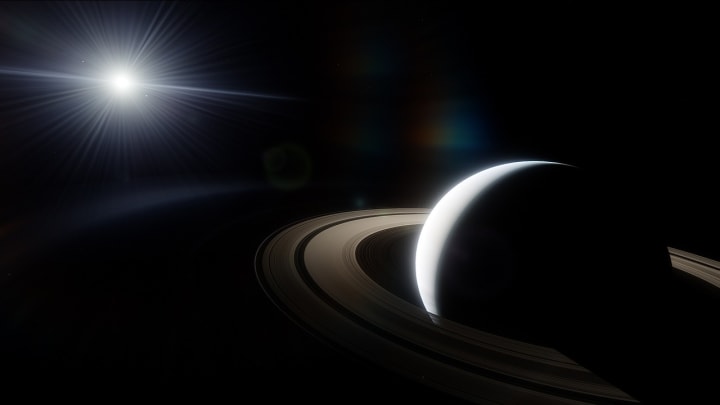
Saturn's rings are primarily composed of ice particles ranging in size from tiny grains to large boulders. The rings also contain dust and rocky debris. The most prominent rings are categorized into several distinct sections:
- A Ring: The outermost ring, known for its brightness and well-defined edges.
- B Ring: The largest and brightest ring, located just inside the A Ring.
- C Ring: A fainter ring that lies closer to Saturn.
- F Ring: A narrow ring located just outside the A Ring, characterized by its unique braided structure.
- G Ring: A faint ring that is less well-defined than the others.
The composition of these rings is crucial for understanding their formation. The predominance of water ice suggests that they may have originated from icy bodies such as comets or moons.
Theories of Formation:
The formation of Saturn's rings has been a subject of intense study and debate among scientists. Several theories have emerged over time, each offering a different perspective on how these magnificent structures came to be.
Cataclysmic Events:
One prevailing theory posits that Saturn's rings formed as a result of cataclysmic events involving its moons or other celestial bodies. According to this hypothesis:
1. Collision with Moons or Comets: It is believed that one or more moons may have collided with comets or asteroids, resulting in debris being scattered around Saturn. This debris could then have coalesced into the rings we see today.
2. Gravitational Forces: The immense gravitational pull of Saturn plays a crucial role in maintaining the stability of these rings. As material was pulled into orbit around the planet, gravitational interactions helped shape and define the structure of the rings.

Recent Origin Hypothesis:
Recent studies suggest that Saturn's rings may not be as ancient as previously thought. Some researchers propose that they formed relatively recently—within the last 100 million years—due to:
1. Destruction of Moons: This hypothesis suggests that existing moons were torn apart by tidal forces or collisions with other celestial objects, leading to the creation of new ring material.
2. Computer Simulations: Advanced computer models have simulated various scenarios for ring formation, supporting the idea that these structures could have originated from relatively recent events in Saturn's history.
Current Research and Findings:
The study of Saturn's rings has been greatly advanced by missions such as NASA's Cassini spacecraft, which orbited Saturn from 2004 to 2017. Cassini provided invaluable data on the composition, structure, and dynamics of the rings.
Insights from Cassini:
1. Detailed Imaging: Cassini captured high-resolution images that revealed intricate details about ring structures, including gaps and waves caused by gravitational interactions with nearby moons.
2. Composition Analysis: Instruments aboard Cassini analyzed particles in the rings, confirming that they are predominantly made up of water ice with varying amounts of impurities.
3. Dynamic Processes: Observations showed that Saturn's rings are not static; they are dynamic systems influenced by gravitational forces and interactions with moons.

Ongoing Debates:
Despite significant advancements in our understanding, debates continue regarding the age and origin of Saturn's rings. Some scientists argue for an ancient origin linked to early solar system processes, while others advocate for a more recent formation based on Cassini's findings.
Conclusion:
Saturn's rings are not only one of nature's most stunning spectacles but also a complex puzzle that continues to intrigue scientists worldwide. From historical observations to modern research facilitated by missions like Cassini, our understanding of how these magnificent structures developed has evolved dramatically.
As we look to the future, ongoing research promises to shed even more light on Saturn's rings—offering insights not only into their origins but also into broader questions about planetary formation and evolution within our solar system. The quest to understand these celestial wonders continues, inviting both scientific exploration and public fascination with one of our solar system's most iconic features.
About the Creator
The Natural Path to Radiant Skin: How Simple Care Yields Lasting Results
In today’s beauty industry, the pressure to chase the latest miracle product is relentless. From serums packed with dozens of actives to aggressive exfoliants promising instant transformation, it’s easy to forget that healthy skin doesn’t need constant intervention. The natural skincare approach flips the script: it focuses on supporting skin’s innate ability to heal, protect, and maintain balance. By working with your skin rather than against it, natural routines deliver results that are not only visible but also long-lasting.
By Kelln Small5 days ago in Education


Comments
There are no comments for this story
Be the first to respond and start the conversation.