
Pre-toddler writing preparation
Helping to bridge the gap between elementary and junior high school

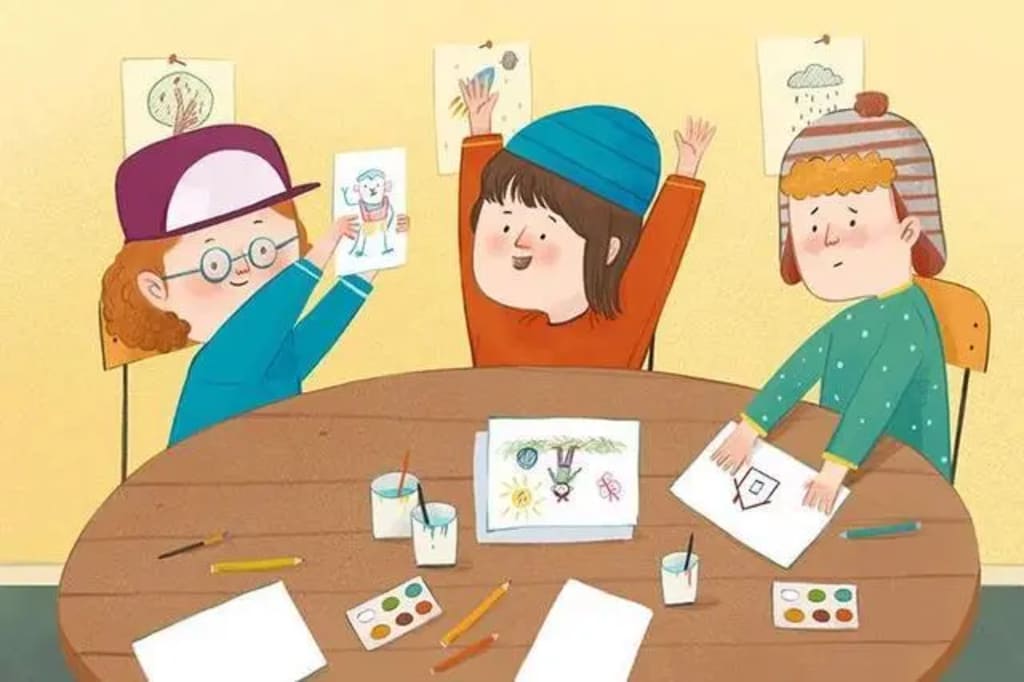
To Kindergarten parents: Pre-writing preparation to help kindergarten and elementary school transition!
The transition from kindergarten to elementary school marks the beginning of a new stage, and it children need to bridge the gap between kindergarten and elementary school. It is a common concern for kindergarten and parents to do a good job of "scientific bridging between kindergarten and elementary school" in order to promote the physical and mental development of children and ensure the improvement of the quality of basic education.
01
Development of pre-kindergarten writing skills
The "Kindergarten Education Guideline (for trial implementation)" clearly states that "children should develop an interest in simple marks and symbols that are common in life." In the "Guidelines for Kindergarten Education", it is stated that "children should develop an interest in books, reading, and writing, and develop pre-reading and pre-writing skills".
In the language area of the Guidelines for Learning and Development of Children Aged 3-6, Reading and Writing Readiness, Goal 3: Have the desire and initial skills to express themselves in writing.
4~5 years old, correct posture when writing and drawing with adult reminders.
5~6 years old, correct posture when writing and drawing.
02
The concept of pre-writing
"Pre-writing is simply defined as the informal writing activities that young children engage in. "There is a principle difference between pre-writing activities and formal, systematic writing.
We can understand prewriting as a play and learning activity in which children use a pen or other writing substitutes to convey information, express feelings, and construct prewriting experiences for others around them through perception, drawing, scribbling, and simulating the use of words or symbols.
It can be a play activity that is spontaneously generated and performed autonomously by young children.
It can also be a play-based learning activity that is guided by adults.
03
What is the difference between pre-writing and elementary school writing instruction?
01. Purpose
Kindergarten
Pre-kindergarten writing activities: Sensitivity to words, marks, and developing interest in writing activities.
Elementary school
Elementary school writing instruction: To master the basic knowledge of writing Chinese characters and the basic skills of writing.
02. Approach
Kindergarten
Pre-kindergarten writing activities: Developing observation, orientation perception, spatial perception, small muscle dexterity and hand-eye coordination.
Elementary School
Elementary school writing instruction: mastering correct writing posture, learning the names of strokes, rules of stroke order, and interlinear structure.
03. Methods
Kindergarten
Pre-kindergarten writing activities: Playful and fun stroke practice based on games and hands-on activities.
Elementary School
Elementary school writing instruction: teacher's explanation and demonstration, student's homework practice, exams, etc.
04. Evaluation
Kindergarten
Pre-kindergarten writing activities: Children are interested in writing, sensitive to Chinese characters, know the inverse of the characters, take the initiative to scribble and write, have good hand-eye coordination, and the brain is comfortable with controlling small muscle movements.
Elementary School
Elementary school writing instruction: correct, neat, and tidy writing, and a certain speed.
04
Implementation points and strategies for pre-writing activities
At the kindergarten level, the task of pre-writing is to master the correct way of holding the pen and writing posture and to develop good writing habits.
no.1 Muscle coordination exercises
Before holding the pencil, children should practice muscle coordination, train their fingers to control flexibly and use finger inertia, and practice the coordination of thumb, index finger, middle finger coordination, and wrist movements. For example.
Develop coordination of small muscles
Do some small hand exercises, you can also put in the area can exercise small hand muscles materials such as: playing with blocks, building plastic, kneading play dough, tearing paper, paper cutting, etc.
You can practice this in small and medium-sized classes and prepare for pre-writing in advance.
Developing wrist movements
You can let children play with some light instruments during outdoor activities to exercise their large muscles and make them develop in a coordinated way. You can also have children use chopsticks correctly during mealtime activities to develop their wrist movements.
Activities to develop hand-eye coordination
There are many actions to develop hand-eye coordination, either through special educational activities or through regional activities, such as wearing beads, tying shoelaces, drawing, cutting and pasting, tying knots with string, tying knots, etc.
no.2 Develop good writing habits
Parents and kindergarten teachers should guide children to write according to the correct penmanship and sitting posture standards and develop good writing habits.
Cultivating writing habits
① Correct sitting posture when writing
② Proper distance between eyes and book when writing
③ Correct pencil grip posture
④The habit of following the hand from left to right with the eyes, etc.
You can make up children's songs that are easy to accept and catchy to urge children to develop good writing habits, such as
The Children's Song
Children should remember that
Writing posture is very important.
When writing, put your feet flat.
Your head is not tilted and your body is sitting upright.
Keep your hands an inch away from the tip of the pen.
Keep your eyes a foot away from the book.
Keep your chest one fist away from the table.
Write beautifully.
No.3 Recognize writing tools
Develop children's sense of direction and a clear idea of up and down, left and right, middle, side, front and back, Recognize various common pens and the functions of these pens; recognize various common writing books and identify up, down, front, back, left, and right with themselves as the center.
For example, use the activity "Little Animals Live in Hotels" to recognize the field grid, (horizontal middle line, vertical middle line, upper left, upper right, lower left, lower right).
no.4 Practice basic strokes with interesting forms
You can design additions such as "white rice", "I add sesame seeds to bread", "little ants", and "sunflower".
You can learn to write "one horizontal" by drawing "crosswalk", "vertical hook" by drawing "fish hook", and "fence" by drawing "fence" to learn to write "a vertical"; by drawing the veins of a leaf to learn to write "skew and press", and drawing a staircase to learn to write "horizontal fold "etc.
For example: "Red Leaves", "Little Snowflakes", "Fish Bones", etc. with the addition of the veins of leaves. Adding drawings of umbrella handles "Little Flower Umbrella", etc.
Practice stroke order with numerical prompts
For example, can you draw lines left and right? Please draw the fish bones according to the arrows on the fish bones and the number cues, etc.
Practice tracing realistic dotted line drawings
For example, draw or photocopy pictures with dotted lines as needed, and let children connect the dotted lines into solid lines, so that they can practice hand control when drawing long lines.
Pre-writing games
For example, the game connecting the dots is initially played by preparing the paper with many dots on it and asking children to connect the dots. In the beginning, you can connect them randomly and pay attention to the smoothness of the lines, and then connect them in order, gradually penetrating some writing rules.
You can also do some "tracing games", "copy Chinese characters", "drive a car", "spell words", and "sandpaper tracing". "In this way, children can enrich their writing knowledge and improve their attention and hand-eye coordination.
Line segment practice with rules
For example, we draw dots and lines in places with limits to control the beginning and end of strokes, to control the purpose of strokes, such as: "straight drawing fence" "diagonal drawing fence", etc.
Practice drawing long lines
For example, draw "Little Animal Fishing", "Chickens and Balloons", etc. to train children to better control their wrists, fingers, as well as paper and pens. Keep the pen and line moving forward together.
05
Pay attention to ways and means
Kindergarten writing education does not seek to be more but more precise. Once you start teaching children to write, pay special attention to the standardization of words and deepen their impressions.
Games lead to persistent practice, and habits are formed through constant practice. Purposefully organize children to Arabic numbers, common strokes in life, simple Chinese characters, etc. However, the requirements for children in practice should not be too high and should be based on the purpose of practicing from large to small, from simple to complex.
The children's "work" needs to be affirmed and encouraged. After each activity, the children's results are posted, displayed, and evaluated as much as possible to further build their confidence so that they can do better-writing activities.
The transition from kindergarten to elementary school should be gentle, including the development of habits, psychological adaptation, and learning adaptation, and the development of good learning qualities is more important than the preparation of knowledge and skills.
Parents and friends should be scientifically prepared for school, respect the developmental rules and learning characteristics of young children, and let's work together at home to scientifically prepare our older children for school!
About the Creator
Ufreleyi
Easy come, easy go.
The Deer’s Carelessness
Once upon a time, our teacher was explaining an important lesson to us in class. He spoke in a calm but thoughtful tone and said, “Do not focus on who is speaking; instead, pay attention to what is being said.” The classroom became quiet, and everyone listened carefully. One student, curious and slightly confused, raised his hand and asked, “Sir, what does this mean?”
By Sudais Zakwanabout 10 hours ago in Education
Calibration Services for Maintaining Instrument Performance and Traceability
In today’s highly regulated and technology-driven world, accurate measurement is essential for quality, safety, and efficiency. From manufacturing plants and laboratories to healthcare facilities and energy operations, organizations rely heavily on instruments to measure temperature, pressure, flow, electrical signals, and countless other parameters. Calibration services play a critical role in ensuring that these instruments deliver precise and reliable results.
By Bobby Yadavabout 11 hours ago in Education
The Piggy Project
I’ve had so many names in this life I lose track of which ones were ever really mine and which ones I wore because someone needed me to. Some were handed to me before I had words to refuse them, before I knew what they meant, before I knew I could say no. Most weren’t meant to hurt. That doesn’t mean they didn’t leave marks. Marks that told me who I belong to, who I am by way of who claims me, recognizes me in the good and bad, who walks beside me.
By Fatal Serendipity2 days ago in Confessions



Comments (1)
Very well written, like your article very much