
Robotics Just Is
Socioeconomic and accessibility disparity in STEM education

Anyone who has met me has heard my STEM story. Some people could probably retell it word for word better than myself at this point. I don't tell my story for the sake of personal notoriety but to specifically bring to light several major issues that continuously get pushed to the shadows, and here we are again.
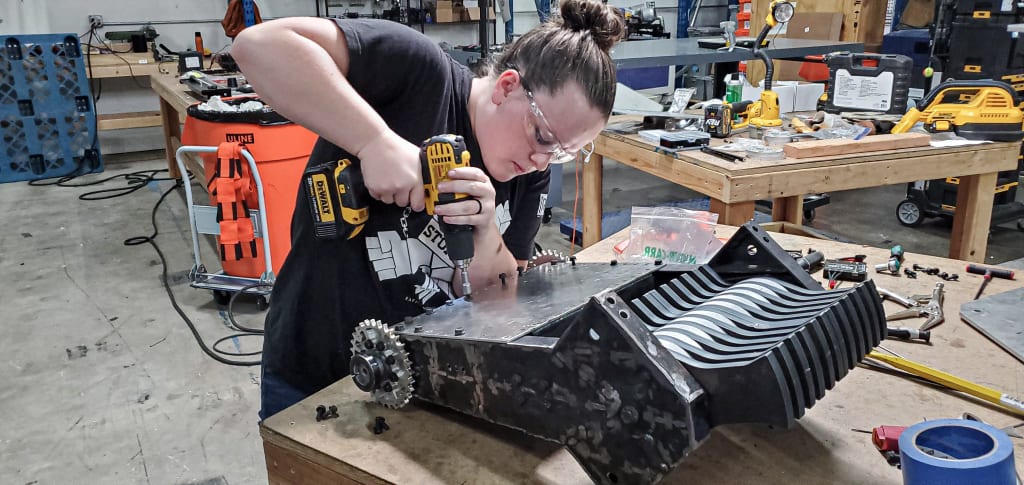
When I say robotics changed my life, I mean it truly changed my life. During some of the scariest and darkest times, robotics was my safety net. I will be forever grateful for the privilege I had to join a robotics team, and the privilege I have to still be active in the robotics community in some way. Robotics always just... is. It has been part of my life since I was 14 and no matter where I go, I find it again in some form or another. My parents made sure I had access to it and gave me the tools necessary to learn. I hopped around and did some coding, some machining, some design. A little of everything. I now mentor high school robotics programs and I'm on a BattleBots team and life feels just like it should because, once again, robotics just is.
I take it for granted.
A few days ago, I commented on an Instagram post about resources for kids interested in robotics. I gave the gist I give everyone: check out a Lego Mindstorms kit, join a FIRST team, take some fun and simple coding and CAD courses. "It's so easy," I said, not really thinking about the weight of my words. "Just get involved."
And then a kid reached out to me through Instagram DMs. "Thanks for the advice, but there aren't FIRST teams around me and Lego Mindstorms kits are more expensive than the monthly minimum wage my parents make. Do you have any other advice?" I sat back and started thinking. No. I really didn't have any other advice. I "know" that FIRST isn't accessible everywhere, and I "know" that Mindstorms kits are expensive, and I "know" that the widely available coding classes I took are only taught in English, but like... there has to be other options, right? Surely there are resources just as good as the ones I'm used to that are made available and affordable in other countries? But honestly? No, not really.
I realized I have been viewing my access to STEM education programs in a very US-centric, middle-class mindset to the point that when this kid begged me for resources on just getting started learning about robotics, I didn't have an answer for them. It punched me in the gut, and then it made me cry.
Earlier I mentioned my STEM story. Many of you know how it begins. "When I was 14 years old, my parents dragged me to a robotics meeting. I didn't want to go." Most 14 year olds don't want to go anywhere, so I'm not really blaming myself for that. But after my interaction with this kid on Instagram, I looked back at myself at the same age and I realized how blind I was to the opportunities being presented to me, and how blind I still am.
I don't want to start approaching STEM education with the, "Be grateful for what you have because someone else has it way worse," mindset because that's not helpful or healthy either. We should still be working daily to improve and expand the impact of STEM education programs in Suburbia, USA, but those of us in positions to have an impact on students outside of our bubble and provide them with resources should be fighting tooth and nail to do so.
I'm currently researching free coding courses, cheap at-home robotics supplies, and accessible STEM education programs for this middle-school aged kid who decided that I was someone they could reach out to for help. They live halfway around the world and I will never meet them in person, but they are so passionate and so excited about even the potential for robotics opportunities, and I wish I could pack up my own robotics team and ship everything to another country to make it happen just for this one kid. That isn't feasible, so we have to come up with a better solution.
I challenge you to look at your STEM education programs, at your own involvement, and ask what you can be doing to make robotics more accessible to students in your own community who don't have the same privileges as you. And then how can we be expanding that to make it accessible for students around the globe who deserve, who need, robotics but don't have the options we do? We have to start approaching our STEM education programs and robotics teams with a mindset of intersectionality and inclusion, crossing socioeconomic and accessibility barriers as we do so.
For me, robotics just is. It always has been. It's constant. I couldn't be more grateful for that, but it hurts me knowing that for so many, robotics can't be. I am committing to the work necessary for making STEM education more widely accessible, and I won't stop until, for every kid, robotics just is.
About the Creator
Gabriella DeYoe
I'm a freelance writer with a passion for STEM education and the arts.
Keep reading
More stories from Gabriella DeYoe and writers in Education and other communities.
Just One Robot
FIRST (For Inspiration and Recognition of Science and Technology) is a worldwide non-profit organization that provides competitive robotics programs for students of all ages. Focusing on the importance of hands-on STEM (science, technology, engineering, and math) education, FIRST is a platform for young engineers to discover their passions and pursue their dream careers. From circuitry to designing for manufacturing to programming, students on FIRST teams get to experience all aspects of robotics engineering.
By Gabriella DeYoe5 years ago in Education
Governance Risk and Compliance Platforms Supporting Secure and Compliant Operations
Governance, risk and compliance platforms have become essential tools for organizations navigating complex operational, regulatory, and digital environments. These platforms help businesses establish clear governance structures, identify and manage risks, and ensure compliance with evolving regulations. As organizations face increasing pressure to protect sensitive data, maintain transparency, and meet regulatory obligations, governance, risk and compliance platforms provide a structured and integrated approach to managing these challenges.
By Bobby Yadavabout 22 hours ago in Education



Comments
There are no comments for this story
Be the first to respond and start the conversation.