
Role of 3D Laser Scanning in Modern Building Renovations
Discover how 3D laser scanning transforms modern building renovations with accurate as-built data, BIM modeling

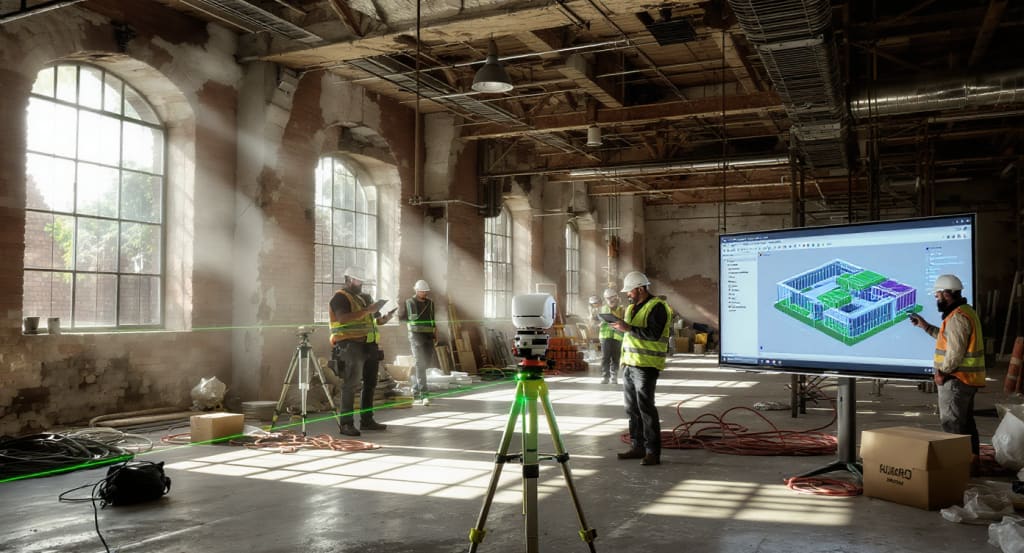
In today’s fast-evolving construction industry, 3D laser scanning has emerged as a game-changing technology, redefining how architects, engineers, and contractors approach building renovation projects.
Whether restoring heritage structures, upgrading aging infrastructure, or modernizing commercial spaces, 3D laser scanning offers unparalleled precision, efficiency, and data reliability.
This article explores how 3D laser scanning supports modern building renovations, its process, benefits, and real-world applications transforming the AEC landscape.
1. Understanding 3D Laser Scanning in Construction
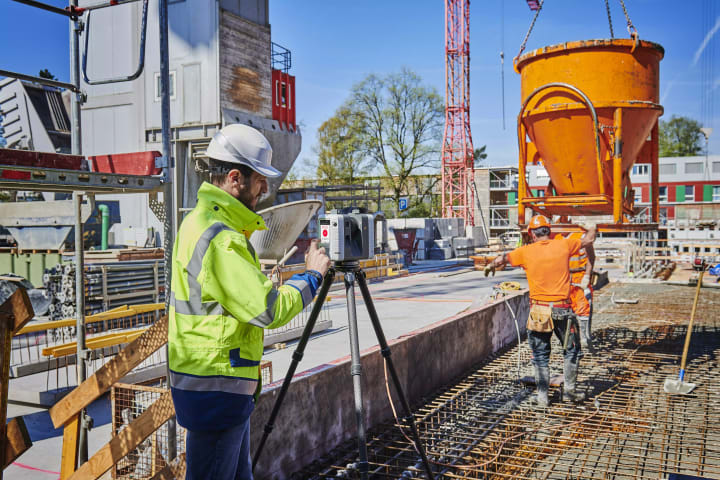
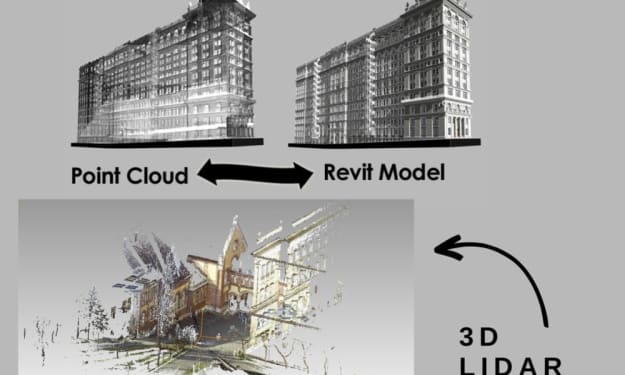
3D laser scanning, also known as LiDAR (Light Detection and Ranging), is a technology that uses laser beams to capture accurate spatial data of a physical environment. The scanner emits laser pulses that bounce off surfaces, measuring millions of points per second. These data points form a highly accurate 3D point cloud, representing the geometry and dimensions of the existing space.
This point cloud can then be converted into BIM (Building Information Modeling) or CAD models, serving as the foundation for design, renovation, and facility management.
2. Why 3D Laser Scanning Is Essential for Renovations
Renovation projects are often more complex than new builds. They deal with unknown existing conditions, as-built discrepancies, and limited documentation of older structures.
Traditional surveying methods often fail to deliver the accuracy needed for today’s fast-paced construction demands.
Here’s why 3D laser scanning has become indispensable for modern renovations:
- Captures true existing conditions with millimeter-level accuracy.
- Eliminates manual measurement errors and outdated blueprints.
- Reduces rework and change orders, saving time and cost.
- Provides digital twins for seamless coordination between design and construction teams.
- Facilitates off-site planning and prefabrication.
3. The Process: From Scanning to Renovation Execution
The integration of 3D laser scanning into a renovation workflow typically follows these key steps:
Step 1: Site Scanning
A 3D laser scanner such as Leica RTC360 or FARO Focus captures millions of spatial data points from various angles around the building. The result is a dense, precise point cloud dataset.
Step 2: Point Cloud Registration
Multiple scans from different positions are aligned and merged using registration software (e.g., Autodesk ReCap or Cyclone Register 360) to create a unified, accurate 3D model of the structure.
Step 3: Point Cloud to BIM Modeling
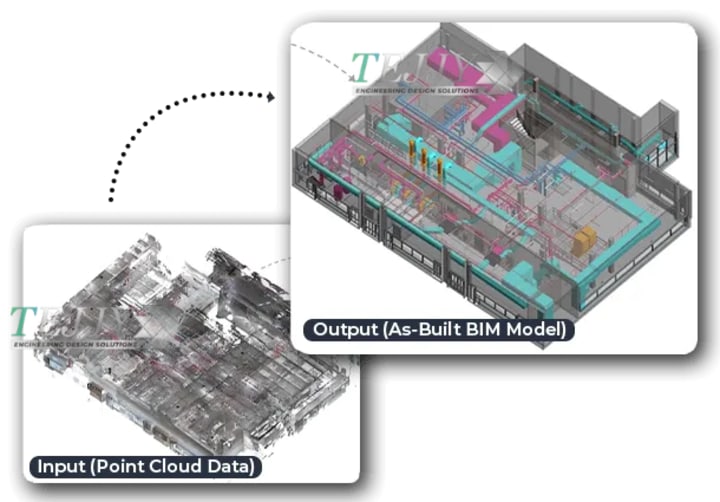
The registered point cloud is then imported into Autodesk Revit or ArchiCAD to create a 3D BIM model at the desired Level of Detail (LOD).
This model serves as a reliable “digital twin” of the existing building.
Step 4: Analysis and Design
Architects and engineers use the as-built BIM model to:
- Identify structural deviations.
- Design retrofit or renovation solutions.
- Plan MEP system upgrades.
- Simulate design alternatives in real-world conditions.
Step 5: Construction and Quality Verification
During the renovation phase, scanning can be repeated to verify construction accuracy and compare the as-built against the as-designed model.
This ensures that the renovation adheres to design intent and regulatory compliance.
4. Key Benefits of 3D Laser Scanning in Renovations
a. Accuracy and Risk Mitigation
With an accuracy of up to ±2 mm, 3D laser scanning eliminates costly surprises on-site. Teams can make informed decisions based on exact measurements, minimizing human error and rework.
b. Cost and Time Savings
According to AEC industry studies, integrating 3D scanning can reduce project costs by up to 15–20% through efficient planning, clash detection, and reduced fieldwork.
c. Enhanced Collaboration and Visualization
3D models can be shared across stakeholders — architects, engineers, contractors, and facility owners — enhancing coordination and communication.
Interactive BIM environments make it easier to visualize renovation scenarios before execution.
d. Preservation of Heritage Buildings
For historic restoration projects, 3D laser scanning captures intricate architectural details that are impossible to document manually.
It ensures heritage accuracy while allowing digital preservation for future reference.
e. Integration with Facility Management
Post-renovation, the BIM model derived from scanning can be integrated into Facility Management (FM) software for asset tracking, maintenance, and lifecycle management.
5. Applications of 3D Laser Scanning in Modern Renovations
3D laser scanning is now being applied across diverse sectors, including:
1. Commercial Building Renovations
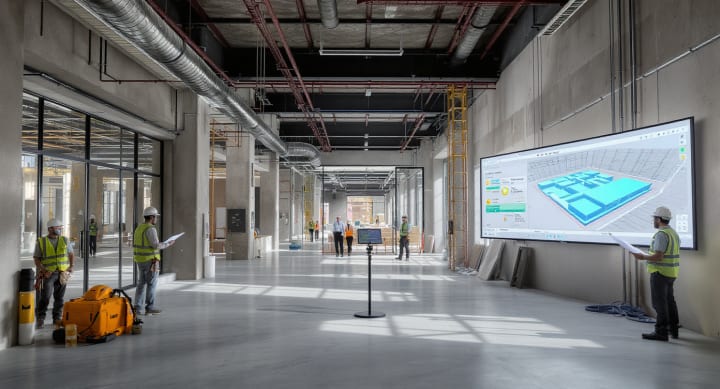
Updating office spaces, retail complexes, and industrial facilities with precise data for HVAC, electrical, and plumbing retrofits.
2. Residential and Multi-Family Buildings
Capturing accurate floor plans and elevations for layout redesign, structural assessment, or interior modernization.
3. Institutional and Government Projects
Documenting existing schools, hospitals, and government offices for energy-efficient retrofits and compliance-driven upgrades.
4. Heritage and Cultural Preservation
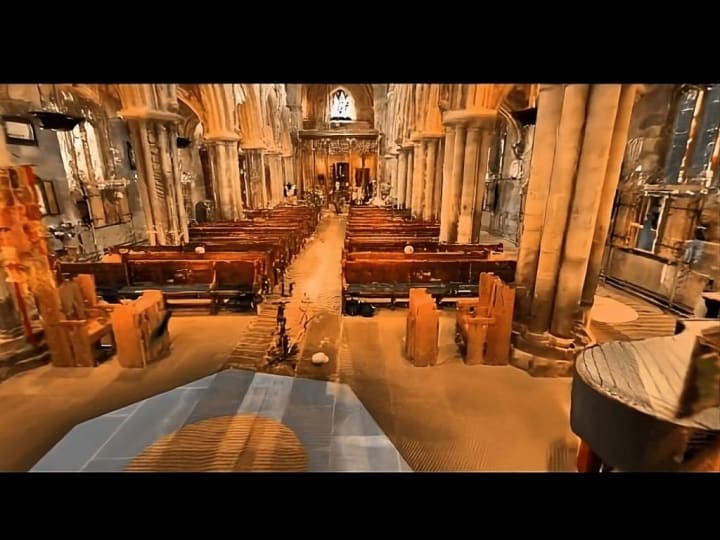
Scanning monuments, museums, and historical sites to preserve architectural integrity while allowing modernization.
5. Industrial and Infrastructure Upgrades
Used for refineries, power plants, and bridges to inspect and plan rehabilitation without interrupting operations.
6. Case Example: 3D Scanning in a Commercial Building Retrofit
Consider a 1970s-era office building being renovated into a high-performance workspace.
Using 3D laser scanning, the project team captured the building’s entire structural and MEP layout in a single day.
The scan data revealed misaligned columns and outdated ductwork positions not shown in old blueprints.
By modeling the point cloud in Revit, the team redesigned the new HVAC and electrical layouts without on-site rework, reducing construction time by 25% and budget overrun risks by 30%.
7. Challenges and Best Practices
While 3D scanning offers tremendous advantages, successful implementation requires:
- Proper scan planning (selecting scanning positions, coverage angles).
- High-performance hardware and software compatibility.
- Trained BIM professionals to interpret and model scan data accurately.
- Data management strategy to handle large point cloud files efficiently.
Partnering with experienced 3D laser scanning service providers ensures consistent quality, optimized workflow, and accurate deliverables.
8. The Future of Renovation with 3D Laser Scanning
The future of building renovation lies in data-driven design and digital collaboration.
3D laser scanning, integrated with AI, AR/VR, and digital twins, will enable immersive visualization, predictive maintenance, and real-time construction monitoring.
With cities across the globe focusing on adaptive reuse, sustainability, and modernization, laser scanning technology is set to become the backbone of renovation workflows — ensuring precision, efficiency, and sustainability in every project phase.
Conclusion
3D laser scanning has revolutionized the way renovation projects are executed.
By bridging the gap between physical structures and digital models, it ensures that every design decision is based on truth, not assumption.
Whether restoring a historical landmark or modernizing a commercial tower, laser scanning empowers AEC professionals with accurate data, seamless collaboration, and risk-free renovation outcomes.
In the age of digital construction, 3D laser scanning is not just a tool — it’s the foundation of smarter, faster, and more sustainable building renovation.
About the Creator
Matt Sharon
A professional content writer. Having years of experience in Technology, health, finance, and construction and real estate field. Writing is my passion and I love to play with words Confidently.
Keep reading
More stories from Matt Sharon and writers in Education and other communities.
Converting Point Cloud to Revit
The architecture, engineering, and construction (AEC) industry is rapidly adopting digital tools to streamline processes and improve accuracy. One of the most transformative workflows in recent years is the conversion of point cloud data to Revit models. This process enables professionals to turn scanned environments into detailed Building Information Models (BIM), ideal for renovation, retrofit, and facility management projects.
By Matt Sharon10 months ago in Education
Responsible AI in Data Science: Ethics, Governance, and Compliance
AI is no longer a background technology. It filters job applications, prescribes medical treatments, and determines the recipients of loans. Millions of decisions that formerly took the judgment of a human are now automated in milliseconds.
By Pradip Mohapatraabout 2 hours ago in Education
Can Physics Explain Existence Itself? Exploring the Ultimate Question of Reality
Why does anything exist at all? Why is there something rather than nothing? In this in-depth, SEO-optimized article, we explore whether physics can fully explain existence, what modern cosmology reveals about the origin of the universe, the limits of scientific explanation, and whether the ultimate answer may lie beyond physics itself.
By shahkar jalal3 days ago in Education



Comments
There are no comments for this story
Be the first to respond and start the conversation.