
She Sells Seashells by the Seashore – An Essay
Uncovering the history, meaning, and hidden story behind the world’s most famous tongue twister.

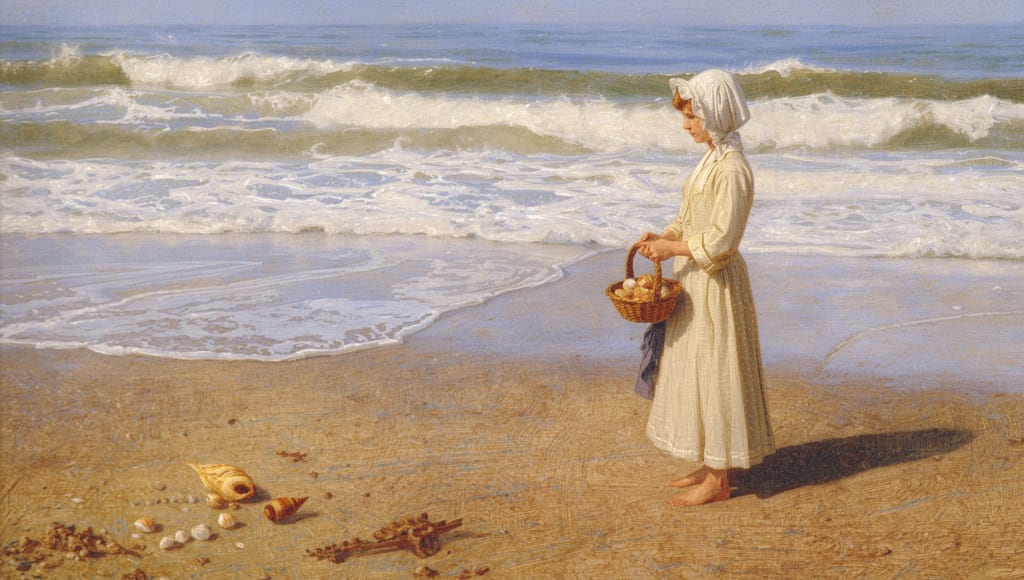
There are some phrases in the English language that seem almost timeless. They roll off the tongue in a playful way, yet they hide more depth than most people expect. “She sells seashells by the seashore” is one of those phrases. At first glance, it’s just a tongue twister, the kind you might hear in a classroom or around a campfire when someone challenges you to say it three times fast. But behind those eight little words is a fascinating mix of history, clever language, and even a story of determination that reaches back to the early 1800s.
Where It All Began
The exact origin of this famous tongue twister isn’t crystal clear, but many historians link it to the life of Mary Anning (1799–1847). Mary was not just any seaside vendor; she was a self-taught fossil collector and paleontologist from the town of Lyme Regis on the southern coast of England. As a child, she began scouring the cliffs and beaches for fossils — not as a hobby, but as a means to help support her family after her father’s death.
It’s worth noting that Mary didn’t technically sell ordinary seashells. She sold fossilized shells and prehistoric remains — things that fascinated scientists and wealthy tourists of the time. Still, her work almost certainly inspired the popular line. In 1908, songwriters Terry Sullivan and Harry Gifford wrote a song titled “She Sells Seashells”, and it is widely believed that Mary’s remarkable life was their inspiration. Over time, that song’s chorus broke free from the sheet music and became the tongue twister we know today.
Why It’s Tricky
If you’ve ever tried to say “She sells seashells by the seashore” quickly, you know it’s not as easy as it looks. That’s because the phrase is packed with alliteration (repeating the same first sound in multiple words) and consonance (repeating similar consonant sounds in close proximity).
The challenge here lies in switching between the “s” sound and the “sh” sound. These are produced in similar ways but require slightly different positions of the tongue and airflow. Your mouth has to adjust very quickly, and when you rush, the sounds tend to blur together. That’s why tongue twisters like this are often used by actors, singers, and public speakers to warm up their voices and sharpen their pronunciation.
More Than Just a Game
While most people meet this phrase as a playful challenge, it’s also a kind of miniature story about work, place, and persistence. In just eight words, you can picture a woman standing on a sunny shore, selling the treasures she’s gathered from the sea. There’s a rhythm to it, almost like the gentle lap of waves, and it’s easy to imagine the sound of shells clinking together in a basket.
For Mary Anning, this wasn’t just a poetic image — it was her life. She faced storms, landslides, and the constant danger of working on unstable cliffs, yet she kept going. Her discoveries helped shape early paleontology, but because she was a woman in the early 19th century, she received little formal recognition in her lifetime. Today, though, her name is remembered alongside the tongue twister that may have been inspired by her.
Educational Value
Teachers often use this phrase to help students with pronunciation, especially those learning English as a second language. It’s short enough to memorize, but complex enough to require real concentration. By practicing it slowly and then speeding up, learners gain better control over their speech.
It’s also a tool for developing listening skills. When students hear others attempt the phrase, they start to notice the subtle differences between “s” and “sh,” which sharpens their ear for detail. In a way, this little line is like a gym workout for the tongue and brain.
A Symbol of Resourcefulness
Beyond the classroom, “She sells seashells by the seashore” can be read as a tiny lesson in business and self-reliance. The “she” in the sentence is independent. She gathers her own products (seashells), chooses her marketplace (the seashore), and makes a living through her own effort. That’s entrepreneurship in its simplest form.
It’s no wonder this phrase has sometimes been used in marketing or motivational contexts. It reminds us that success can come from starting with what’s right in front of us — even something as simple as shells washed up by the tide.
Why It Stays With Us
Many tongue twisters fade into obscurity, but this one has stayed alive for over a century. There are a few reasons for that:
It’s easy to remember — only eight words.
It paints a clear picture — anyone can imagine a seashore and shells.
It’s playful — people of all ages enjoy trying to say it fast.
It has a real story behind it — the connection to Mary Anning gives it depth.
In a world where so much of our communication is typed rather than spoken, the fact that this old-fashioned phrase still pops up in classrooms, acting studios, and even social media trends says something about its enduring charm.
Conclusion
“She sells seashells by the seashore” may seem like a simple children’s rhyme, but it carries history, challenge, and meaning within its short structure. It’s a playful exercise in language, a nod to a remarkable woman’s determination, and a reminder of the creativity hidden in everyday life. Whether you use it to warm up before a performance, practice your English, or simply have a laugh with friends, it connects you to over a century of voices that have stumbled, laughed, and tried again. And maybe that’s the real beauty of it — just like the woman in the phrase, we keep going, one shell at a time.
About the Creator
Keep reading
More stories from Vocal Member and writers in Education and other communities.
Predicting the Future, Cartoon-Style: The Simpsons’ Hits and Misses
If someone had told you back in the 1990s that a yellow cartoon family could “predict” the future, you probably would’ve laughed. Yet here we are, decades later, still talking about The Simpsons and how often their fictional jokes seem to line up with reality. Created by Matt Groening in 1989, this show wasn’t made to be a crystal ball — it was meant to make people laugh. But somehow, between all the slapstick humor, satirical jabs, and life in the quirky town of Springfield, the writers have dropped hints about events that actually came true. And of course, not every prediction hit the mark — some were way off, and that’s part of the fun.
By Vocal Member 6 months ago in Education
China Hair Care Industry Analysis Market Size, Trends, and CAGR (2026–2034)
For decades, the Chinese beauty market was dominated by skincare, but in 2026, the focus has shifted upward. The "Skinification of Hair" has turned the humble shampoo into a sophisticated multi-step ritual. Driven by a young, urban population facing high-stress levels and environmental pollutants, the China hair care market is currently on an explosive trajectory. The China hair care market was valued at USD 15,547.6 million in 2025 and is projected to reach USD 22,146.4 million by 2034. According to IMARC Group, the market is expected to grow at a compound annual growth rate (CAGR) of 4.01% from 2026 to 2034."
By Neeraj kumar5 days ago in Education
Why Companies Depend on Business Consultants During Periods of Major Change
Change has become a constant reality for businesses across industries. Organizations today must adapt to digital transformation, shifting customer expectations, economic uncertainty, regulatory changes, and internal restructuring. These transitions often require fast, high-impact decisions that influence long-term stability, profitability, and competitive advantage. Managing change effectively is no longer optional; it is a critical leadership responsibility.
By Nicole Metz3 days ago in Education



Comments
There are no comments for this story
Be the first to respond and start the conversation.