
Social Media’s Effect on Reality, Authenticity & Human Bonds
Exploring how digital platforms reshape our sense of reality, challenge personal authenticity, and influence the fabric of human connection.

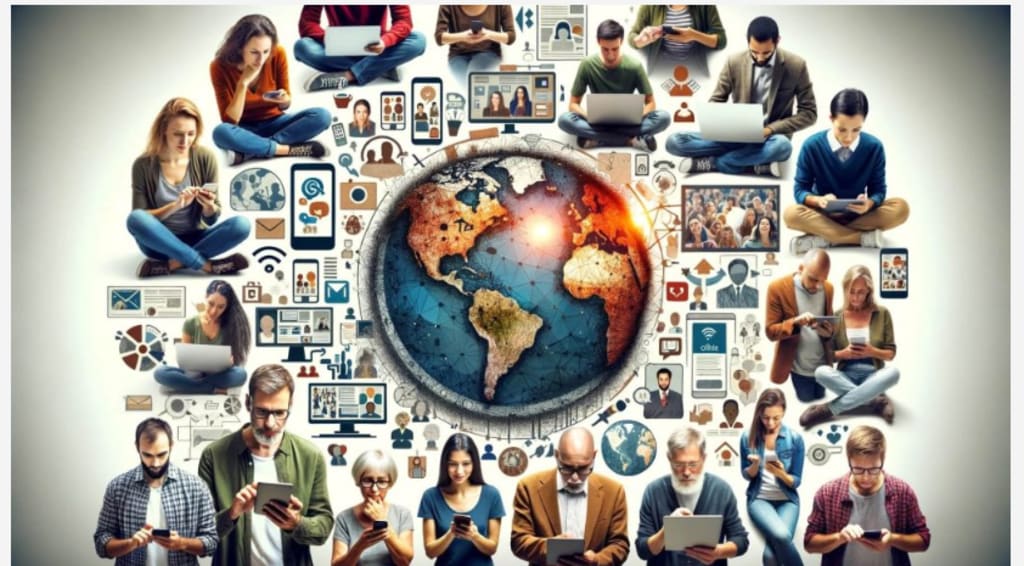
The human intellect intricately constructs narratives, much like how our visual faculties merge images to form mental impressions. These mental frameworks shape our perceptions of people, objects, and places, deeply influencing our emotional responses to life’s experiences. These perceptions, formed within the mind’s intricate workings, significantly shape our decisions and the paths we follow in life. Prior to the widespread rise of social media, presenting a deliberately crafted version of reality to others was a challenging feat. As a result, manipulating collective thought was a difficult undertaking. However, the emergence of social media marked a pivotal shift, introducing a landscape where individuals can easily curate fictional versions of themselves, shaping misleading realities to influence public sentiment in their favour.
In the past, public opinion was largely moulded by trusted figures who communicated through television and other traditional mass media channels. These voices were considered credible, largely because their public image was seen as a reflection of their true selves. Unlike today's social media environment—where curated personas have become the norm—these traditional opinion leaders upheld a standard of authenticity. The idea of influencing opinion without full transparency would have been considered unacceptable in that context.
Nonetheless, social media has fundamentally transformed human interaction, though often in deceptive ways. The digital environments created by these platforms are frequently artificial. This is starkly demonstrated by statistics from 2021: Facebook removed approximately 1.3 billion fake accounts, Instagram identified 95 million false profiles, and Twitter struggled with around 20 million bogus accounts. These figures highlight a widespread trend of individuals constructing deceptive online identities, which can be exploited for harmful purposes and pose risks to societal stability. Fake accounts enable users to distort perceptions of others and are often used to target individuals or spread misinformation with harmful intent. Such actions commonly stem from personal grievances or vendettas. Yet, stories are rarely black and white—there are always multiple perspectives.
However, social media often showcases just one side of a narrative, disproportionately empowering those who manipulate stories against others. Victims of such narratives frequently struggle to rebuild their credibility. This manipulation of public opinion has serious consequences. Throughout history, communities have developed mechanisms to resolve disputes—judges and mediators were entrusted to ensure justice prevailed, especially when someone's reputation was at stake. These systems emphasized thorough investigation before judgment. In contrast, social media, with its rapid sharing and shallow scrutiny, is ill-suited for uncovering the full truth.
Due to its capacity to propagate misinformation, social media has intensified social divisions and cultivated distrust in institutions. Anti-establishment voices often exploit these platforms to spread falsehoods, deepening rifts between different societal groups. As these misleading narratives circulate unchecked, they inflict lasting damage on national unity and social cohesion. This ongoing erosion of societal harmony underscores the need for responsible engagement in the digital sphere. Although social media is now integral to communication, it's vital to protect ourselves from the superficiality and deception it often promotes.
Robust legislation is a powerful means to counter the rise of fake profiles and deceptive content. Strict laws must be enacted against those who create and use such accounts for harmful purposes. While tracking IP addresses can identify the source, understanding the true intentions behind anonymous accounts remains a challenge. Hiding behind a false identity to cause harm is a serious offence that demands swift legal response. Addressing such behaviour will strengthen the integrity of social media platforms.
Technology, especially artificial intelligence, plays a key role in detecting and preventing the spread of false information. Advanced digital tools can help identify misinformation early, encouraging the circulation of more accurate content. In the education sector, integrating social media literacy into school and university programs is essential. Young people must learn that social media is not just a tool for information—it requires critical thinking and careful navigation. Authorities should monitor accounts that spread hate and disinformation, and cybersecurity teams should investigate their content to reduce online deceit.
It is also crucial for society to adopt responsible digital behaviour. Every individual has a duty to verify the authenticity of information before sharing it online. This collective responsibility will go a long way in restoring trust in social media as a communication tool. Above all, strong legal frameworks must govern what is shared on these platforms. Only content that benefits society should be circulated, allowing social media to serve as a force for good. In our digitally connected world, social media use is inevitable—but so is our obligation to use it wisely and truthfully. Failure to do so risks allowing misinformation to spread like a silent epidemic, breeding chaos, hatred, and division.
About the Creator
Murad Ullah
My qualification is in English Literature and Linguistics, and I am an expert in English writing.
Keep reading
More stories from Murad Ullah and writers in Education and other communities.
International Relations and Global Economic Development
In an increasingly interconnected world, the link between international relations and global economic development has grown stronger and more complex. Nations no longer operate in silos; instead, their economic prospects are deeply shaped by their diplomatic relations, trade alliances, political stability, and participation in global institutions. As globalization advances, understanding the interplay between international relations and economic development becomes essential—not only for policymakers and economists, but also for ordinary citizens whose lives are influenced by global trends.
By Murad Ullah9 months ago in Education
Best Vibe Coding Platforms for Building AI-Native Products
Vibe coding platforms are transforming how teams develop AI-native products by enabling the conversion of ideas into functional software through natural language and AI collaboration. They help startups and enterprises move faster from concept to execution without losing alignment.
By Mobisoft Infotech4 days ago in Education
Growing Together: How Community Service Strengthens Lives and Neighborhoods
Community service creates positive change by connecting people through shared effort and responsibility. When individuals step forward to help, they address real needs while building trust within their neighborhoods. Because service encourages collaboration, it allows residents to see one another as partners rather than strangers. This sense of unity strengthens a community's social fabric.
By Kevin Knasel6 days ago in Education




Comments (2)
Well
It is a very important information about social media how they important and Demag in youth.