
Tape Backup vs. Disk Backup: How to Select the Right Solution for Your Business?
Tape Backup vs. Disk Backup

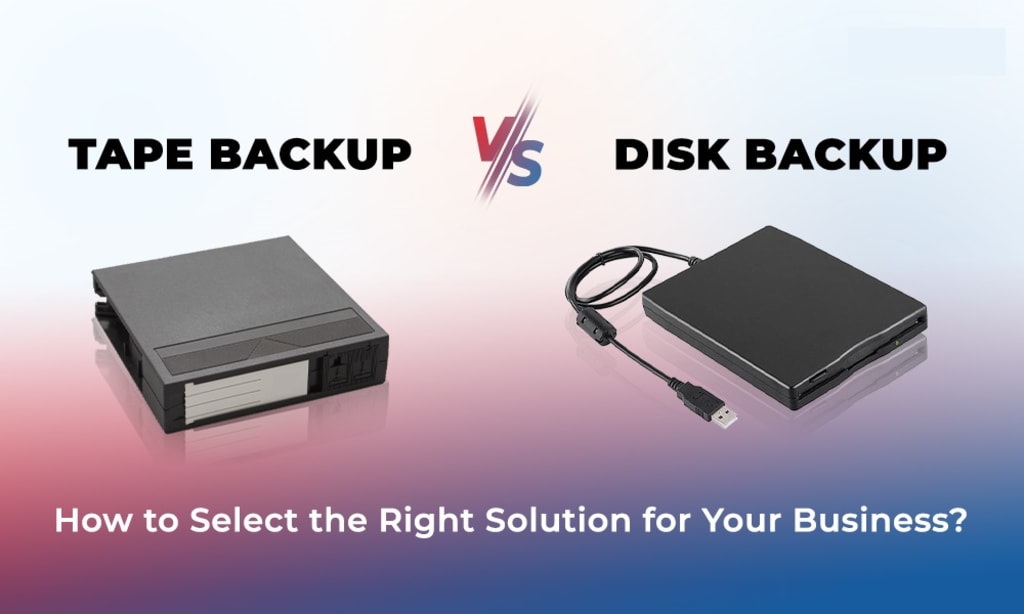
Today, most businesses rely on cloud or network devices like NAS or custom-built RAID servers. However, those who deal with long-term data archival & retention prefer off-site data backups for data security. This is where they need to employ a magnetic tape storage model, simply, a tape backup system.
Using tape backup might seem obsolete over disk backup, but tape’s many advantages still hold relevance. Whether you are upgrading your data backup infrastructure or installing a new one, choosing between tape backup and disk backup can involve many considerations.
This post will deeply compare the two technologies to help you choose the right backup solution for your business.
Backup vs. Archive
When we talk about backups, we generally mean short-term storage. Backups are typically easy to modify and update. They are usually associated with either disk drives like HDDs and SSDs or cloud backups.
Archives, on the other hand, are meant for long-term storage. They retain old data and records for longer durations without allowing any data modification. A significant advantage of archives is that they are not connected to any network, making them immune to data breaches, malware attacks, etc.
What is a Tape Backup?
Tape backups, or tape archives, are created using LTO Ultrium technology. These reliable LTO tapes are used in an LTO tape drive to create and access data backups. When combined, these drives form a tape library containing hundreds of LTO tapes.
As mentioned, tape backups are mainly used where you need to retain data and records for extended periods (approx. 10-15 years). While tape backups have slow read/write speeds, they are long-lasting and far out live disk backups. They are also highly scalable, and the overall cost of ownership is quite low.
What is a Disk Backup?
Disk backups are everyday backups quite common among individuals and small enterprises. These are usually taken on storage media with shorter lifespans, such as HDDs, SSDs, RAID/NAS servers, etc. Such backups are mainly used for short-term data storage or data transfer.
A disk backup offers a simple interface to access data. They are mostly connected to a network or accessed via simple USB to USB or USB to SATA cables, they are more accessible and adaptable. However, staying connected on a network easily exposes them to malware attacks, data breaches, and more risks.
Difference between Tape Backups and Disk Backups
Disk backups ensure that data is recoverable in case of data loss due to drive failure, file deletion, or any other catastrophic event. They help deal with data losses at smaller intervals of time.
On the other hand, tape backup or archive is a solution that helps a user store data for longer periods. Archiving allows old data, like financial records, etc., to stay safe on a storage media that is not required.
Here is a difference between the two –
Disk Backup – A disk backup is created locally on conventional storage devices such as HDDs/SSDs, etc. A disk backup contains all of the data, like images, documents, and other files, including or excluding important files. While creating a backup copy on another device, the data source remains intact. Data backups are periodically updated, i:e. old data is deleted or replaced with new data. This makes data backups dynamic. However, due to the usage of conventional storage media, it is a short-term storage solution (lasting for around 4-5 years).
Tape Archive/backup – A tape archive is a sophisticated enterprise storage solution that is mainly built using cold cloud storage or offline tape libraries/archives. Cold archives are not connected to an active internet connection, which makes tape backups safe and secure. Tape archives are used for keeping specific files and records that are vital for the core functioning of a business. They also help in meeting compliance standards.
While creating tape archives, the data at the source is permanently moved and stored as tape archives. As accessing tape data requires specific hardware, hence, it is not used often for data updation and deletion. A tape backup/archive, once created, is not modified. Hence, it is an ideal long-term storage solution (around 15 years).
Which One to Choose?
This is an executive decision dependent on your business model. You must carefully assess all your present and future backup requirements to make a sound decision.
Ultimately, your business needs should dictate the choice for a data backup model. To help you out, here’s what you must consider while debating Tape backup vs. Disk backup –
- Amount of data updated regularly on network drives/backup drives
- Current bandwidth
- Budget
- Hardware requirement
- Long-term IT strategy for data longevity
- Business continuity plans
Adding a Layer of Security to Data Backups
We take backups to prevent unwanted data loss and retain important information for a long time. However, there have been many instances where backups have failed, making leaving users and businesses looking for immediate data recovery solutions.
Data loss from magnetic tape storage is nothing to be undermined. As magnetic tapes are pretty resilient, losing access to your data backup on tape is rare, but it’s not impossible. Usual cases of inaccessible data on a magnetic tape include incompatible tape drive, incompatible parser, misaligned leader pin, etc. This is where you must utilize advanced tape data recovery software.
Such software can handle various tape parsers like Tivoli, BKF, CPIO, etc., and they come with advanced algorithms that allow IT professionals to recover tape backups on healthy LTO tapes.
Final Verdict
Magnetic tape backups are reliable and resilient, and offer longevity to the data backups. LTO tapes are also economical, highly scalable, and secure due to their off-site setup. However, as a downside, they have slower read/write speeds and require special hardware and storage conditions for maintaining a healthy tape library.
Disk backups, on the other hand, are quite fast, offer immediate access to data, and are easy to use. However, ownership cost increases significantly as compared to tape backups, as disk drives are pretty expensive, and constant use reduces their already limited shelf lives. Disk backups are also prone to malware, ransomware, etc., which can cause data loss.
With these clear distinctions, consider every possible data backup model and then invest in one that meets most of your needs.
About the Creator
Mayank Yadav
Mayank Yadav is a digital marketing professional with over 4+ years of experience. Presently, he is vigorously rendering and polishing off his versatile skills in the field of Search Engine Optimization (SEO).
Keep reading
More stories from Mayank Yadav and writers in Education and other communities.
Best iPhone Data Eraser Software [2024]
Before you sell, discard, exchange, or give away your iPhone, it is crucial to erase the device data to protect your privacy and confidentiality. If you don’t erase iPhone data, there is a high chance your device becomes vulnerable to identity & data theft or misuse. Erasing the iPhone data ensures your sensitive information, be it email, banking passwords, etc., is not accessible to anyone.
By Mayank Yadav2 years ago in Lifehack
Aircraft Airspeed Indicator Parts: History, Function, and Their Role in Aviation Safety
Introduction: Why Airspeed Matters in Aviation As someone deeply fascinated by aviation systems and aerospace history, I’ve always believed that understanding aircraft instruments is key to appreciating how flight became safe, reliable, and scalable. Among all cockpit instruments, the airspeed indicator holds a special place. It is not flashy, not digital by origin, yet it has been fundamental to aviation safety for more than a century.
By Beckett Dowhan2 days ago in Education
Unlocking Your Potential: A Journey of Personal Growth and Professional Development
Personal growth and professional development are closely linked. As people grow personally, they often unlock new skills that help them at work. In the same way, professional development can lead to more confidence and personal satisfaction. Both areas support one another and move together in a cycle of improvement. Understanding this connection is the first step toward lasting success.
By Greg Deshieldsabout 13 hours ago in Education


Comments
There are no comments for this story
Be the first to respond and start the conversation.