
The 1970-S Lincoln Cent: A Masterclass in Minute Details
Let's dive into it

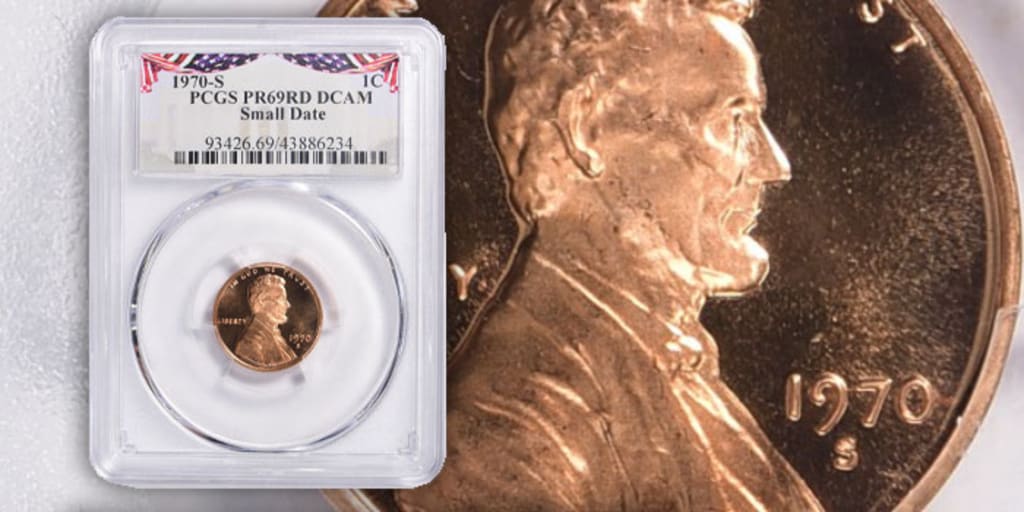
The Core Principle: "High 7" vs. "Low 7"
The most widely taught method for identification focuses on the alignment of the date, giving each variety its common nickname.
- The 1970-S Small Date ("High 7"): In this variety, the top of the digit "7" lines up perfectly with the tops of the "9" and "0." The bottom of the "7" also aligns with the bottom of the "0". This creates a "level" or "high" appearance.
- The 1970-S Large Date ("Low 7"): Here, the top of the "7" sits distinctly lower than the tops of the other numerals. Similarly, its base is also positioned lower than the base of the "0". This misalignment is the most frequently cited diagnostic.
However, judging alignment by eye alone can be challenging without a direct comparison. The following table consolidates the key identification points to give you multiple avenues for verification.
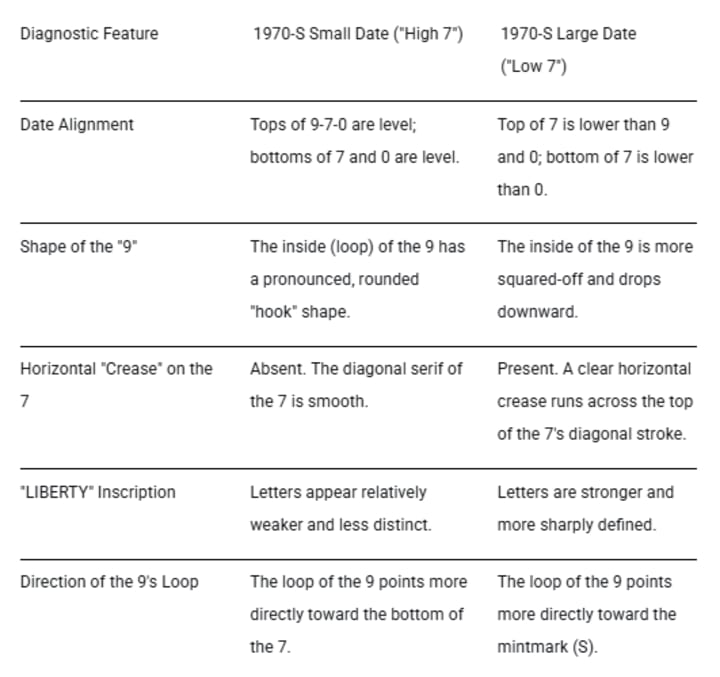
The Expert's Secret: The Crease on the 7
While the alignment is crucial, the single most reliable diagnostic—and one often missed in general guides—involves the digit 7 itself. As noted by detailed variety experts, all genuine 1970-S Large Date cents feature a tiny horizontal crease that runs across the top of the 7's diagonal stroke. This crease is completely absent on all Small Date coins.
This feature is a fail-safe marker. When in doubt, use a 5x-10x loupe to look for this minute incuse line. Its presence instantly confirms a Large Date.
Why the Details Matter: Scarcity and Value
Understanding these details is not an academic exercise; it has direct and substantial financial implications for collectors. The Small Date variety is notably scarcer, estimated to represent only 10% to 15% of the total 1970-S mintage, if not less. This relative rarity is reflected dramatically in the market.
- Common Large Date: An uncirculated or proof specimen typically trades for less than $1.
- Scarce Small Date: Even a circulated specimen can be worth $20 or more. In pristine, gem uncirculated (MS65RD) condition, the value jumps to approximately $80, and top-tier examples (MS67RD) have sold for over $600.
The Professional Authentication Workflow
When a potential 1970-S Small Date crosses my desk, I follow this systematic process:
The Professional Authentication Workflow
When a potential 1970-S Small Date crosses my desk, I follow this systematic process:
- Initial Triage with "LIBERTY": I first check the strength of the "LIBERTY" inscription. If it's bold and sharp, my initial lean is toward Large Date.
- Alignment Check: I then analyze the date alignment, looking for the tell-tale "High 7" characteristic.
- Definitive Diagnosis with the Loupe: Regardless of the above, I always put the coin under magnification. I examine the inside of the 9 for its shape and, most importantly, scrutinize the diagonal of the 7 for the presence or absence of the horizontal crease. This is the step that provides absolute certainty.
- Digital Cross-Reference: For a final layer of verification, especially when examining a coin from a photo, I use high-resolution imaging tools. A platform like Coin ID Scanner can be invaluable here. By uploading a clear, cropped image of the date, you can compare your coin side-by-side with verified examples of both varieties. This digital "second opinion" is an excellent way to confirm your visual analysis, particularly for the subtle shape of the 9.
- Contextual Verification: Finally, I consider the coin's overall appearance and provenance. This holistic view ensures no detail is out of place.
Mastering the 1970-S cent varieties sharpens your eye for the entire Lincoln series and beyond. It teaches you that in numismatics, true expertise lies in knowing not just what to look for, but how to look. The next time you sift through a roll of cents, remember that a fraction of a millimeter's difference in a single digit could be the key to a significant find.
About the Creator
Laura Bennett
Numismatist and data science expert passionate about uncovering the stories behind historical coins through analytics. Bachelor’s degree in Archaeology and a Master’s in Data Science from Harvard University. https://coin-identifier.com/
Keep reading
More stories from Laura Bennett and writers in Education and other communities.
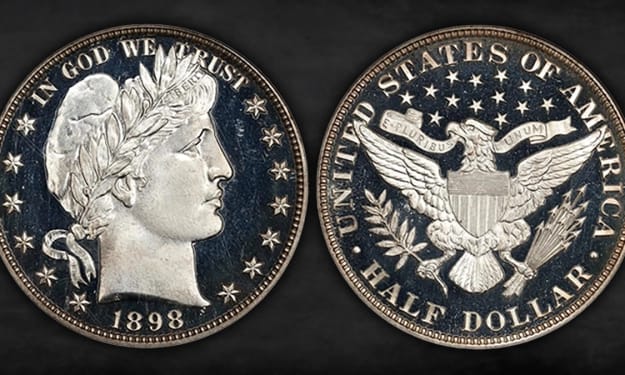
Condition is King: A Professional's Guide to Grading Barber Half Dollars
As a Senior Numismatic Analyst, I've held thousands of Barber Half Dollars, each with a story told not in words, but in micro-abrasions. Minted from 1892 to 1915, these coins are a classic series where condition is everything. The difference between a Good (G-4) and an Extremely Fine (XF-40) specimen can be thousands of dollars, all hinging on the preservation of a few critical design elements. This guide will teach you the professional's methodology for identifying wear on a Barber Half Dollar, turning you from a casual observer into a discerning grader.
By Laura Bennetta day ago in Education
CalWORKs California 2026: The Complete Guide to Cash Aid, Eligibility, Benefits & How to Apply
If you’re a low-income family in California struggling to pay rent, utilities, child care, groceries, or transportation, CalWORKs might be the most important program you’ve never fully understood.
By Free Laptops From Government3 days ago in Education
Why the Anti-Obesity Drugs Market Is Changing the Way Weight Management Is Approached?
Obesity is now one of the largest epidemic problems we are facing globally, for all ages and all lifestyles, and with the increased knowledge of the chronic sequelae associated with obesity, the focus is shifting away from diet and exercise. In this context, the anti-obesity drug market is gaining acceptance as a medical treatment for long-term weight loss maintenance.
By Akshay Kumar3 days ago in Education


Comments
There are no comments for this story
Be the first to respond and start the conversation.