
The Bio-Logic Era Inside China’s $9 Billion Premium Skincare Ascent
China Premium Skincare Market
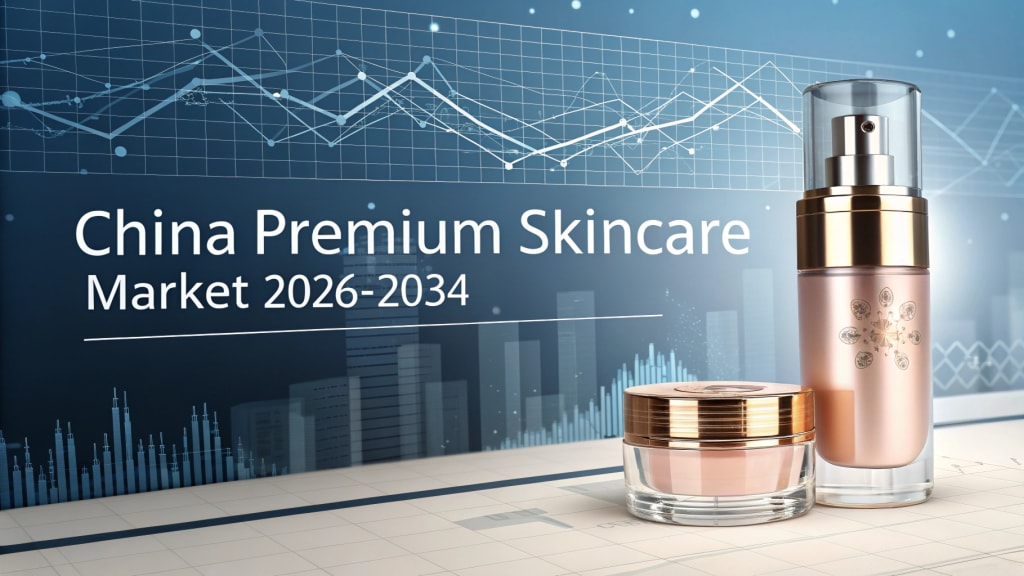
The era of the "one-size-fits-all" luxury cream is officially over. Walking through the beauty halls of the Tianshan District or scrolling through a live-stream on Douyin in 2026, it becomes clear that the Chinese beauty consumer is now the most demanding on the planet. I call them "Skin-Intellectuals" shoppers who can break down a chemical formula with the precision of a lab technician and who value clinical proof over celebrity endorsements.
This evolution is driving a market that will more than double in the next decade. But to understand how we get to $9.4 billion, we have to look at the three "invisible" forces reshaping the industry: the synthesis of ancient wisdom with biotech, the rise of the AI-powered bathroom, and a radical new regulatory landscape.
1. The High-Tech "C-Beauty" Renaissance
The most significant trend of 2026 is the emergence of "Modern TCM" (Traditional Chinese Medicine). For years, local brands were seen as cheap alternatives to French or Japanese giants. No more. Domestic powerhouses like Pechoin, Winona, and Proya are using biotechnology to "upgrade" ancient herbal wisdom.
We are seeing ginseng, cordyceps, and lingzhi being processed through low-temperature enzymatic extraction to maximize potency without the irritation of synthetic chemicals. It’s a "Best of Both Worlds" approach: the emotional comfort of cultural heritage paired with the clinical efficacy of a Swiss lab. In 2026, this "Cultural Luxury" (Guochao) is why local brands are finally capturing double-digit shares of the premium segment, often out-pacing heritage Western brands in sheer innovation speed.
2. The AI Bathroom: Personalization as the Ultimate Luxury
If you walk into a high-end mall in Chengdu today, the first thing you’ll see isn't a salesperson, but an AI diagnostic station. Premium brands have integrated "Digital Twin" skin modeling into their retail experience.
By early 2026, the path to purchase starts with a selfie. Apps on platforms like Xiaohongshu and Alibaba allow users to analyze hydration levels, UV damage, and even microbial balance. But the real luxury is what comes next: the Custom Batch. The 2026 consumer doesn't want the same bottle as their neighbor. They want a formula adjusted for the humidity of their specific city, their recent travel schedule, and their personal stress levels. High-end brands like L'Oréal (with their Perso technology) and local innovators are now offering customized, "fresh-mixed" serums delivered to your door within 72 hours. This AI-driven loyalty is a primary engine behind the market's 9% growth rate it moves skincare from a "commodity" to a "personalized health solution."
3. "Skinification" and the Post-Procedure Glow
A massive structural shift I’ve noticed this year is the migration of premium skincare logic into other categories a trend known as "Skinification." Because China’s cosmetic surgery market (specifically non-invasive "tweak-ments" like fillers and lasers) is booming, premium skincare has rebranded itself as "Post-Procedure Recovery." Brands are no longer just selling "anti-aging"; they are selling "barrier repair." There is a surge in "medical-grade" lines (like Comfy or Voolga) specifically designed to heal the skin after a laser session. In 2026, a premium skincare kit is increasingly viewed as the essential "after-care" for the nation's aesthetic investments. If you’re spending $500 on a laser treatment, spending $200 on a specialized recovery serum feels like a logical, defensible expense.
4. Regulatory Trust as a Premium Filter
In 2026, the NMPA (National Medical Products Administration) has implemented some of the world's strictest ingredient transparency laws. While this initially caused a headache for R&D departments, it has ultimately saved the premium market.
By weeding out "pseudo-luxury" brands that couldn't prove their efficacy claims, the government has cleared the field for high-quality players. Consumers in 2026 are increasingly "rational"—they cross-check ingredients on apps before they buy. The new regulations have made "Safety" and "Transparency" the most valuable brand assets. For the $9.4 billion forecast to become reality, trust has become the new status symbol.
5. The Demographic Shift: Men and the "Silver Economy"
Finally, we have to look at who is buying. While young women in Tier-1 cities remain the core, 2026 is seeing two "sleeping giants" wake up:
The Male Grooming Surge: Led by Gen Z, men are moving past basic cleansers into premium serums and eye creams. Brands like UNLICS are proving that the male vanity market is a multi-billion dollar opportunity.
The Silver Economy: As China’s population ages, "Pro-Aging" (the positive spin on anti-aging) is becoming a major focus. These are consumers with the highest disposable income and a deep desire for products that offer "longevity" rather than just a temporary fix.
Conclusion: The Defensible Luxury
As we look toward 2034, China Premium Skincare Market is maturing. It is no longer a "small, mood-lifting purchase" to be made on a whim. It is a disciplined, data-backed regimen that sits at the intersection of health, technology, and identity.
The successful brands of the next decade won't be those with the most famous spokesperson, but those that can provide "receipts" clinical proof, cultural resonance, and a personalized experience. In 2026, the industry is proving that in the world of beauty, science is the most luxurious ingredient of all.
About the Creator
Keep reading
More stories from Neeraj kumar and writers in Education and other communities.
Rising Demand for Premium Pet Food Drives Market Growth in China
In 2026, the quiet hum of a Shanghai apartment is often punctuated not by the cries of a child, but by the satisfied crunch of a "freeze-dried" meal. This shift isn't just a lifestyle quirk; it’s a economic powerhouse. The China pet food market, valued at USD 22.51 Billion in 2025, is charging toward a projected USD 32.87 Billion by 2034. With a CAGR of 4.30%, the industry is witnessing a profound transformation where pets have officially moved from the backyard to the center of the family portrait.
By Neeraj kumarabout 8 hours ago in Education
The Future of Jobs: What Skills Employers Want Most
The world of work is changing faster than ever. Artificial intelligence, automation, remote work, and digital transformation are reshaping industries across the globe. Many traditional roles are evolving, while new job categories are emerging. For professionals, students, and job seekers, one question matters most: What skills will employers value in the future?
By Muhammad Irfan Afzal3 days ago in Education
Redefining Access: The Evolution of Private Market Participation
Private markets were once considered an exclusive arena reserved for pension funds, endowments, family offices, and ultra-high-net-worth individuals. High minimum investments, long lock-up periods, and complex legal structures limited participation to a narrow segment of investors. However, over the past decade, this exclusivity has gradually faded. Financial innovation, regulatory updates, and digital transformation have collectively expanded the pathways into private equity, venture capital, private credit, infrastructure, and real assets.
By Michael Christopher Venturino3 days ago in Education
Super Bowl LX Recap: A Team Called Hawks
Sixty. The Super Bowl turned 60! Still amazes me that this was the sixtieth Super Bowl played in NFL history. It seems like yesterday that I watched Super Bowl XXVII, the first SB I ever watched. The QB who won Super Bowl XXVII has since called a few SBs, and will call next year's game, but that's another story. Super Bowl LX took place at Levi's Stadium in Santa Clara, California, the home stadium of the San Francisco 49ers. However, it was one of their division foes who represented the NFC, as the Seattle Seahawks faced off against the New England Patriots.
By Clyde E. Dawkins7 days ago in Unbalanced



Comments
There are no comments for this story
Be the first to respond and start the conversation.