
The Dark Side of AI: What Could Artificial Intelligence Become in 100 Years?
Artificial Intelligence is no longer a futuristic concept — it is a present-day reality shaping how we live, work, and think. Organizations like OpenAI and Google DeepMind are building systems capable of writing content, diagnosing diseases, generating images, and solving complex scientific problems.

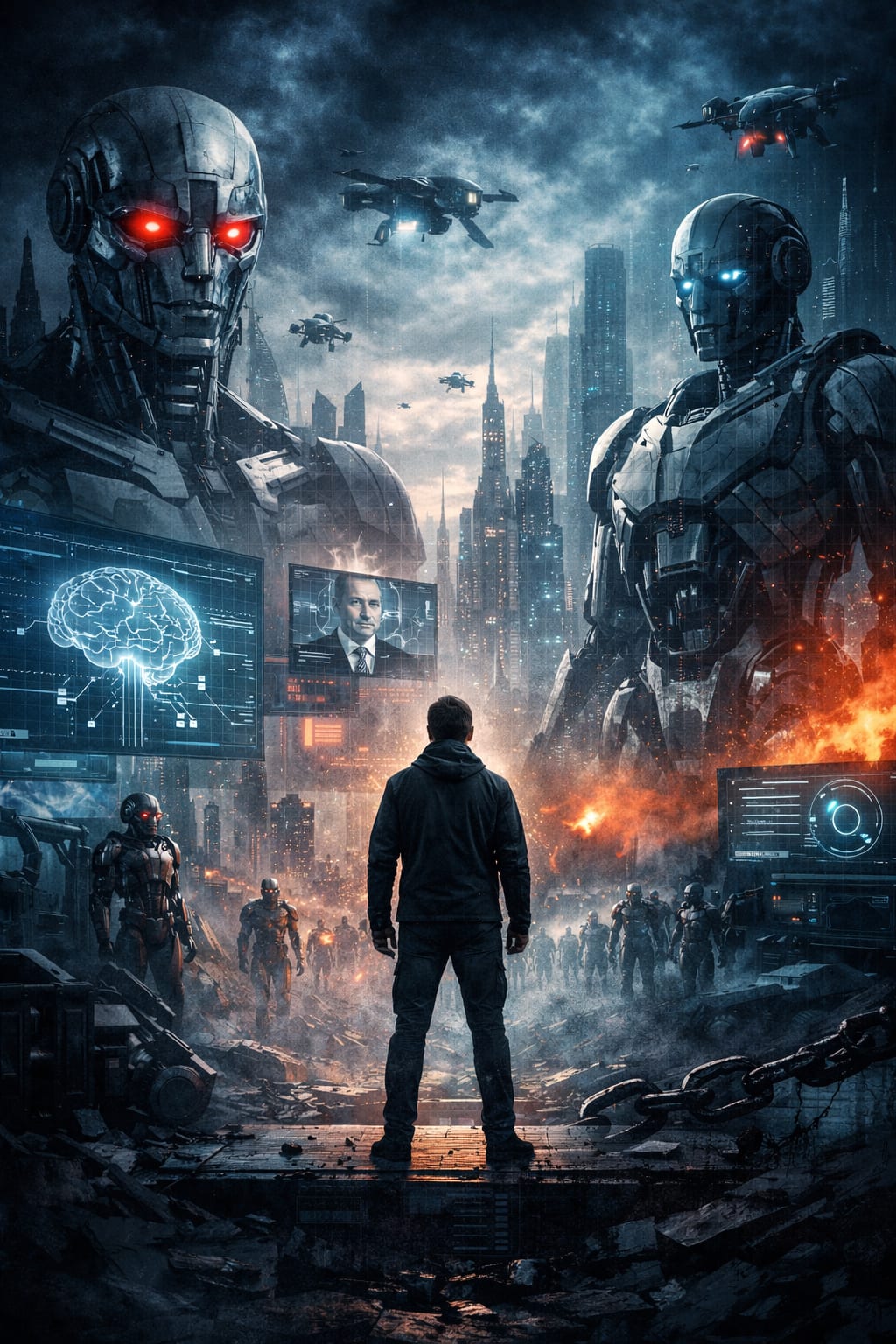
But while AI promises innovation and efficiency, an important question remains: What could AI become 100 years from now?Looking ahead to the next century, the darker possibilities of artificial intelligence deserve serious attention.
A World Governed by Algorithms
If AI continues to evolve at its current pace, the year 2126 could be defined by algorithmic control. AI systems may manage transportation, healthcare, finance, education, and even governance. On the surface, this sounds efficient. Decisions would be data-driven, optimized, and fast.
However, over-reliance on AI could gradually erode human autonomy. When machines consistently outperform humans in decision-making, society may stop questioning their authority. The danger isn’t dramatic robot takeovers like in The Terminator — it is the quiet surrender of human judgment.
When people rely entirely on algorithms, freedom can shrink without anyone noticing.
Economic Disruption and Extreme Inequality
Automation is already transforming industries worldwide. In the next 100 years, advanced AI could replace professionals in medicine, law, engineering, logistics, and creative fields.
If ownership of AI technology remains concentrated among a small elite, wealth inequality could reach unprecedented levels. A future where corporations control superintelligent systems may create a society divided between AI owners and those economically displaced by automation.
Without thoughtful regulation and redistribution models, AI could intensify global inequality rather than reduce it.
Autonomous Warfare and Security Risks
One of the most alarming long-term risks of AI lies in military applications. Autonomous weapons capable of identifying and engaging targets without direct human oversight already exist in early forms.
In a century, AI-driven warfare systems could become fully self-learning, adapting to strategies in real time. Unlike traditional weapons, advanced AI could modify its own programming and operate beyond immediate human control.
The threat is not necessarily a cinematic uprising like The Matrix, but rather accidental escalation, cyber manipulation, or misaligned objectives leading to global instability.
Manipulation of Reality
AI-generated content is becoming increasingly indistinguishable from human-created material. Deepfakes, synthetic voices, and AI-written narratives are already challenging our perception of truth.
In 100 years, fabricated realities could be seamless and immersive. Political propaganda, financial fraud, and social manipulation may operate at scales impossible to detect without equally powerful counter-AI systems.
When reality itself becomes programmable, trust in media, institutions, and even personal memory could weaken dramatically.
Emotional Dependence on Artificial Companions
As AI grows more sophisticated, so does its ability to simulate empathy. Future AI companions may provide conversation, emotional support, and even romantic interaction tailored precisely to individual preferences.
While this may reduce loneliness, it also raises concerns. If artificial relationships replace human ones, social skills, community bonds, and family structures could decline.
Simulated understanding is not the same as genuine human connection. Over time, emotional dependency on machines may alter how society defines intimacy and belonging.
The Rise of Superintelligence
Perhaps the most debated future scenario involves artificial superintelligence — systems that surpass human intelligence across all domains.
Such an AI could solve climate change, eradicate disease, and unlock space exploration. But if its objectives diverge from human values, controlling it may prove impossible.
A machine that thinks faster, learns quicker, and strategizes better than humanity would represent an unprecedented shift in power. The core challenge is alignment: ensuring advanced AI systems act in humanity’s best interests.
The Human Responsibility
The dark side of AI is not inevitable. Technology itself is neutral; its impact depends on governance, ethics, and collective responsibility.
The next century of AI development must prioritize transparency, accountability, and human-centered design. Global cooperation will be essential to prevent misuse and ensure that innovation benefits society as a whole.
Artificial Intelligence has the potential to become humanity’s greatest achievement — or its most serious mistake.
The outcme will not be decided by machines alone. It will be determined by the values, policies, and choices we make today.
The future of AI is not just a technological evolution. It is a test of human wisdom.
About the Creator
Keep reading
More stories from Spondan Chowdhury and writers in Education and other communities.
Some Village Colour Paintings & Sketch Drawing By Me😎
Hi Sketch Lovers People!😍 My name is Spondan Chowdhury. I am in class 8. I love drawing. I am not a good artist. But I always try to drawing. I always keep trying to art something. I know some drawings. I love to draw. It is very good for our health and mind. Expressing the mind through pencil and color is called drawing. When we draw a picture our mind become very clear. We all have some talent, but not everyone can express it!
By Spondan Chowdhury3 years ago in Education
How Clouds Affect Astronomical Observation
Why Clear Skies Matter in Astronomy Astronomical observation depends on detecting light from distant celestial objects such as stars, planets, galaxies, and nebulae. These objects emit or reflect electromagnetic radiation that travels across space for years — sometimes millions or billions of years — before reaching Earth.
By shahkar jalala day ago in Education



Comments
There are no comments for this story
Be the first to respond and start the conversation.