
The Future of Space Travel
Can Humans Colonize Mars or Even Travel Beyond Our Solar System?
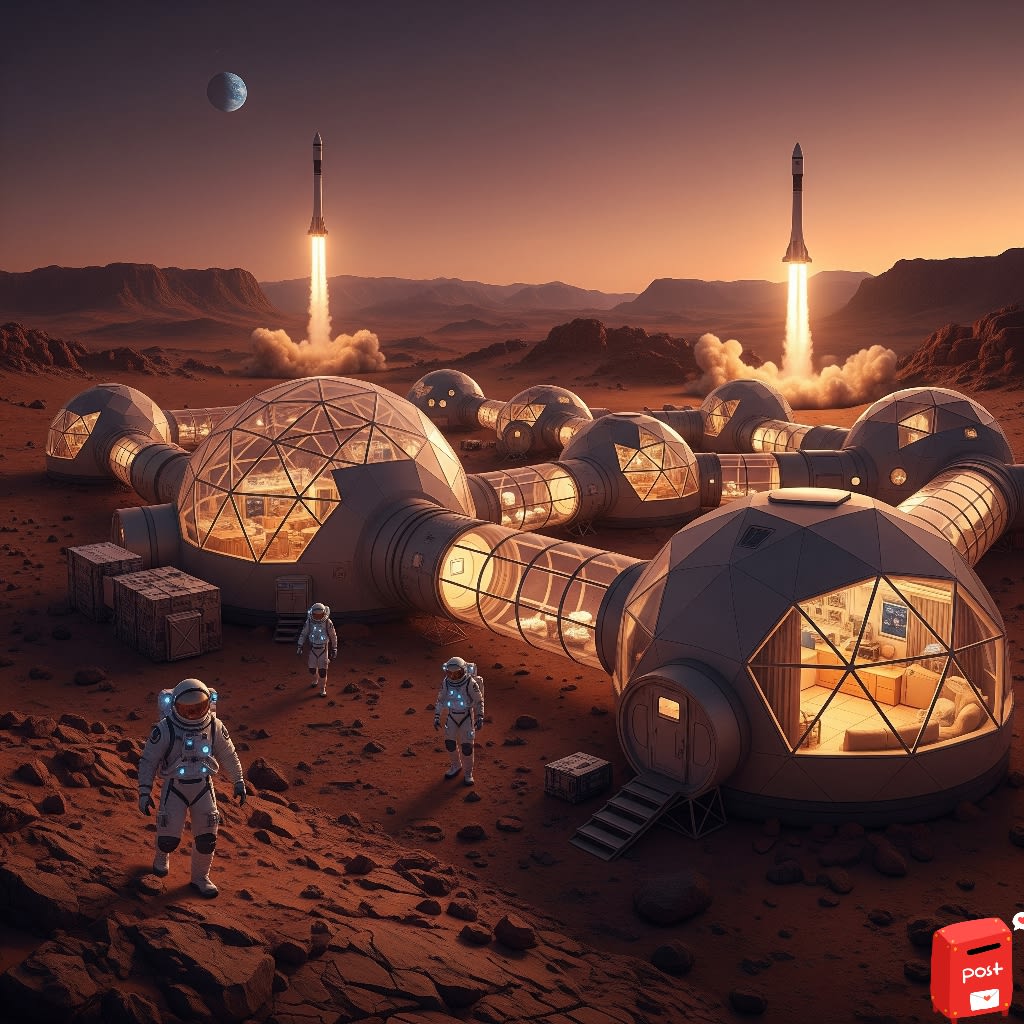
The Future of Space Travel – Can Humans Colonize Mars or Even Travel Beyond Our Solar System?
For centuries, humanity has gazed at the night sky with wonder, asking whether we could one day leave Earth and make a home among the stars. With rapid advances in technology and growing interest from both governments and private companies, that dream feels closer than ever. The question is not only whether we can travel beyond our home planet, but whether we can truly colonize other worlds like Mars—or even venture beyond our solar system.
Why Mars?
Mars has long been considered humanity’s best chance for colonization. It is relatively close—on average, about 225 million kilometers away—and shares some similarities with Earth. A Martian day is about 24.6 hours, and the planet has polar ice caps made of water and carbon dioxide. These features make Mars more appealing than other destinations, such as the Moon or Venus.
However, Mars is far from a second Earth. Its atmosphere is over 95% carbon dioxide, too thin to support human life. The planet is cold, with average temperatures around –60°C, and its surface is bombarded by harmful radiation from the Sun because of its weak magnetic field. Any future settlers would need advanced technology to survive, from pressurized habitats to protective suits.
The Technology Challenge
Companies like SpaceX are actively working on spacecraft designed to carry humans to Mars. Elon Musk’s vision includes building a fleet of reusable rockets, capable of transporting supplies and settlers. NASA, too, has outlined long-term missions to Mars, with test runs planned through its Artemis program, which first aims to establish a presence on the Moon.
But the obstacles are immense. Long-duration space travel poses serious risks for human health. Prolonged exposure to zero gravity weakens bones and muscles, and cosmic radiation increases cancer risks. To survive on Mars, colonists would need closed-loop life support systems, methods to produce oxygen and water, and ways to grow food in a hostile environment.
One promising concept is terraforming—altering Mars’ climate to make it more Earth-like. Some scientists suggest releasing greenhouse gases to warm the planet and thicken its atmosphere. However, this would take centuries, if not millennia, to achieve. For now, survival would depend on creating self-sufficient colonies inside domes or underground shelters.
Beyond Mars – The Solar System and Beyond
While Mars may be humanity’s first outpost, our ambitions do not stop there. Colonizing the Moon could provide a stepping stone, offering valuable experience in living off Earth and supplying resources for deeper space missions. Moons of Jupiter and Saturn, like Europa and Titan, are also intriguing, though they lie much farther away and present even harsher conditions.
Travel beyond our solar system, however, introduces challenges of an entirely new scale. The nearest star system, Alpha Centauri, is over 4 light-years away. With current technology, it would take tens of thousands of years to reach. Scientists are exploring radical concepts such as nuclear propulsion, solar sails, and even warp drives, but for now these remain theoretical.
Projects like Breakthrough Starshot aim to send tiny probes propelled by lasers to nearby stars within a human lifetime. While such missions may be possible in the coming decades, transporting entire human crews across interstellar distances is still far beyond our reach.
Why It Matters
The drive to colonize other worlds is not just about adventure. Earth faces threats ranging from climate change to asteroid impacts. Establishing colonies elsewhere could act as a “backup” for humanity, ensuring our survival if disaster strikes. Moreover, space exploration pushes science and technology forward, inspiring new innovations that benefit life on Earth.
The Road Ahead
Realistically, colonizing Mars may happen within this century, but it will begin with small research bases rather than thriving cities. Interstellar travel remains a dream, but the first steps—developing advanced propulsion, building sustainable habitats, and testing life support systems—are already underway.
The future of space travel is uncertain, but one truth stands out: humanity is no longer content to simply look at the stars. We are preparing to live among them.
About the Creator
Keep reading
More stories from Muhammad Shahram and writers in Education and other communities.
Why Do We Sneeze?
Sneezing is something we all experience, whether it’s triggered by a cold, allergies, or even just a sudden whiff of pepper. It might feel like an inconvenience in the middle of a meeting or while you’re eating your favorite food, but sneezing is actually one of the body’s most fascinating and powerful defense mechanisms. This simple action tells us a lot about how our body works to protect itself from potential harm. Let’s dive into the science of sneezing, why it happens, and some interesting facts that make this common reflex more extraordinary than we think.
By Muhammad Shahram5 months ago in Education
Why the Eyewear Market Is Transforming Vision Care and Personal Style?
Beyond vision correction and eye protection, eyewear has been widely adopted as a generic fashion accessory. Today, the eyewear market straddles health care, technology and the fashion industries in terms of both function and appearance.
By Akshay Kumar2 days ago in Education
Bartender
On the heels of grief, pain bears down hard. On the heels of death, pain awakens the quiet place between the end of our own life and now. Feeling anything is like seeing a film and in black and white, slow motion, all sound turned off. Just watching. Gritting teeth, awkward smiles and bloody red eyes move around, scanning the others who are feeling something I don't want to feel, but I do. Escapism is all I have ever known. ~
By ROCK aka Andrea Polla (Simmons)3 days ago in Poets




Comments
There are no comments for this story
Be the first to respond and start the conversation.