
The Light That Changed the World
The remarkable journey of Albert Einstein — from a quiet boy to the father of modern physics.

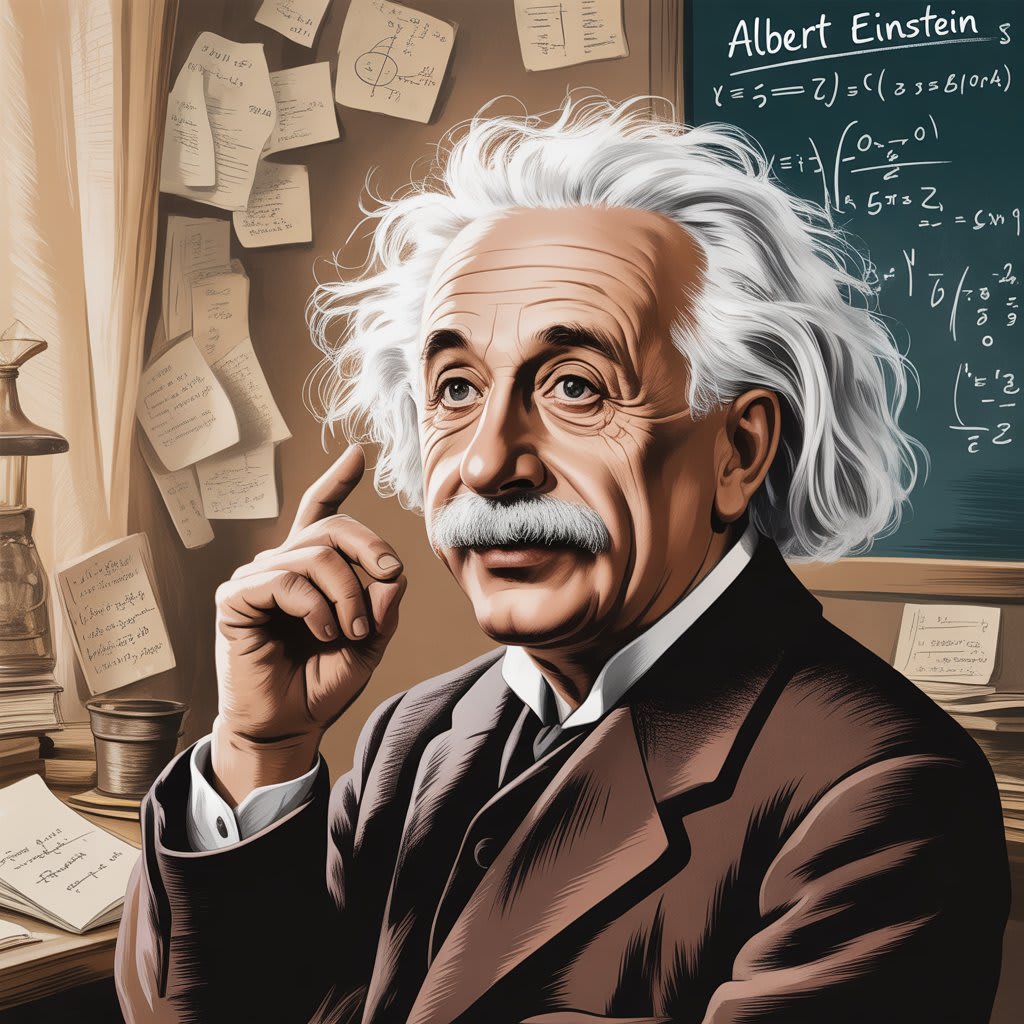
In a small town called Ulm, in Germany, on March 14, 1879, a child was born who would one day change the way the world understood time, space, and the universe itself. His name was Albert Einstein.
But when he was born, no one imagined this child would become one of the greatest minds in history. In fact, many people thought the opposite.
Albert was a quiet boy. He didn’t speak much until the age of three. His parents, Hermann and Pauline Einstein, were worried. He was different from other children. He didn’t play rough games. He preferred to sit alone, build towers with blocks, or stare out of the window for hours.
But Albert's mind was always working. One day, when he was five, his father gave him a simple compass. It was just a small, ordinary-looking object. But when Albert saw the needle moving, always pointing north no matter how he turned it, he was amazed.
“How does it know where to point?” he wondered. That question never left his mind.
A Curious Mind in a Rigid School
Albert loved to ask questions. But in school, this made life difficult for him. His teachers wanted obedience, not curiosity. They taught facts, not understanding. Albert hated learning by memorizing. He wanted to know why things worked the way they did.
One day, a teacher told him, “You will never amount to anything.”
Albert didn’t argue. He simply stopped listening to the people who tried to put limits on his mind.
Outside the classroom, he read books on physics and mathematics that were far beyond his age. He discovered the works of Isaac Newton, Blaise Pascal, and James Clerk Maxwell. These books lit a fire in his imagination.
By the time he was a teenager, Albert had already decided what he wanted to do in life. He wanted to understand the universe. He wanted to know the rules behind light, time, gravity, and everything in between.
Struggles and Rejection
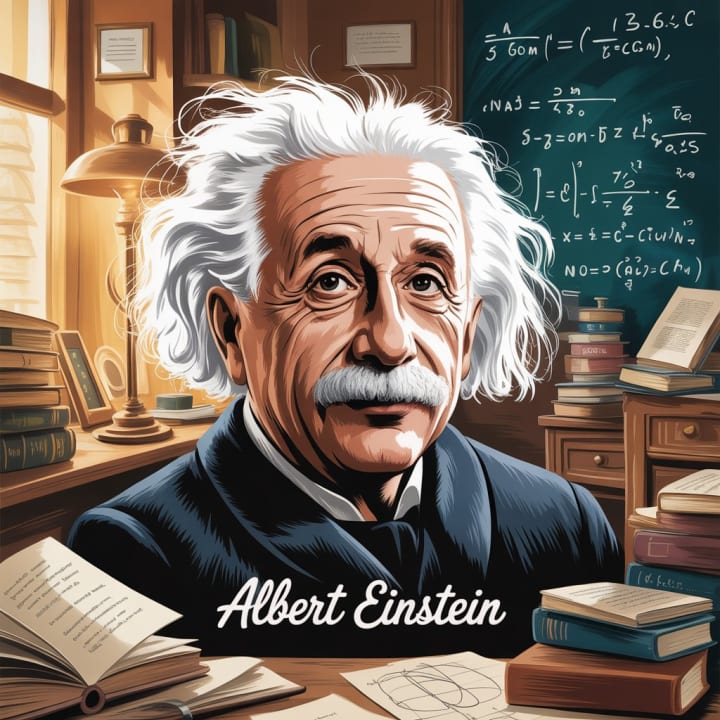
When Einstein applied to the Swiss Federal Polytechnic School in Zurich, he failed the entrance exam—except in math and science. He had to finish high school first. Many people would have given up after such failure. But not Albert.
He tried again, got in, and eventually graduated. Still, he couldn't find a teaching job after university. No school wanted to hire him. He applied to many places, but faced rejection after rejection.
Finally, through a friend, he got a job at the Swiss Patent Office in Bern. It wasn’t a scientist’s job — he had to review other people's inventions. But it gave him time to think. And Albert did more than think. He dreamed.
The Miracle Year
In 1905, something incredible happened. Albert Einstein, then just a 26-year-old patent clerk, published four scientific papers that would change the world. Scientists call it his Annus Mirabilis, or "Miracle Year."
One of those papers introduced the most famous equation in history:
E = mc² — energy equals mass times the speed of light squared.
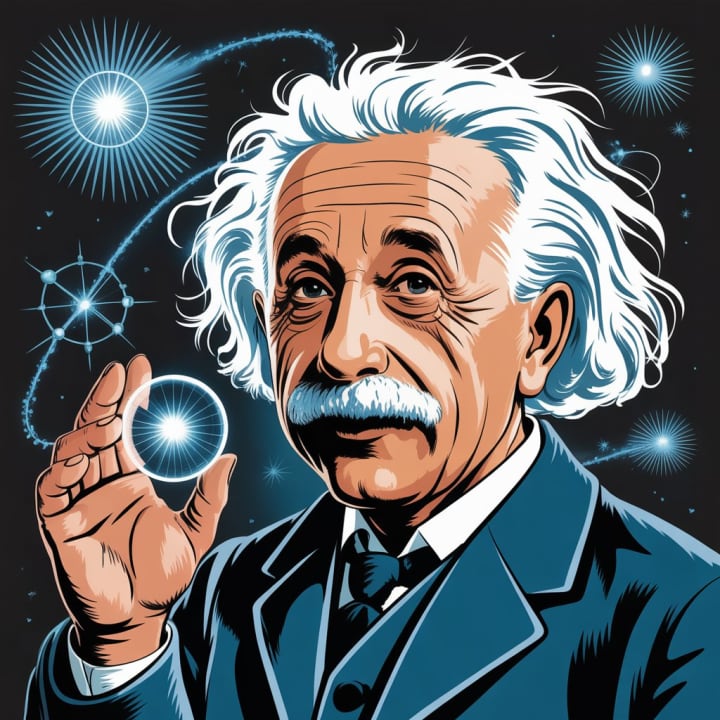
This equation revealed that mass and energy are two forms of the same thing. It would later become the foundation of nuclear power and atomic energy.
Another paper explained the photoelectric effect, which showed that light acts not just as a wave, but also as particles called photons. This would win him the Nobel Prize in Physics in 1921.
Still another paper explained special relativity — the idea that time and space are not fixed, but relative to the speed at which you're moving. It was revolutionary.
And all of this came not from a lab, but from a young man working at a desk, scribbling ideas during his breaks.
From Scientist to Icon
Einstein's theories slowly gained attention in the scientific world. But it was in 1919, after British astronomer Sir Arthur Eddington confirmed his theory of general relativity during a solar eclipse, that Einstein became a global superstar.
He was featured on the front page of newspapers. People around the world began to admire not only his brain, but his personality. With his messy hair, thoughtful eyes, and kind smile, he became the symbol of genius.
But Einstein didn’t care for fame. He cared for truth, for peace, and for justice.
A Voice for Peace
When Adolf Hitler rose to power in Germany, Einstein, who was Jewish, spoke out against the Nazis. He moved to the United States and took a job at Princeton University.
During World War II, fearing that the Nazis might develop atomic weapons, Einstein signed a letter to U.S. President Franklin Roosevelt, warning him. This led to the Manhattan Project, which created the first atomic bombs.
Although he never worked directly on the bomb, Einstein was deeply saddened by the destruction it caused. After the war, he became a strong voice for world peace, nuclear disarmament, and human rights.
The Humble Genius
Despite his fame, Einstein lived simply. He didn’t care about money or luxury. He wore old clothes, refused to wear socks, and enjoyed long walks. He loved music and played the violin to relax.
Einstein often said,
"Try not to become a man of success, but rather try to become a man of value."
He received countless honors, awards, and invitations from kings and presidents. But he never let it change who he was.
The Final Chapter
Albert Einstein passed away on April 18, 1955, at the age of 76. Even in his final days, he was working on theories about the universe. His brain was later studied by scientists, hoping to find the secret behind his genius. But what they found was this: Einstein’s brain was not extraordinary in size — it was the way he used it.
Legacy
Today, Albert Einstein’s name is known everywhere. Schools, colleges, institutes, awards, and even space missions are named after him. His theories continue to shape science, technology, and even philosophy.
But more than that, Einstein taught us how to think differently, to question deeply, and to never give up on our dreams — even when the world doubts us.
Moral of the Story:
You don’t need to be born great. You just need to stay curious, work hard, and believe in your mind. True genius lies not just in talent, but in dedication, courage, and kindness — just like Albert Einstein.
About the Creator
AFTAB KHAN
SUBSCRIBE ME AND READ STORY
Storyteller at heart, writing to inspire, inform, and spark conversation. Exploring ideas one word at a time.
Writing truths, weaving dreams — one story at a time.
From imagination to reality
Keep reading
More stories from AFTAB KHAN and writers in Education and other communities.
The Village Lesson
In the heart of a peaceful valley, surrounded by green hills and winding rivers, lay a small village named Sundarpur. The people of Sundarpur led simple lives—most were farmers, potters, or weavers. Life was slow but full of warmth. Children ran barefoot through the fields, and the air often carried the smell of fresh earth and woodsmoke.
By AFTAB KHAN7 months ago in Education
Best Laptop with Long Battery Life
Running out of battery at the worst moment is frustrating, whether you’re working, studying, or traveling. If you want a laptop that lasts all day without living near a charger, this video is for you. Today, I’m breaking down the best laptops with long battery life that actually deliver in real-world use.
By Projectorseaa day ago in Education




Comments
There are no comments for this story
Be the first to respond and start the conversation.