
The Misinterpretations of Bagua in Western Feng Shui
Expert Insights from FengShuiPro.net

Introduction
To truly master a subject, one must diligently study its underlying theories rather than blindly accepting information. This is especially true for Feng Shui, one of the most complex and profound fields in Chinese culture. At a minimum, Feng Shui researchers should obtain accurate information directly from authentic Chinese Feng Shui sources.
However, in reality, many Western Feng Shui authors, teachers, and practitioners neither understand Chinese nor study authentic Feng Shui principles. As a result, they cannot fully grasp real Feng Shui. What they practice and teach may carry the name of Feng Shui, but it has little connection to genuine Chinese Feng Shui.
Having read nearly all the Feng Shui books available in libraries, I have found that only a few truly touch upon authentic Feng Shui principles, philosophy, and profound knowledge.
Clarifying a Common Misunderstanding About the Bagua in Western Feng Shui
Many Western Feng Shui books contain erroneous concepts. For example, one author classifies the two Bagua diagrams in Feng Shui as "Yin Pa Kua" (Yin Bagua) and "Yang Pa Kua" (Yang Bagua) (see Note), claiming that the Yin Bagua applies to Yin Feng Shui (gravesites) and the Yang Bagua to Yang Feng Shui (homes and buildings). She has published numerous Feng Shui books, all repeating this claim, suggesting that no one has corrected her over the years. It is unclear where she obtained this idea, but it is undoubtedly incorrect.
Note: "Pa Kua" follows the Wade-Giles romanization system, an older method of transliteration, while "Bagua" follows the Pinyin system, which is the standard and widely used system today.
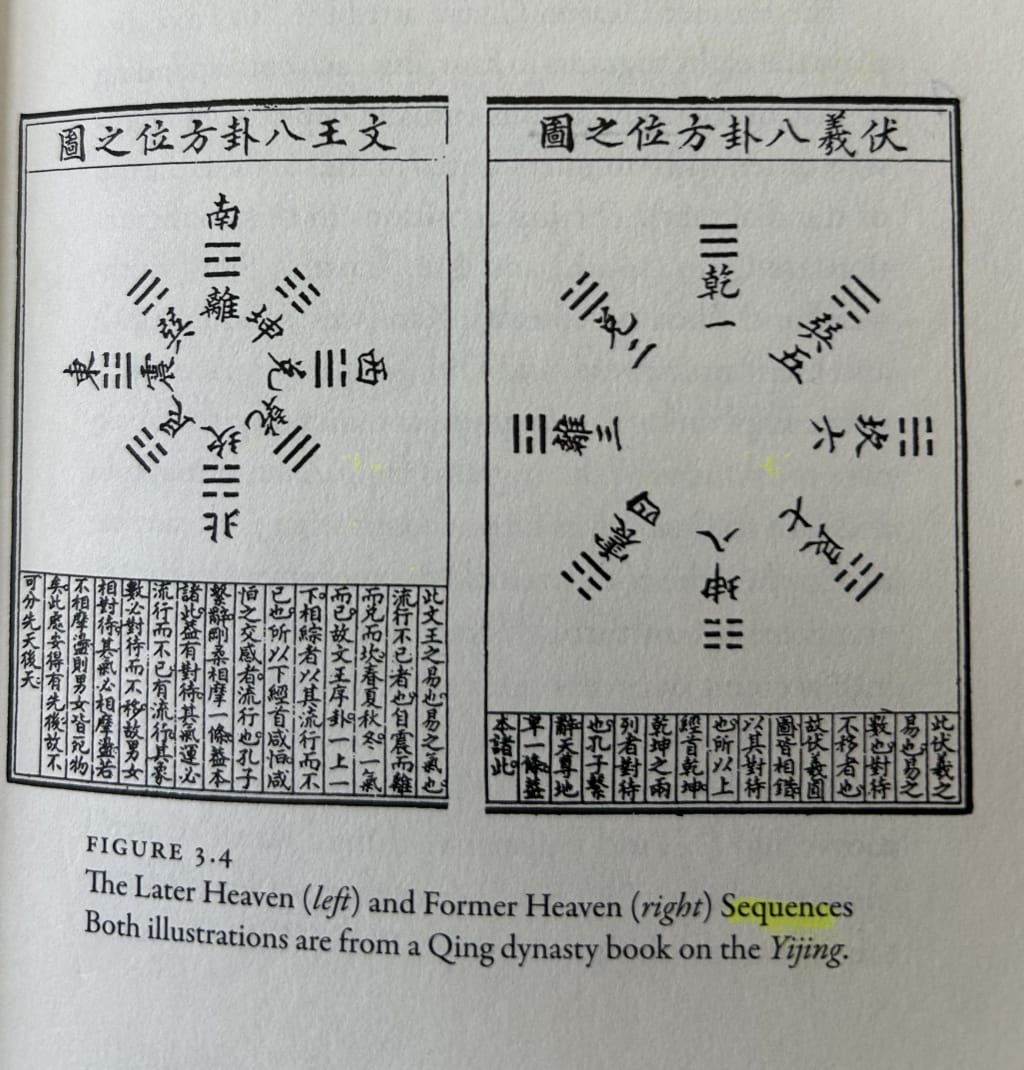
In traditional Chinese Feng Shui, no such classification exists. What this author calls "Yin Pa Kua" is formally known as the "Former Heaven Chart" (先天八卦图), while "Yang Pa Kua" refers to the "Later Heaven Chart" (后天八卦图). There are multiple translations of these chart names; I have chosen the one used in The I Ching: A Biography by American sinologist Richard J. Smith.
The terms "Former Heaven" (先天, xiantian) and "Later Heaven" (后天, houtian) are classical Chinese philosophical concepts with no exact English equivalents. To illustrate with a simple analogy: before birth, a baby exists in the "Former Heaven" state; after birth, the baby enters the "Later Heaven" state.
The "Former Heaven Chart" represents the state of the universe before human existence, while the "Later Heaven Chart" represents a spatiotemporal system centered on human activity.
From a philosophical perspective, "Yin" and "Yang" can only describe two things that exist on the same level and are interdependent, inseparable, yet opposite. Since "Former Heaven" and "Later Heaven" exist on different levels, they cannot be classified as Yin and Yang. The two Bagua diagrams should not be defined in these terms.
The Role of the Later Heaven Chart in Feng Shui
The claim that the "Yin Bagua" (Former Heaven Chart) is used for Yin dwellings and the "Yang Bagua" (Later Heaven Chart) for Yang dwellings is entirely incorrect. In Feng Shui, whether determining the orientation of a Yin dwelling (grave) or a Yang dwelling (house), only the Later Heaven Chart is used.
A classic example of this can be found in the Book of Burial (葬书) by the Jin Dynasty (317–420) Feng Shui grandmaster Guo Pu (郭璞), where the Bagua diagram used for site selection is the Later Heaven Chart. The book's title itself indicates that it is a guide to Feng Shui for Yin dwellings.
Furthermore, what this author refers to as the "Yin Bagua" - the Former Heaven Chart - did not even appear until the Song Dynasty (960–1276). If her claim were true, what diagram was used for Yin dwellings before the Song Dynasty?
This is just one of many erroneous ideas found in Western Feng Shui books. Unfortunately, readers often passively absorb incorrect information. The sad reality is that many theories circulating online and in books today are filled with errors.
Fortunately, the classification of "Yin Bagua" and "Yang Bagua" is a basic concept and does not impact real Feng Shui practice. It does not interfere with Feng Shui judgment or affect its results. However, some mistaken concepts in Western Feng Shui books can lead to entirely incorrect Feng Shui assessments, resulting in flawed outcomes.
I will discuss this further in the future.
Coming Up Next
In the next post, we will explore one of the few accurate concepts found in Western Feng Shui schools - the "Three Harmonies" rule - and examine how it relates to the Chinese zodiac.
About the Creator
Lidong Yu
I am a Chinese Feng Shui consultant and educator, raised and trained in China. My work draws on classical Feng Shui traditions to help people better understand the relationship between themselves, their environments, and time through Qi.
Why Workplace Safety Is Quietly Becoming a Business Survival Factor in Abu Dhabi’s Industrial Sector
Something has changed in how industrial projects are awarded in Abu Dhabi. It is not always written clearly in tender documents. But companies feel it during vendor reviews, site audits, and client meetings. Workplace safety is now being treated as a signal of how stable and reliable a company really is.
By Umar Quality Jounal4 days ago in Education
from death into life
Young Aldin of Wiloh had never contemplated death. It was almost strange — so many around him had the tendency to obsess over it, to clamor and claw almost desperately at their own perceptions of the end to know death as much as they could: when it would come, why it would come, where it would take them when it did.
By angela hepworth7 days ago in Fiction




Comments
There are no comments for this story
Be the first to respond and start the conversation.