
The Multiverse Hypothesis
Are we living in one of infinite realities?
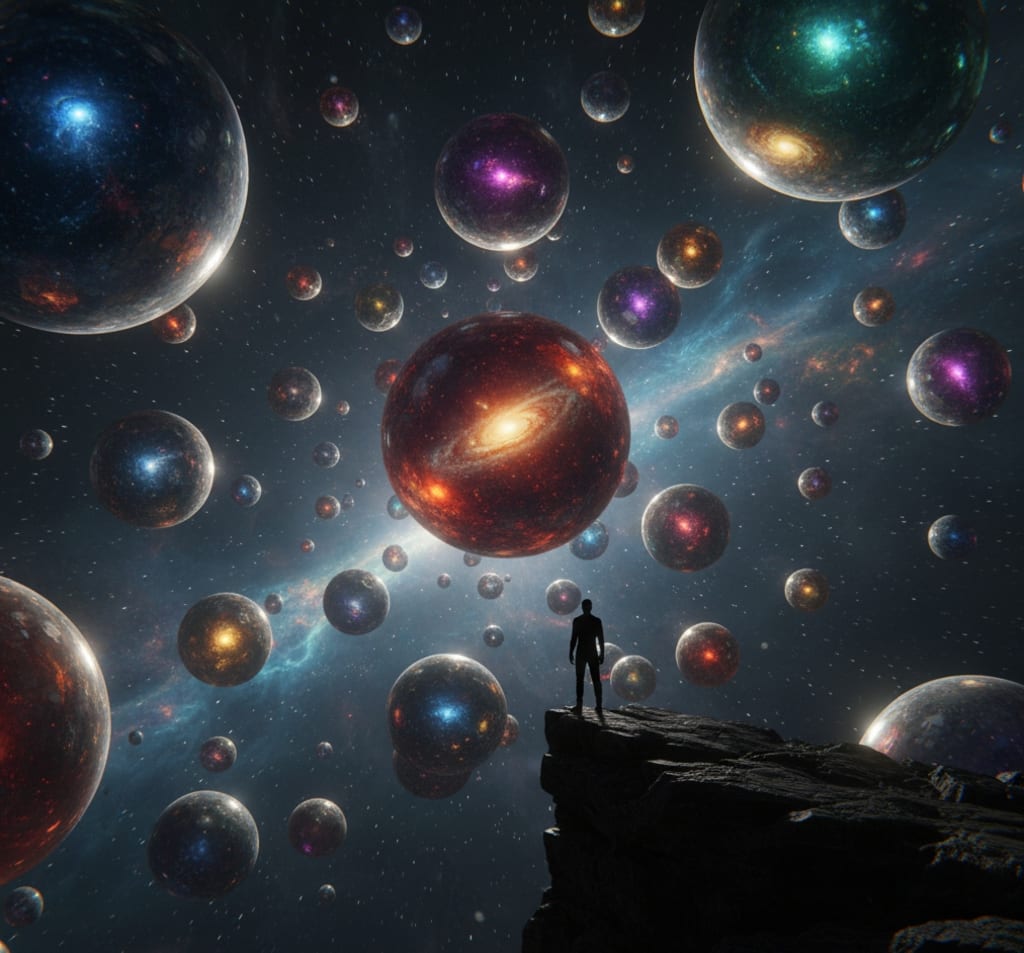
The Multiverse Hypothesis: Are We Living in One of Infinite Realities?
For centuries, humanity has looked up at the stars and wondered whether we are alone in the universe. But modern science has taken that curiosity to an entirely new level. Instead of asking whether life exists beyond Earth, physicists are now asking whether entire realities beyond our universe could exist. This idea, known as the Multiverse Hypothesis, suggests that our universe may be just one of countless others—each with its own laws of physics, histories, and even versions of ourselves.
What Is the Multiverse Hypothesis?
The multiverse is the concept that our universe is not unique but part of a much larger cosmic network of universes. These universes might exist in parallel, side by side, or even in dimensions beyond our perception. While the idea sounds like science fiction, it is rooted in real scientific theories that attempt to explain some of the biggest mysteries in physics and cosmology.
One of the most popular explanations comes from the inflation theory of the early universe. According to this model, space expanded at an unimaginable speed after the Big Bang. This rapid expansion may have created multiple “bubble universes,” each evolving independently with its own set of physical constants. In other words, the very laws that govern our reality—like gravity, time, and matter—could be entirely different in another universe.
Evidence and Scientific Backing
Skeptics argue that the multiverse is unprovable, but there are scientific reasons to take the idea seriously. For example, the cosmic microwave background radiation—the afterglow of the Big Bang—shows strange patterns that some scientists suggest could be scars from collisions with other universes.
Quantum mechanics also hints at a multiverse through the many-worlds interpretation. In quantum physics, particles can exist in multiple states at once until they are observed. Some physicists argue that instead of collapsing into one outcome, every possibility actually happens—but in separate universes. That would mean every decision we make splits reality into different branches, creating infinite versions of our lives.
Philosophical and Existential Questions
If the multiverse is real, it raises profound questions about identity, choice, and destiny. Could there be another version of you reading this article in a slightly different way? Is there a universe where you made different life decisions, leading to a completely different outcome?
The hypothesis also touches on the age-old question of why our universe seems so perfectly suited for life. This is known as the fine-tuning problem. The multiverse offers one possible answer: if there are infinite universes, it is not surprising that at least one—ours—has the right conditions for life.
Critics and Challenges
Despite its appeal, the multiverse hypothesis is controversial. Critics argue that without direct evidence, it remains more of a philosophical idea than a scientific one. After all, how can we study or measure other universes if we cannot even detect them? Some scientists worry that embracing the multiverse could push physics into the realm of speculation, where theories cannot be tested or disproven.
Why the Multiverse Matters
Even if the multiverse cannot be proven, exploring the idea pushes the boundaries of science and philosophy. It challenges us to rethink the meaning of reality and our place within it. The hypothesis also fuels technological and theoretical advancements, as scientists strive to test the limits of physics, quantum theory, and cosmology.
Conclusion
The multiverse hypothesis may never be confirmed, but its power lies in expanding our imagination and curiosity. Whether or not infinite realities exist, the very possibility opens doors to new ways of thinking about life, existence, and the universe itself. We may be living in just one small corner of an endless cosmic ocean—or perhaps, the only universe there is. Either way, the search for answers continues, and with it, humanity’s eternal quest to understand the unknown.
About the Creator
Keep reading
More stories from Muhammad Shahram and writers in Education and other communities.
Black Holes
Black Holes: Portals, Powerhouses, or Cosmic Traps? Few celestial objects capture the imagination quite like black holes. These mysterious giants of the universe are often portrayed in movies and science fiction as gateways to other worlds, cosmic monsters devouring everything in their path, or even sources of unimaginable energy. But what exactly are black holes? Are they portals, powerhouses, or inescapable traps? The truth, as science reveals, is both fascinating and far stranger than fiction.
By Muhammad Shahram4 months ago in Education
Could Dark Matter Interact With Itself?
What Is Dark Matter? Dark matter is a form of matter that does not emit, absorb, or reflect light. Because it is invisible, astronomers cannot observe it directly through telescopes. Its presence is inferred from its gravitational influence on visible matter.
By shahkar jalal7 days ago in Education


Comments
There are no comments for this story
Be the first to respond and start the conversation.