
The Rise of Private Universities: A Hidden Growth Driver in the German Education Market
Private universities are capturing the international market by bypassing language barriers and offering seamless English-taught curriculums.

Germany has long stood as the global poster child for accessible higher education. For decades, the country has prided itself on a state-funded public university system that charges virtually zero tuition. However, a quiet yet powerful revolution is currently reshaping this academic landscape. Private universities are no longer just a niche alternative for the wealthy elite; they have evolved into a critical growth engine for the entire sector.
According to authoritative market analysis, the German higher education market stands on the precipice of a massive expansion. The market size, valued at USD 1.27 billion in 2024, is projected to skyrocket to USD 6.28 billion by 2033. This staggering growth, driven by a Compound Annual Growth Rate (CAGR) of 19.40%, signals a fundamental shift in how education is delivered, consumed, and valued in Europe’s largest economy.
While public institutions often struggle with overcrowding and bureaucratic inertia, private players are capitalizing on the demand for digitalization, specialized services, and English-taught programs. This article explores why private universities are the hidden drivers behind these impressive numbers and what this means for students, investors, and the future of learning in Germany.
Why is the German Higher Education Market Projecting 19.4% Growth?
The market is expanding rapidly due to a massive technological overhaul and a widening gap between public supply and student demand.
To understand the aggressive 19.40% CAGR forecast by IMARC Group, we must look beyond simple enrollment numbers. The market growth is heavily influenced by the "Component" segmentation, specifically Solutions and Services.
For decades, German higher education relied on analog processes. Today, private universities lead the charge in adopting Student Information Systems (SIS), advanced Campus Management software, and Performance Management tools. Unlike the slow-moving procurement processes of state institutions, private entities remain agile. They rapidly deploy Cloud-based solutions - a key segment identified in the market analysis - to offer hybrid learning environments that appeal to the modern, digital-native student.
Furthermore, revenue generation extends beyond tuition fees. It flows from the comprehensive ecosystem these universities build. This includes premium career counseling services, distinct "Services" segment growth, and partnerships with EdTech firms. Consequently, this commercialization of education infrastructure propels the market toward that USD 6.28 billion valuation.
What Is Driving the Sudden Shift Toward Private Institutions?
Students are increasingly trading tuition fees for guaranteed entry, smaller class sizes, and a service-oriented educational experience.
Twenty years ago, private universities in Germany were a rarity. Today, enrollment in these institutions has seen a tenfold increase, with recent estimates suggesting over 370,000 students have chosen the private route. What drives this exodus from the free public system?
The primary driver is the infamous Numerus Clausus (NC) - the strict grade point average required to enter popular programs like Psychology, Medicine, or Business at public universities. For many capable students who missed the 1.0 or 1.3 GPA cutoff, the door to a public university remains firmly shut. Private universities have stepped in to fix this market inefficiency.
By offering a holistic admission process that values motivation and interviews over raw grades, they capture a massive segment of the student population. Moreover, the "End User" segmentation shows a distinct preference among these students for the Service model. They view themselves as customers. They expect and receive small seminar groups of 20 rather than lecture halls of 800. This ensures they do not get lost in the system.
How Are International Students Fueling the Private Sector?
Private universities are capturing the international market by bypassing language barriers and offering seamless English-taught curriculums.
Germany recently hit a record high of over 402,000 international students, solidifying its place as a top global study destination alongside the US and UK. However, the traditional public university system remains a fortress of the German language (typically requiring C1 level proficiency), which deters many talented applicants from India, China, and the United States.
Private universities have identified this gap and filled it aggressively. They account for a disproportionately large share of English-taught programs in Business, Data Science, and Engineering.
This strategy aligns perfectly with the market's "Higher Education Institutions" segmentation. By removing the language barrier and offering "relocation services" (a key value-add service), private schools make it easy for international talent to enter the German labor market. For an expat student, paying tuition often represents a calculated investment. It allows them to bypass the years required to master the German language before even starting a degree.
Public vs. Private Universities: Which Offers the Better Study Experience?
The choice depends entirely on the student's priorities: budget and independence versus efficiency and networking.
To help you evaluate the landscape, we have compiled a comparison based on the latest market data and student feedback.
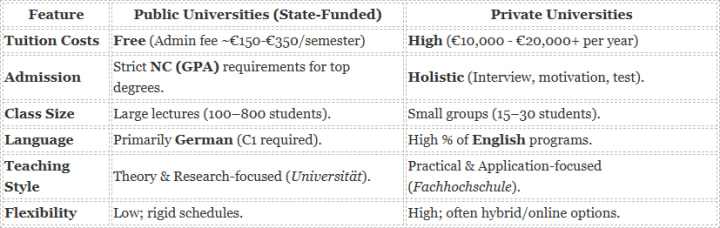
This table highlights the fundamental trade-off. Public universities offer prestige and low cost but demand high independence. In contrast, private institutions charge a premium for a streamlined, supportive environment.
Does the "Employability First" Approach Justify the High Costs?
Yes, specifically for students seeking direct corporate placement, as private universities prioritize industry partnerships over theoretical research.
Public universities in Germany, particularly the traditional Universitäten, focus heavily on Wissenschaft (academic knowledge). While this excels for future researchers, it can leave job-seekers feeling unprepared for the corporate world.
Private institutions, often accredited as Fachhochschulen (Universities of Applied Sciences), market themselves as career accelerators. They integrate mandatory internships, "soft skills" training, and networking events into the curriculum. Many offer "Dual Studies" (Duales Studium), where students work and study simultaneously, often with tuition covered by a partner company.
Referring back to the IMARC market forecast, the growth in the Services segment is partly due to this career support. Private colleges invest heavily in alumni networks and corporate liaisons. For a student aiming for a management role at a mid-sized German company (Mittelstand), the ROI of a private degree can be substantial if it grants direct access to hiring managers, bypassing the cold-application process.
What Does the Future Hold for the German Education Market?
We are moving toward a hybrid model where private competition forces public digitization, driving the total market value upward.
The projection of a USD 6.28 billion market by 2033 is not just about more private universities opening; it concerns the modernization of the entire sector. The "Deployment" segmentation in the market analysis highlights a clear shift toward Cloud technologies.
As private universities set the standard for digital campuses where students can access lectures, grades, and admin services via an app, public universities will be forced to catch up. This competition is healthy. It drives investment in EdTech, infrastructure, and educational software across the board.
Consequently, the "hidden" growth driver is not just the private schools themselves, but the pressure they apply to the entire German education ecosystem to innovate. The 19.40% growth rate reflects a system in transition, moving from analog tradition to a digital, service-oriented future.
Frequently Asked Questions
Are private university degrees valid in Germany?
Yes, absolutely. Provided the university is state-recognized (staatlich anerkannt) and the program is accredited by the German Accreditation Council (Akkreditierungsrat), the degree is legally equivalent to one from a public university. Employers generally respect these degrees, especially from established institutions.
How much do private universities cost in Germany?
Costs vary significantly but generally range between €500 and €1,500 per month. Bachelor’s programs can cost between €10,000 and €15,000 per year, while specialized MBA programs may charge upwards of €30,000 in total. However, many students offset this with tax deductions and flexible payment plans.
Is it easier to get a job with a private university degree?
Not necessarily "easier," but often faster. Private universities often have dedicated career centers and partner companies, which can streamline the networking process. However, German employers value skills highly, so a degree from a prestigious public university remains highly respected.
Can I study in English at a private university?
Yes. This is one of the biggest selling points. While public universities conduct most bachelor's programs in German, private universities offer a vast array of 100% English-taught degrees to attract international talent.
About the Creator
Joey Moore
I'm Joey Moore, a seasoned Research Analyst with 5+ years of experience in market research. Expert in data analysis, strategic planning, and industry insights. Proven track record in delivering actionable reports.
Keep reading
More stories from Joey Moore and writers in Education and other communities.
From Virtual Visits to AI How Telehealth Is Changing European Healthcare?
Telehealth is changing European healthcare faster than anyone predicted. Initially, during the global pandemic, patients simply used video calls to speak with doctors safely. However, the landscape has shifted dramatically since then. Now, Artificial Intelligence (AI) drives a new era of proactive medicine, moving beyond simple screen-to-screen communication. This evolution transforms how providers across Europe deliver care, ensuring efficiency and precision.
By Joey Moore2 months ago in Education
How to Avoid Scams in Online Transcription Work
The growing popularity of remote work has made online transcription an attractive option for people who want to earn income from home. With flexible schedules and low entry barriers, transcription work appeals to students, freelancers, stay-at-home parents, and professionals looking for additional income. However, the increasing demand for transcription services has also created opportunities for scammers who target beginners unfamiliar with how legitimate transcription jobs operate. Understanding how to recognize and avoid scams is essential for building a safe and sustainable transcription career.
By Mahesh Kumara day ago in Education
Sudden Radio Interference During Live Events
There is a specific kind of silence that only event professionals know. It’s not the silence of a quiet room. It’s the silence that happens when a microphone drops out in the middle of a wedding vow, a keynote speech, or a live broadcast.
By Elvezio Guarinoa day ago in Education
Draft Deleting? Don't Do It!
Today, I had a little time. I decided that I would have a look at the drafts that I have on Vocal. This is part of a long-term wish to have everything I've written on paper rather than virtually. I've not looked at them for weeks and something drew me to them, just to browse and see what was there.
By Rachel Deeming4 days ago in Writers




Comments
There are no comments for this story
Be the first to respond and start the conversation.