
Want to Prepare Your Data for Agentic AI in Minutes? Here’s How
Data for Agentic AI in Minutes

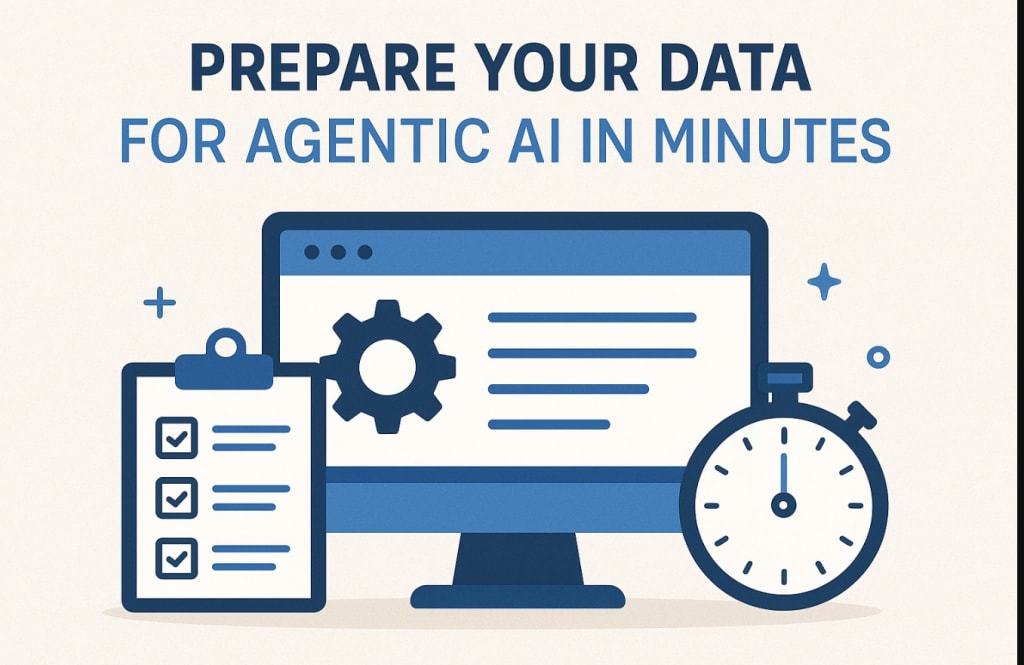
AI is advancing at an even quicker rate than the majority of organisations can adjust to it, and Agentic AI is rapidly growing to be the second significant progress in automation. In contrast to old-fashioned analytics, machine learning, or even generative AI, which learn, forecast, or take action on your behalf to achieve goals with minimal instructions.
Things are, however, more complicated. Gartner predicts that by 2027, more than 40% of agentic AI initiatives will have been terminated because of increasing costs, ambiguous business value, or inadequate risk management. In their recent survey of 3,412 enterprise professionals, it is clear how young the market still is: 19% have already made major investments, 42% are taking tentative steps, 8% are yet to take the first step, and 31% turn out to be uncertain or adopt a wait-and-see attitude.
It is not the technology, but the data behind it that is the challenge. And in this blog, we break down, quickly and practically, how to get data for Agentic AI ready in just a couple of minutes.
What is the Difference with Agentic AI?
Systems that are intended to think and act independently are called agentic AI. These are not mere chatbots or recommendation engines. They act as more of functional partners that:
● Understand objectives
● Plan their own steps
● Navigate uncertainty
● Interact with environments
● Learn from outcomes
Imagine AI agents that automatically schedule meetings, real-time optimisation of supply chains, or automatically check compliance in complex workflows. This requires them to have a particular form of data, which is not simply structured into insights, but on intent, behaviour, and consequence.
The Five Data Building Blocks Agentic AI Needs.
The agentic systems require the multi-dimensional perception of the world, as is the case with human beings.
Here are the core components:
1. Goal-Oriented Data
The AI agent must have an idea of what it is optimising and why.
This means defining:
● Objectives
● Success metrics
● Constraints
● User preferences
● Operational rules
2. Environment-Level Context
Agents do not act in vacuums and therefore require a model of the world around them.
This includes:
● States (what’s happening now)
● Practical activities (what is possible to do).
● Consequences (what occurs following an action)
3. Sequential and Temporal Data.
The agentic AI heavily depends on the knowledge of sequences:
● Activity logs
● Clickstreams
● Sensor timelines
● Workforce processes
● User journeys
4. Real-Time and Dynamic Data
Because the agents do not have occasional actions, but constant ones, they require:
● Live updates
● Continuous data pipelines
● Event-driven triggers
5. Feedback Data
This could be the most significant one. Feedback is the linkage of action and outcome:
● Did the agent succeed?
● Was it an improvement or a deterioration of performance?
● What should it do differently next time?
The Reason Why Data Preparation for Agentic AI is More Demanding.
Although the configuration might seem analogous to the classical AI, three distinctive issues predetermine agentic AI with respect to its data:
1. The Need for Deep Context
The environment, rules, dependencies, and relationships should be interpreted by agents.
This needs context modelling as opposed to point modelling.
For example:
● The decisions in the supply chain are determined by the market trends.
● Approval workflow is determined by user roles.
● Some policies affect process flow.
2. Exploration vs Exploitation
The agents should not only learn through the safest or most common examples, but they should also learn through exploration.
In this way, the dataset must consist of:
● Edge cases
● Missed opportunities
● Failed outcomes
● Rare scenarios
3. Sparse or Delayed Rewards
When expressed in the real world, results can appear later:
● Satisfaction of customers happens months later.
● Inventory choices influence quarterly performances.
● Risk decisions do not show any effect until they happen.
How to Clean Your Data in 2 Minutes.
In a hurry? The following checklist is simple and can be implemented quickly:
Step 1: Define the Agent’s Goals
Document a wanted result, the non-negotiables, and success measures.
Step 2: Workflow or Environment Map
● Identify:
● States
● Actions
● Processes
● Dependencies
Even a flowchart comes in handy.
Step 3: Time-Series Logs Organisation
Make sure that your systems record sequences or history - not snapshots.
Step 4: Enable Real-Time Feeds
This may be APIs, event streams, alerts, or operational dashboards.
Step 5: Capture Feedback
Link actions to outcomes wherever they can be, even in a manual mode of start.
Conclusion
Traditional AI won’t be replaced by agentic AI; agentic systems will build on top of it, powering the next wave of automation, planning, and intelligent decision-making. Organizations that get their data in order today will be the ones leading this shift.
To achieve truly independent and intelligent AI systems, the foundation must be strong.
And that foundation is data, the place where long-term value and meaningful transformation begin.
FAQ
What tools or platforms are commonly used to prepare data for Agentic AI?
You don’t need heavy tools, just the right ones. Kafka, Airflow, Snowflake, or cloud services like AWS, Azure, and GCP help you manage real-time data and feedback so Agentic AI works smoothly.
How can data science certifications help in preparing data for Agentic AI?
Certifications like USDSI®’s CDSP™, Columbia’s Data Science Certificate, and Cornell’s eCornell program build skills in data cleaning and real-time pipelines, helping you prepare the structured data Agentic AI depends on.
How can simulation and synthetic data help prepare data for Agentic AI?
Using simulation or synthetic data, rare events and edge cases can be modeled in minutes, allowing Agentic AI to learn, test decisions, and adapt safely without waiting for real-world occurrences.
About the Creator
Pradip Mohapatra
Pradip Mohapatra is a professional writer, a blogger who writes for a variety of online publications. he is also an acclaimed blogger outreach expert and content marketer.
Keep reading
More stories from Pradip Mohapatra and writers in Education and other communities.
Must-Have Kali Linux Tools for Cybersecurity Specialists in 2026
Kali Linux is a popular platform among professionals working in ethical hacking and cybersecurity. With the global cybersecurity tools market estimated to rise to USD 208.05 billion in 2025 and potentially surpassing USD 450 billion by 2033 at a CAGR of 9.5%, the demand for efficient security tools has never been greater, as per Business Research Insights.
By Pradip Mohapatra3 months ago in Education
The Balanced Parent: Embracing Parenthood Without Losing Yourself
In today’s fast-paced society, the demands on parents have never been higher. From managing work deadlines to preparing meals and helping with homework, the modern parent juggles countless responsibilities daily. Amid all this, it’s easy to feel overwhelmed. Yet, being a hands-on parent is one of life’s most rewarding roles when approached with intention and heart.
By Alfonso Kennard6 days ago in Education



Comments
There are no comments for this story
Be the first to respond and start the conversation.