
What is a Straight Line in Mathematics?
A brief description on straight line
Introduction:
The concept of What is a straight line in Mathematics? is foundational. It is one of the simplest and most fundamental geometric shapes, yet its implications and applications are vast and profound. In this article I will try to explain into the concept of what is a Straight Line in Mathematics, exploring its definition, properties, equations, and significance in various mathematical contexts.
Explanation:
Definition of a Straight Line:
In geometry What is a Straight Line? is an infinite set of points which can be extended in both directions without any curvature. It has no thickness, no width, and no height; it is one-dimensional. The straight line is often considered the shortest distance between two points, a concept that is both intuitive and mathematically rigorous.
Historical Perspective:
The study of straight lines dates back to ancient civilizations. Euclid, a Greek mathematician, provided a systematic study of geometry in his work "Elements," where he defined a straight line as "a line which lies evenly with the points on itself." This definition, though simple, encapsulates the essence of straightness—consistency and uniformity in direction.
Basic Properties of a Straight Line:
1. Linearity
A straight line is characterized by its linearity, meaning it does not curve or bend. This property can be observed by plotting the line on a Cartesian plane, where it appears as a continuous line extending infinitely in both directions.
2. Infinite Length:
A straight line can be extended infinitely in both directions. This infinite nature is a key property that distinguishes lines from line segments, which have defined endpoints, and rays, which extend infinitely in only one direction.
3. No Thickness:
A straight line is one-dimensional. It has no thickness or width, making it an idealized geometric object. In practical terms, when we draw a line on paper, it will have some thickness, but mathematically, a line is considered to have zero width.
Equations of a Straight Line:
The representation of straight lines using equations allows for a precise mathematical description. There are several forms of the equation of a straight line, each with its own advantages depending on the context.
a. Slope-Intercept Form:
The slope-intercept form is one of the most commonly used equations of a straight line. It is given by:
y= mx+c
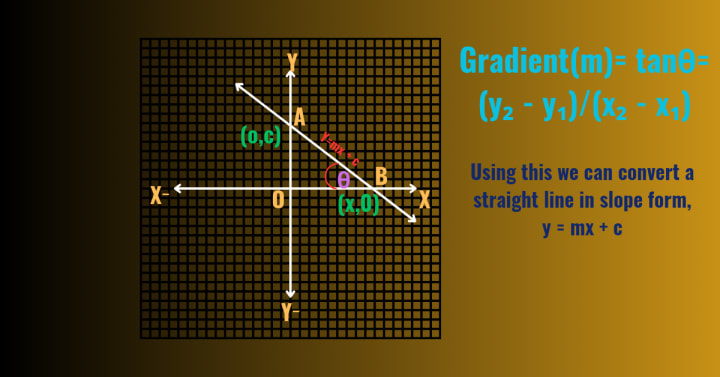
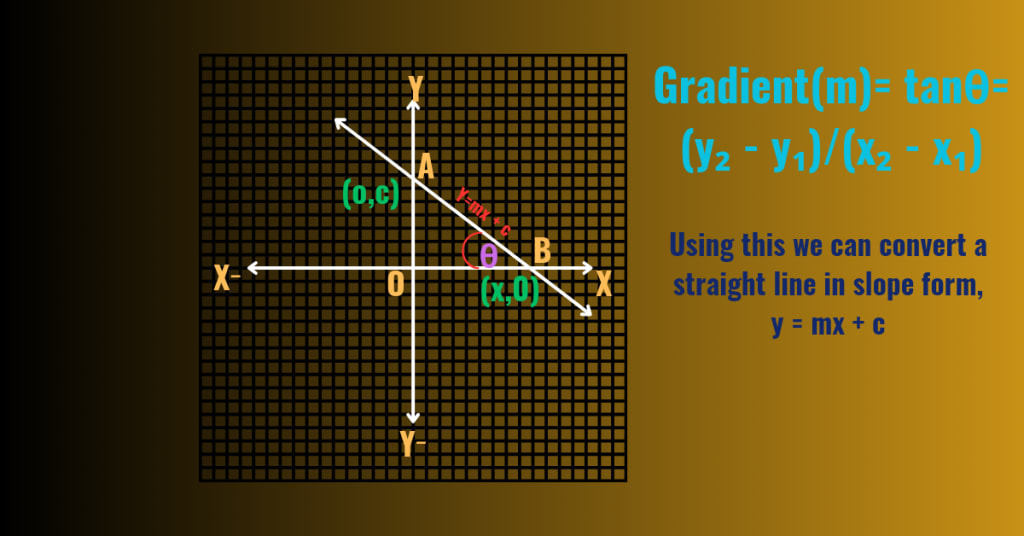
where m represents the slope or gradient of the line, Again m can be expressed as,
m = tanθ = (y₂ - y₁) / ( x₂- x₁),where θ = Inclination of the straight line,and(x₁,y₁), (x₂,y₂) are two points passes through the straight line.
and c represents the y-intercept. The slope m measures the steepness of the line, defined as the ratio of the rise (change in y) to the run (change in x). The y-intercept c is the point where the line crosses the y-axis.
For example, if we have the equation y = 2x+3, the slope(m) is 2, and the y-intercept(c) is 3. This means the line rises 2 units for every 1 unit it moves to the right, and it crosses the y-axis at the point (0, 3).
Some Problems related on Slope Intercept form of Straight line:
Question(1): The y-intercept and slope of a line is 5 and -1 respectively.Find the equation of the line.
Solution: y-intercept(c) = 5
Slope of the line (m) = - 1
∴ Equation of the line,
y = mx + c
=> y = (-1)x + 5
=> y = - x + 5
=> x + y = 5
Question(2): If (2,3) and (-1,1) points lie on a straight line, find the slope of the line.
Solution: ∵ x₁ = 2, y₁ = 3
x₂ = -1, y₂ = 1
∴ Slope of the line (m) = ( y₂ - y₁) /( x₂ - x₁)
= (1 - 3) /(-1 - 2)[putting values]
= - 2/ -3
= ⅔
b. Point-Slope Form:
The point-slope form is useful when we know a point on the line and its slope. It is given by:
y−y₁= m (x - x₁)
where (x₁,y₁) is a known point on the line, and m is the slope of the line.
For instance, if we know a line passes through the point (2, 3) with a slope of 4, the equation is:
y−3=4(x−2)
This can be simplified to the slope-intercept form if needed.
c. Standard Form:
The standard form of the equation of a linear straight line is:
Ax+By=C
where A, B, and C are constants. This form is particularly useful in solving systems of linear equations and in integer arithmetic.
For example, the equation 3x+4y=12
represents a straight line. We can convert this to the slope-intercept form to find the slope and y-intercept:
As we have,
3x+4y=12
=> 4y = - 3x + 12
=> y = - ¾ x + 12/4
=> y = - ¾ x + 3
So, the slope of the straight line is −3/4 and the y-intercept is 3.
Some Problems related on Straight line:
Question(a):Find the slope and y-intercept of the given line, - x + 10 = 5y
Solution: ∵ - x + 10 = 5y
=> y = - x /5 +10/5
=> y = - ⅕ x + 2
now comparing the above equation with y = mx + c
we get,
Slope (m) = - ⅕
and y-intercept (c) = 2
Question(b):Gradient of a line is 2 and passes through the point (-3,1),find the equation of the straight line.
Solution: ∵ Gradient of the line(m) = 2
point = (-3,1)
∴ Equation of the straight line,
y - y₁ = m(x - x₁)
=> y - 1 = 2{x - (-3)} [putting values]
=> y - 1 = 2 ( x + 3)
=> y - 1 = 2x + 6
=> - 2x + y -1- 6 = 0
=> - 2x + y - 7 = 0, which is the required equation of the straight line.
Question(c): The gradient of a straight line is -1 and y-intercept is 3, find the equation of the straight line.
Answer: Gradient (m) = - 1
y-intercept (c) = 3
∴ Equation of the straight line will be,
y = mx + c
=> y = (- 1)x + 3 [ putting value]
=> y = - x + 3
Graphical Representation:
Graphing a straight line involves plotting points that satisfy the line's equation and connecting them with a continuous line. The graphical representation provides a visual understanding of the line's behavior and properties.
1. Plotting Points:
To graph a line, we can start by choosing values for x and calculating the corresponding y values using the line's equation. Plotting these points on a Cartesian plane and connecting them gives us the line.
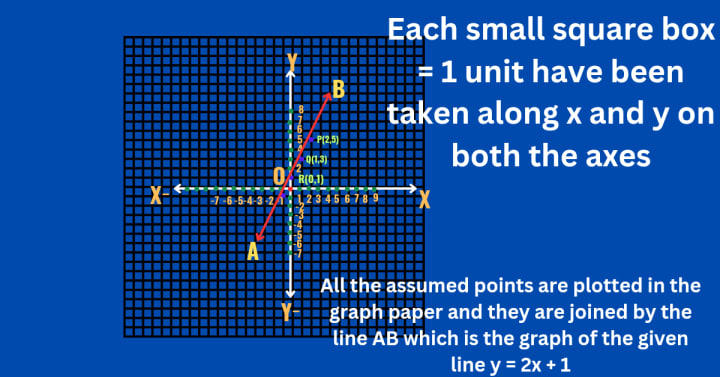
For example, for the line y=2x+1,
we can choose x values such as -1, 0, 1, and 2, and find the corresponding y values:
When x=−1,then from above equation we get, y=2(−1)+1 = - 2 + 1 =−1
When x=0,then from above equation we get, y=2(0)+1= 0 + 1 =1
When x=1,then from above equation we get, y=2(1)+1 = 2 + 1 =3
When x=2,then from above equation we get, y=2(2)+1= 4 + 1 =5
Plotting these points and connecting them gives us the graph of the line.
2. Using Intercepts:
Another method is to use the x-intercept and y-intercept. The x-intercept is the point where the line crosses the x-axis, and the y-intercept is the point where the line crosses the y-axis.
The Intercept form of a straight line is ,
x/a + y/b = 1,
where, a = x-intercept
b = y-intercept
For example,Find x and y intercept of the line 3x+4y=12
Solution:To find the x-intercept,we will take y=0
now the equation will become
3x+4(0)=12
=>3x + 0 = 12
=>3x =12
=>x= 12/3
=>x = 4
So, the x-intercept is 4
To find the y-intercept,we will take x=0,now the equation will become,
3(0)+4y=12
=>0 + 4y = 12
=>4y=12
=>y=12/4
=>y = 3
So, the y-intercept is 3
The above sum can be done in another way also,
∵ 3x+4y=12
=> 3x /12 + 4y / 12 = 12 / 12 [dividing bothsides by 12]
=> x/4 + y/3 =1 [Converting the given equation similar to x/a + y/b = 1]
∴ The x-intercept is 4
and the y-intercept is 3
Plotting these intercepts and connecting them gives us the graph of the line.
Some Problems related on Intercept of straight line:
Question(A):The x-intercept and y-intercept of a straight line are 2 and 3 respectively,find the equation of the straight line.
Solution: x-intercept(a) = 2
y-intercept(b) = 3
As we know that intercept form of a straight line is,
x / a + y / b = 1
=> x / 2 + y / 3 = 1 [putting values]
=> 6(x / 2 + y / 3) = 1X 6 [ As L.C.M of 2 and 3 is 6,so multiplying bothsides by 6]
=> 3x + 2y = 6, which is the required equation of the straight line.
Question(B): Find x-intercept and y-intercept of the given straight line, 3x - y = 12
Solution: ∵ 3x - y = 12
=> 3x /12 - y/12 = 12/12
=> x / 4 + y / (-12) = 1
Now comparing the above equation with x/a + y/b = 1 we get,
x-intercept(a) = 4
and y-intercept(b) = -12
Slope of a Straight Line:
The slope of a straight line is a measure of its steepness and direction. It is a crucial concept in understanding the behavior of lines.
1. Definition of Slope:
The slope m of a line passing through two points (x₁,y₁) and (x₂,y₂) is given by:
m=(y₂- y₁) / (x₂- x₁)
This formula calculates the rate of change of y with respect to x.
2. Positive and Negative Slope:
A positive slope indicates that the line rises as x increases. For example, the line y=2x+1 has a positive slope of 2, meaning it rises 2 units for every 1 unit it moves to the right.
A negative slope indicates that the line falls as x increases. For example, the line y=−3x+4 has a negative slope of -3, meaning it falls 3 units for every 1 unit it moves to the right.
3. Zero and Undefined Slope:
A zero slope indicates a horizontal line, where y remains constant regardless of x. For example, the line y=5 is horizontal.
An undefined slope indicates a vertical line, where x remains constant regardless of y. For example, the line x=2 is vertical.
Parallel and Perpendicular Lines:
Now, we will understand the relationships between lines involve in studying parallel and perpendicular lines.
1. Parallel Lines:
Two lines are parallel if they have the same slope but different y-intercepts. Parallel lines never intersect.
For example, the lines y=2x+1 and y=2x−3 are parallel because they both have a slope of 2.
Some Problems on Parallel Lines:
Question(x): Find a straight line which is parallel to the line 2x + 3y = - 1 and passes through the point (- 2, - 1)
Solution: 2x + 3y = - 1
=> 3y = - 2x - 1
=> y = - ⅔ x - ⅓ [dividing both sides by 3]
∴ gradient of the line (m₁) = - ⅔
∵ we will find a line which is parallel to the above line, then
m₂ = m₁ [ Let, m₂ is the gradient of the line which we will find]
=> m₂ = - ⅔
Now, we will find the line which passes through the point (-2,-1) and has gradient - ⅔ also parallel to 2x + 3y = - 1
∴ Required straight line will be,
y - y₁ = m (x - x₁)
=> y - (-1) = - ⅔ [x - (-2)]
=> y + 1 = - ⅔ ( x + 2)
=> 3(y + 1) = - 2 ( x + 2)
=> 3y + 3 = - 2x - 4
=> 2x + 3y + 3 + 4 = 0
=> 2x + 3y + 7 = 0
Question(y):Find the equation of straight lines which is parallel to x - 2y + 5 = 0 and at unit distance from the point (- 2, 2)
Solution: Let, the line parallel to x - 2y + 5 = 0 is x - 2y + c = 0
Now, the distance of the above line from the point = (Ax₁+ By₁+c) / ±√(A² + B²)
= [1(-2) +(-2)2 +c] / √(1)² +(-2)² [ Here,A = 1,B = - 2, x₁ = - 2 and y₁= 2]
= (- 2 - 4 + c) /±√1 +4
= (- 6 + c) /±√5
Now, according to question,
(- 6 + c) /±√5 = 1
=> - 6 + c = ±√5
=> c = 6 ±√5
∴ Required straight lines will be,
x - 2y + 6 +√5 = 0 [ putting value of c]
and x - 2y + 6 -√5 = 0 [ putting value of c]
2. Perpendicular Lines
Two lines are perpendicular if the product of their slopes is -1. This means the slopes are negative reciprocals of each other.
For example, if one line has a slope of ¾ then the slope of perpendicular line of it will be - 4/3
Some Problems on Perpendicular Lines:
Question(m): Find the equation of straight line which is perpendicular to the line 2x + 3y + 1 = 0 and passes through the point (2,1)
Solution: ∵ 2x + 3y + 1 = 0
=>3y = - 2x - 1
=> y = - ⅔ x - ⅓ [dividing both sides by 3]
∴ gradient of the line(m₁) = - ⅔
Let, the gradient of the line which is ⊥ to the given line = m₂
As, we know for two perpendicular lines,
m₁ X m₂ = -1
=> - ⅔ X m₂ = -1 [ putting value]
=> m₂ = 3/2
∴ Required equation of straight line will be
y - y₁ = m₂ ( x - x₁)
=> y - 1 = 3/2 ( x - 1)
=> 2y - 2 = 3x - 3
=> 3x - 2y - 3 +2 = 0
=> 3x - 2y - 1 = 0
Question(n): Check whether given pair of lines are perpendicular or parallel,
3x - y + 2 = 0
x + 3y -1 = 0
Solution : ∵ 3x - y + 2 = 0
=> y = 3x + 2
∴ Gradient of the line(m₁) = 3
Again, x + 3y -1 = 0
=> 3y = - x +1
=> y = - ⅓ x + ⅓ [dividing both sides by 3]
∴ Gradient of the line(m₂) = - ⅓
As, m₁ ≠ m₂
So, the given pair of lines are not parallel.
Again,
m₁ x m₂
= 3 x ( - ⅓)
= - 1
So, the given pair of lines are ⊥ to each other.
Applications of Straight Lines:
Straight lines have numerous applications in various fields, like geometry and algebra to physics and engineering.
1. Geometry:
In geometry, straight lines are used to define shapes, angles, and other geometric figures. They form the basis for understanding more complex geometric concepts.
2. Algebra:
In algebra, straight lines are used to represent linear equations and inequalities. They give a visual way to understand solutions to equations and systems of equations.
3. Calculus:
In calculus, straight lines are used to approximate curves through the concept of tangent lines. The slope of a tangent line to a curve at a point represents the instantaneous rate of change of the function at that point.
4. Physics:
In physics, straight lines are used to model motion and forces. For example, the motion of an object with constant velocity is represented by a straight line on a position-time graph.
About the Creator
Keep reading
More stories from champak jyoti and writers in Education and other communities.
what is momentum class 9
Introduction: Physics is a fundamental science that seeks to explain the natural phenomena of the universe. Among its many interesting concepts momentum is one of them, which is a principle that plays a crucial role in the study of motion and dynamics. Momentum is a key concept that bridges the understanding of both motion and the forces that affect it. In this article, I will discuss into the concept of momentum,particularly what is momentum class 9 providing a thorough explanation with examples, equations, and real-life applications.
By champak jyoti2 years ago in Education
Menu Boards for Cafés: Design Ideas and Benefits
I'll never forget the first time I walked into a local coffee shop that had just upgraded from their hand-written chalkboard to a sleek digital menu display. The difference was striking—not just visually, but in how quickly I could scan the menu, see vibrant images of specialty drinks, and notice the seasonal promotions rotating in the corner. That experience opened my eyes to how much menu presentation actually matters in café environments.
By Jerry Kane 4 days ago in Education
Budget Constraints and Developmental Harm
Timotheus Homas Abstract This article examines the tension between budgetary limitations and developmental protection in education law. Drawing on Timotheus Homas’ critique of fiscal justifications for exclusion, the paper argues that financial constraints cannot excuse predictable developmental harm. Integrating mental health and early childhood research, the article reframes budget decisions as legally consequential acts with long-term developmental implications.
By Emma Wegenastabout 4 hours ago in Education



Comments (1)
Thanks for the analysis