
What is cloud seeding?
Cloud Seeding: An Overview of a Weather Modification Technique
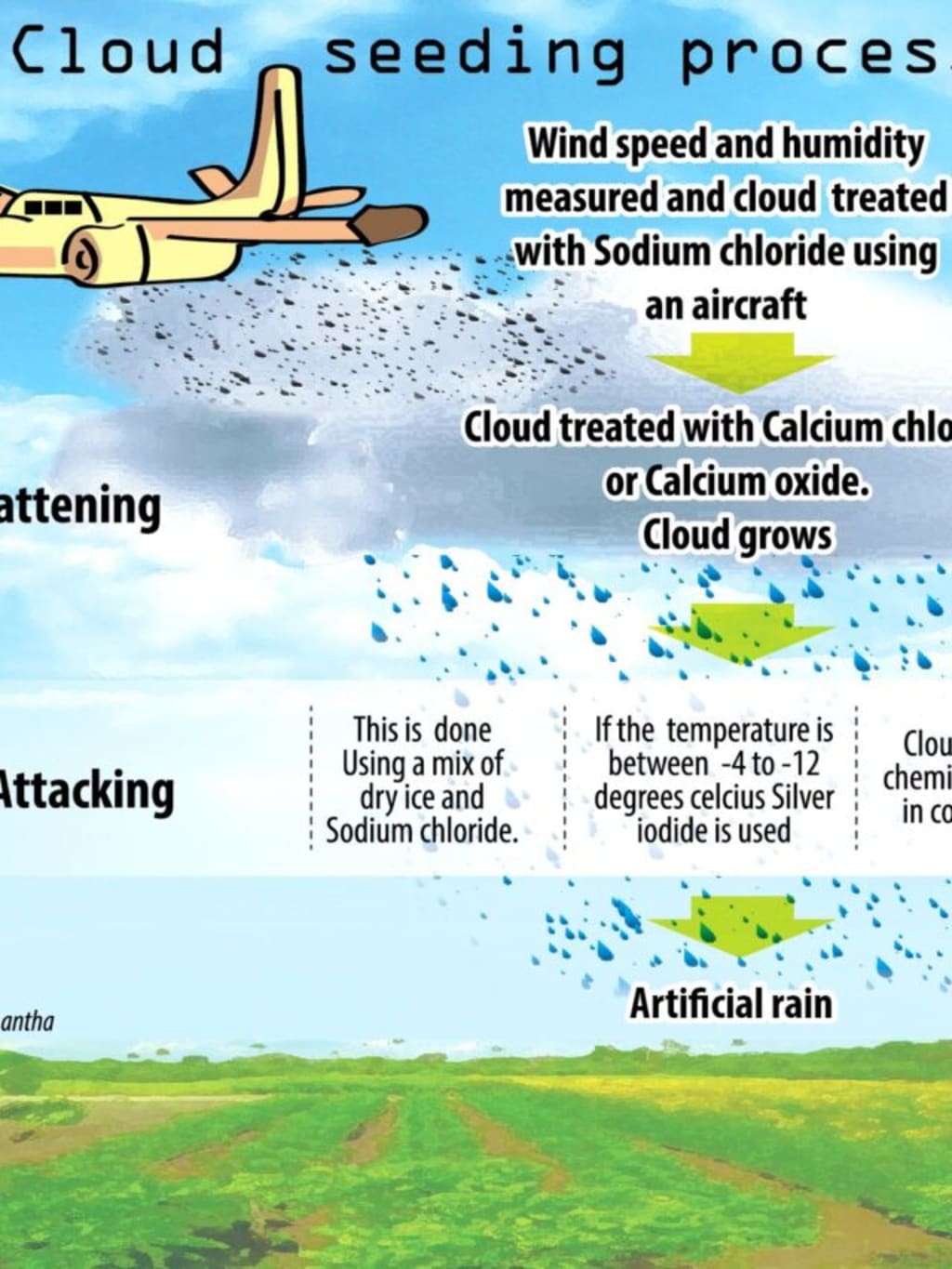
Cloud seeding is a weather modification technique that involves the introduction of substances into the atmosphere with the aim of inducing precipitation. The process usually involves adding small particles to clouds, such as silver iodide, potassium iodide, or dry ice, which encourages the formation of rain or snow.
The idea behind cloud seeding is that these particles can act as a nucleus for water droplets or ice crystals to form around, which would otherwise not occur due to the lack of sufficient moisture in the air. As a result, the clouds become denser and more likely to produce precipitation.
Cloud seeding has been used in many countries around the world, particularly in areas experiencing drought or water shortages. For example, in the United States, cloud seeding is used in California to increase rainfall during the winter season and to reduce the risk of wildfires. In China, cloud seeding is used to increase precipitation in regions experiencing water scarcity.
The history of cloud seeding can be traced back to the early 1900s, when scientists first began to investigate the possibility of modifying weather patterns. However, it was not until the 1940s that the first experiments in cloud seeding were conducted. Since then, cloud seeding has become an established practice in many parts of the world.
There are different methods of cloud seeding, such as ground-based or aerial methods. In ground-based methods, silver iodide or other particles are released from generators placed on the ground. In aerial methods, the particles are released from planes or helicopters.
One of the challenges of cloud seeding is determining its effectiveness. While there have been studies that suggest cloud seeding can increase precipitation, it is difficult to measure the actual impact of cloud seeding on weather patterns. In addition, cloud seeding can have unintended consequences, such as altering the distribution of precipitation in a particular region or causing environmental damage.
Despite these challenges, cloud seeding remains a valuable tool for managing water resources in areas experiencing drought or water shortages. As technology and our understanding of weather patterns continue to advance, cloud seeding may become an even more effective means of inducing precipitation and mitigating the effects of climate change.
How Does Cloud Seeding Work?
Cloud seeding works by introducing materials into the atmosphere that can act as nuclei for the formation of precipitation. These nuclei can be in the form of particles of silver iodide, potassium iodide, or other materials. When these nuclei are introduced into a cloud, they attract water molecules, which then condense around them. As the water droplets grow in size, they become heavy enough to fall to the ground as rain or snow.
There are two main methods of cloud seeding: ground-based and aerial. Ground-based cloud seeding involves releasing the seeding material from the ground, while aerial cloud seeding involves dropping the material from an airplane or helicopter.
Ground-Based Cloud Seeding
Ground-based cloud seeding is the most common method of cloud seeding. It involves releasing the seeding material into the atmosphere from the ground. This can be done using various methods, such as:
Rocket Flares: This method involves firing rockets into the air that contain the seeding material. The rockets explode at a certain altitude, releasing the material into the cloud.
Burners: Burners are used to generate heat that creates an updraft, which carries the seeding material into the cloud.
Generators: Generators release the seeding material into the air by propelling it with compressed air or gas.
Aerial Cloud Seeding
Aerial cloud seeding involves dropping the seeding material from an airplane or helicopter. This method is particularly useful for reaching clouds that are at higher altitudes. The seeding material is released in a similar way to ground-based cloud seeding, using methods such as:
Flares: Flares are dropped from the aircraft, and they ignite in the air, releasing the seeding material.
Liquid Solutions: Liquid solutions containing the seeding material are sprayed from the aircraft into the cloud.
Benefits of Cloud Seeding
Cloud seeding can have several benefits, including:
Increasing precipitation in areas that suffer from drought or water shortages.
Reducing the impact of hailstorms on crops and infrastructure.
Increasing the amount of snowfall in mountainous regions, which can help to replenish water reserves.
Reducing the risk of forest fires by increasing humidity levels.
Conclusion
Cloud seeding is a valuable tool in managing weather patterns and water resources. While it is not a magic solution for droughts and water shortages, it can certainly help to mitigate the effects of these natural disasters. With continued research and development, cloud seeding may become an even more effective tool for managing weather patterns and water resources in the future.
About the Creator
Keep reading
More stories from Dilip kumar padi and writers in Education and other communities.
How a labour boy built Hyundai?
Imagine a poor boy in a small village. who works in the fields for 17 hours every day, just for one square meal a day. Now imagine that this boy became the owner of a car company worth lakh crore in the future. This is the story of the founder of Hyundai, Chang Ju-Yung. Chung Ju-Yung was born in 1915 in a small village in Korea. His wanted to become a school teacher. But his family was so poor that he couldn't study much. As a child, he had to work in the fields with his family. But after working so hard, sometimes, they couldn't even feed each other. forget about proper clothes and medical care. Chung had to go to a nearby city to sell wood. There he saw that people had enough food and clothes without toiling in the field whole day. Seeing all that made him really sad and frustrated. He wanted a better life for himself. One day, he read in the newspaper that a big construction site in a city nearby, needs laborers. This news motivated him to do something. In 1932, at the age of 16, Chung made a surprising decision. He was going to run away to the city. One night, Chung quietly left for the city with his friend. He reached Kowon city after walking about 160 km, and started working as a construction laborer. It was hard work for measly wages. But Chung was happy because he was able to earn independently for the first time in his life. Life kept continued like this for about two months, until he got caught. Chung's father found him and he had to come back to farming. His family was happy to have him back but Chung was not. These two months had ignited a passion for construction and civil engineering in Chung. Also, he knew that he would never be able to beat poverty by working in the fields. And that's why he tried to run away two more times. But each time, his father found him. Finally, in 1934, at the age of 18, he attempted his fourth escape, and this time, no one stopped him. He reached Seoul which is the capital of South Korea today. He did whatever work he found there. First, a construction laborer, then a factory worker, and finally, he got a delivery boy's job in Bokhyang Rice Store. Customers and the shop owners were so impressed with his work that in just six months, he became the store's manager. After this, Chung worked very hard to grow the shop. In 1937, store's owner fell seriously ill and took a surprising decision. Thanks to Chung's hard work, he handed the store over to him. At the age of 22, Chung had become the owner of a business from an employee. In the next two years, Chung worked even harder, built trust and reputation in the market, which helped him grow his business. Everything was going well, but then suddenly a tragedy occurred. It was World War II era, and Japan ruled Korea. Japan wanted sufficient rice supply for their army during the war, and it overtook all the rice shops in Korea, including Chung's rice shop. All of his hard work was destroyed at once. Chang was very sad, but he didn't give up. "If I put my heart and soul sincerely into whatever work I am doing, I will surely succeed." With this thought, he started looking for a business that the Japanese government couldn't control. Soon, he started focusing on the car repair business. In 1940, he took a loan of 3,000 won and opened an Ado service garage. But this time, he was so unfortunate that the garage burnt down just after a month of opening and everything was burnt to ashes. Chung's situation was very difficult. He had to pay his loan and compensate his customers for the loss. A normal person could easily give-up in such a situation. But like always, Chung faced a problem head first. He took another loan of 3,500 won and built an even better garage. Chung realized that the biggest problem for the customers was the long time period it took to get their cars repaired. That's why, he made speed his main focus. Where his competitors took 20 days for a certain repairs, Chung's garage would do them in 5 days. His garage was so successful that in the next 3 years, i.e. till 1943, his workforce grew up to 80 employees. By this time, Chung had repaid all of loan and settled his family in Seoul. Business was growing rapidly but then another disaster struck. Japan needed to make war related equipment for World War II. So, Japan took his garage's ownership and merged it with a local steel plant. Once again, his business was taken away from him. Chang had come back to square one. He was forced to return to his village with his family. But this time, he had 50,000 won saved. And he was confident that he would establish another business. With the end of World War II, Japan's rule in Korea also ended. Northern areas of Korea had Soviet Union's influence and America's in the southern area. Both of them fought the war against Japan in World War II. That's why Korea was divided between North and South Korea. Chung came back to Seoul in 1946 and restarted his car repair business. Business was old but this time, the name was new. Hyundai Auto Service. Hyundai means modern. The car repair business was going on well, and that's when Chung noticed that America was constructing buildings for its military forces. He spotted a big opportunity in the construction business. He didn't have much experience in construction. But he still had that passion for construction that he had since he worked as a laborer in the past. That's why, at the age of 31 in 1947, he created the Hyundai Civil Works Company and entered the construction business. He got many small projects in the beginning, but by the 1950s started, his company was getting major construction projects. And now this was his major business. Everything was going fine, but we saw another twist in the tale. In June 1950, North Korea attacked South Korea. North Korean troops were very close to Seoul. That's why Chung had to escape to Pusan with all of his savings. But even after such a big crisis, Chung didn't give up. At that time, US Army was fighting North Korean army along with South Korea. And they needed tents, warehouses, and army headquarters. Chung observed that Americans had no shortage of money. They just wanted reliable and timely delivery. And Chung gave it to them. He started with a small team and adopted the "Can Do" Moto. If the price is right, they would any construction project. A war was underway and he had to face many problems and many losses. But once he gave his word, he never left any project in the middle. Due to this reliability, he developed strong relationship with Americans. The war ended in 1952, but Chung continued getting contracts from America. Later, in order to rebuild the country, South Korean government began building bridges, dams, and roads rapidly. Hyundai played a major role in all this and had exponential growth in the business. South Korea's biggest dam, Soyoung dam, and the most important expressway, Kyungbu Expressway was made by Hyundai. In 1960s, Chung had reached his early 50s and owned a successful construction company owner. But he wasn't satisfied with this. Chung had already built thousands of kilometers of roads and now it was time to build cars to run on those roads. In 1967, Chung established the Hyundai Motor Company. In 1968, he had a deal with Ford in which he was going to assemble the Cortina cars. This joint venture ran successfully for two years. After which, conflicts started developing between the two companies. Ford didn't want Hyundai to build its own cars. And that's why, in 1973, Chung ended that partnership and started looking for new partners immediately. He tried to partner with General Motors and Volkswagen for their manufacturing technology. But everyone refused. Finally, in the same year, they partnered with Japan's Mitsubishi Motors. Mitsubishi was ready to give Hyundai its car making technology. The best part was that as per this deal, Hyundai could sell its own cars. Around the same time, South Korean government issued an order for automobile companies to build a citizens car. A car that is affordable and reliable and only uses parts made in South Korea. In 1976, Chung set up a new plant and Hyundai produced South Korea's first ever mass produced car, Hyundai Pony. Due to its affordability, this car was so successful in South Korea that Hyundai captured 60% market share. It became the biggest car company in South Korea. But there was one catch. The total car market of South Korea was only 30,000 cars. It was not sufficient to be profitable. Also, although Hyundai Pony was successful in South Korea, it was a huge failure in the overseas market. The quality of the car was not good. It paint would fade in the heat. And it often had mechanical issues. Due to these reasons, Hyundai Motor Company had been in loss for the last 7 years. People suggested Chung that he should close the company immediately. But Chung's decision shocked everyone. Instead of closing, he was planning to build a new car factory that would manufacture 300,000 cars annually. The company's management couldn't understand this decision. Who will buy 3,00,000 cars in a market of 30,000 cars? But Chang knew the answer. South Korean economy was growing rapidly and thousands of people were becoming economically empowered every year. That meant that the demand for cars was going to increase rapidly in the coming years. Plus, Hyundai's new cars were specifically made to export to foreign countries. This factory was built in 1980, and in 1982, Hyundai launched Pony 2 with many improvements. This car was not only a huge hit in South Korea, but it was also successfully exported to Africa, Latin America and Canada. In the next few years, Hyundai sold 400,000 cars and became profitable. Hyundai was now established as a decent car company on a global level. But the toughest and biggest car market in the world, USA, was still to crack. Internationally, it was important to be successful in the USA to become a major car company from a decent car company, When Hyundai studied the US market, it realized that Japan had captured the compact car segment. And there's already cut-throat competition in mid and large-sized American car market. That's why Hyundai targeted the sub-compact car market, where the competition was virtually zero. Also, Hyundai saw that there's a huge second-hand car market in the USA. They offered their new Hyundai Excel at the price of a second-hand car. That too with a five-year warranty. This strategy shook the car market in the USA. Second-hand car buyers instantly shifted to the Hyundai XL. In 1986, Hyundai sold about 170,000 Excels in the USA. In 1987, they sold about 260,000 cars. In these years, Hyundai XL became the top-selling imported car in the USA. Until then, no other car company had seen such an initial success in the US market. And with that, Hyundai was established as a major car company on a global level. That year, at the age of 72, Chung retired from Hyundai and became the honorary chairman. After which, his brothers and sons managed the company and head the company with the same type of determination. Today, Hyundai is the world's third-biggest car company. In just 2022, they sold about 40,000,000 cars. Even though, globally, Hyundai is known for its car business. But very few people know that there are 42 companies in the Hyundai Group. For example, Hyundai Elevator, Hyundai Information Technology, and Hyundai Heavy Industries, biggest shipbuilding company in the world. And because of Hyundai, South Korea has raced ahead of Japan to become the world's biggest shipbuilding country. For South Korea, Hyundai is not an ordinary company. Hyundai is an institution that rebuilt the country, created thousands of jobs and won global recognition to South Korea. And all this was started by a village boy who didn't even have basic facilities like food, education, healthcare. But he had immense passion, vision, and most importantly, a desire for better. If you want to know how a plane crashed due to the wrong push of a button, click on this article
By Dilip kumar padi3 years ago in Education
The Safety Net China’s $596 Billion Health Insurance Revolution (2025-2033)
In 2026, the concept of "Health is Wealth" has taken on a literal financial meaning in China. As the nation navigates a complex demographic shift and a post-pandemic heightened sense of risk, the insurance sector has emerged as the ultimate stabilizer. According to latest research, the China health insurance market size reached USD 321.4 Billion in 2024 and is now on an aggressive path to reach USD 596.1 Billion by 2033. Exhibiting a robust CAGR of 7.10%, the industry is thriving on a powerful combination of government support, aging population needs, and a digital-first approach to medical services.
By Neeraj kumar3 days ago in Education
Forging Command: The Path That Shapes a Military Leader
Military leadership is built through years of discipline, sacrifice, and deliberate development. It is not simply about giving orders or holding authority, but about guiding others in situations where clarity, courage, and responsibility matter most. The making of a military leader is a steady process that transforms ordinary individuals into figures capable of influencing outcomes under the most demanding conditions.
By Eric Schnabel2 days ago in Education
Writing About Writing: The Rainbow Trap
The good thing about living in modern times is that LGBTQ representation in media is increasing. Not just in niche and Independant media, either, but also in mainstream media. Books, movies, TV shows, comics... they're finally catching on that LGBTQ+ people form a significant part of their audience, and deserve to see themselves on screen and in fiction, not just as victims in documentaries and true crime shows.
By Natasja Rose2 days ago in Writers


Comments
There are no comments for this story
Be the first to respond and start the conversation.