
Why 3D Printing Is Advancing Germany’s Manufacturing Futur?
The Shift Toward Customization, Speed, and Digital Production

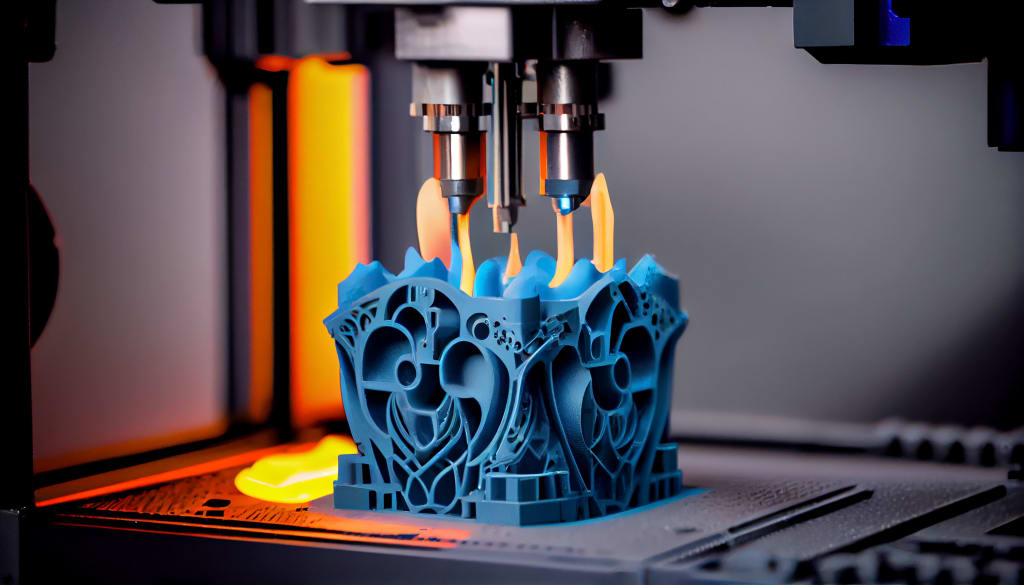
Germany 3D Printing and Its Growing Importance
Germany's position as a worldwide leader in manufacturing is to some extent linked to how it is also at the forefront of technological progress, with 3D printing being one of the most disruptive. Once developed for rapid prototyping applications, it is now used for production applications in the automotive, aerospace, health care, and general industrial sectors.
3D printing allows businesses to produce complex components directly from digital files and has the potential to be both more efficient and to reduce material waste. The technology is being adopted to favor more flexible and integrated production systems.
Understanding What 3D Printing Really Involves
3D Printing or additive manufacturing is the layer-by-layer assembly of a product from plastics, metals, resins, or composites, which typically creates less waste than customary subtractive manufacturing (where material is removed).
It is used to manufacture prototypes, tools and spare parts, the final product, and allows engineers to quickly and cheaply revise designs.
Key Factors Driving Adoption in Germany
A major driver has been increased demand for precision and innovation. Industries require components to meet exacting performance standards and AM can produce parts with geometries that cannot otherwise be manufactured.
Speed to production is also a consideration, as companies can take an idea to a physical product more quickly.
Sustainability also comes into play, with less waste and more optimized material usage.
The Role of Innovation and Technology
Continued advances in 3D printing are increasing the range of modeling software, as well as materials employed for new applications.
With automated and digital workflows, engineers can simulate how a part will perform before printing, allowing them to integrate additive into existing manufacturing.
Research institutions and industrial partners combine forces for process improvement and the identification of new applications.
Changing Industrial and Workforce Dynamics
A further implication is that manufacturers that can localize printing technology can re-engineer their supply chains to print as they need parts rather than store them.
Increasingly in demand are occupations such as computer-helped designers, materials scientists, and machine operators, training for which occurs through apprenticeship, certification, and other training programs offered by employers.
More customization is increasingly utilized to respond to the needs of the customer.
Benefits and Strategic Advantages
3D printing provides several important benefits:
• Design Freedom: Enables creation of complex shapes.
• Faster Development: Accelerates innovation cycles.
• Material Efficiency: Reduces waste in production.
• On-Demand Manufacturing: Limits inventory needs.
• Competitive Edge: Supports high-value industrial output.
These strengths reinforce Germany’s advanced manufacturing capabilities.
Click here if you want to know more about Germany 3D Printing Market
Regional Expansion and Industrial Integration
German industrial clusters are integrating additive manufacturing technologies with existing plants, with the automotive, aerospace and healthcare sectors being most active with AM adoption in Germany.
The technology providers consult with end users, helping implementation, and the availability of equipment has enabled small and medium enterprises to become involved.
Challenges Facing 3D Printing
However, initial costs of equipment, coordination of the production process and the difficulty in obtaining consistently high quality from differing materials remain problems.
Regulatory constraints on commercialization include medical devices and the aviation industry. Intellectual property protection requirements for digital designs are another constraint in some jurisdictions.
Active research and training are required to overcome these challenges.
Future Outlook of 3D Printing in Germany
Expected future developments of 3D printing in Germany are industrialization, automation, diversification of materials, and the combined use of additive and subtractive manufacturing processes (hybrid manufacturing).
As digital manufacturing continues to grow, companies that take advantage of this technology now will likely be in a position to innovate and succeed as it becomes a core competitive factor.
Conclusion
3D printing is playing a vital role in Germany’s transition toward modern, digitally driven manufacturing. By enabling precision, customization, and faster development, it strengthens the country’s industrial foundation.
With continued innovation and collaboration, additive manufacturing is set to remain an essential contributor to Germany’s leadership in advanced production technologies.
About the Creator
deepanshu Thakur
A dedicated Market Research Professional specializing in in-depth analysis, industry forecasting, and strategic insights. Known for precision, reliability, and delivering research that adds real business value.
Keep reading
More stories from deepanshu Thakur and writers in Education and other communities.
Why Video Analytics Is Transforming Brazil’s Intelligent Surveillance?
Brazil Video Analytics and Its Growing Importance Brazil is rapidly expanding its digital infrastructure as cities, businesses, and institutions seek smarter ways to improve safety and operational efficiency. Among the most important technologies supporting this transformation is video analytics. Instead of simply recording footage, modern systems are now capable of interpreting visual data and generating meaningful insights in real time.
By deepanshu Thakurabout 15 hours ago in Education
Why A2 Milk Is Changing the Way People Think About Dairy?
Recent developments in dairy consumption have been towards health and digestibility, with one of the most important developments in recent years being an increase in popularity of A2 milk. Once thought to be a niche product for people with difficulty digesting regular milk, an A2 following has developed among families, athletes and the health-conscious.
By Akshay Kumar5 days ago in Education
The Intersection of Inclusion, Mental Health, and Legal Protections: Understanding IDEA’s Role in Safeguarding Students’ Educational and Emotional Well-Being
Timotheus Homas Abstract Inclusion under the Individuals with Disabilities Education Act (IDEA) is often framed as a civil rights mandate concerned with access and equality. This article argues that inclusion also serves a critical mental health and developmental protection function, particularly during early childhood. Drawing on Timotheus Homas’ scholarship, the article examines how inclusive educational environments mitigate psychological harm, while exclusionary practices exacerbate vulnerability. The analysis contends that IDEA’s protective purpose cannot be fulfilled without recognizing inclusion as a safeguard against developmental and mental health injury.
By Emma Wegenast8 days ago in Education
The Lesions of Devotion
Every day I set myself down on the freshly cut lawn and strip myself bare. I take my guitar and finger the frets and pick at the strings, listening for dissonance. My life is dissonance. I twist the tuning pegs until each string sounds bright. Then I kneel, calves pointing behind me, kneecaps facing forward. All exposed to the breeze. I close my eyes and play the melody.
By Paul Stewart7 days ago in Fiction



Comments
There are no comments for this story
Be the first to respond and start the conversation.