
Back to School — But Locked Out
When Schools Ignore a Non-Custodial Parent’s Rights

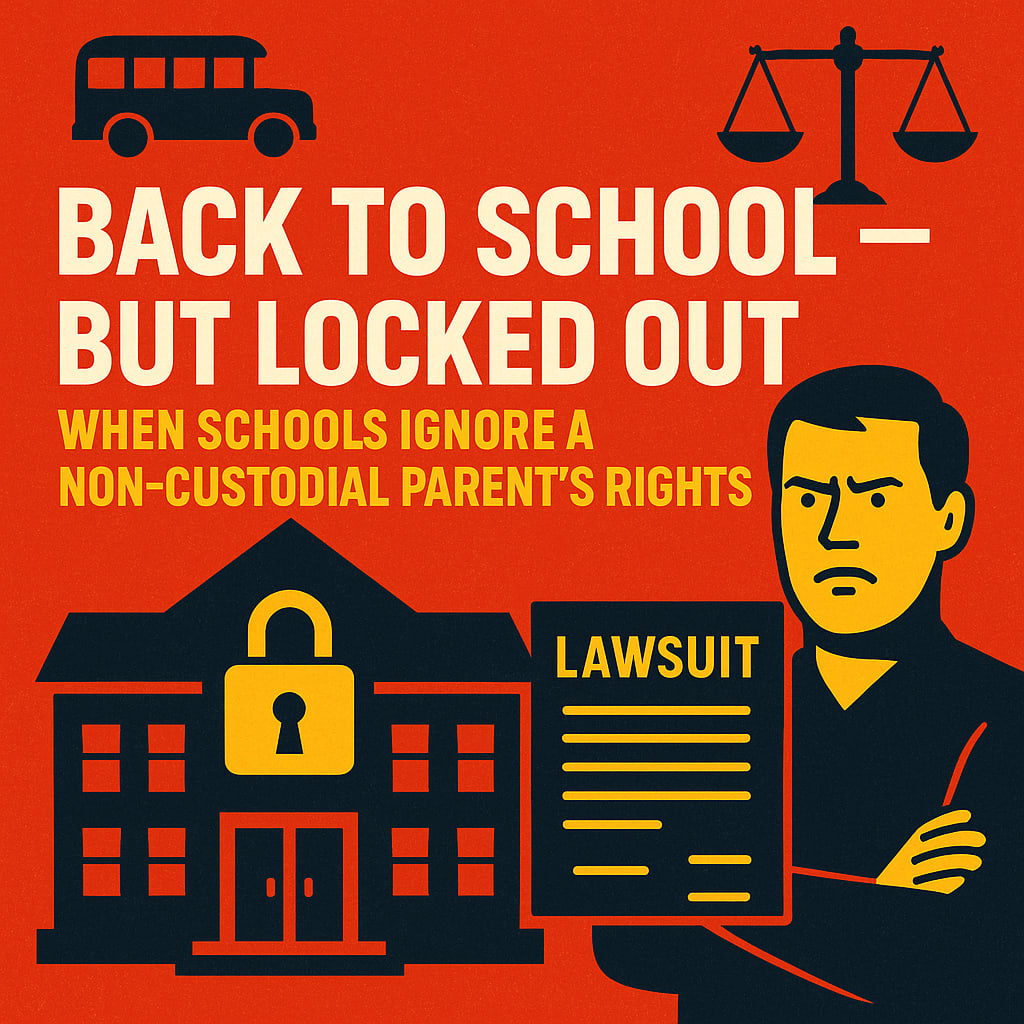
It’s that time of year again — the smell of sharpened pencils, the weight of backpacks, the awkward first-day-of-school pictures… unless you’re the non-custodial parent who isn’t allowed within arm’s reach of your child’s educational life.
For many of us, the return to school isn’t a season of joy — it’s a season of exclusion. Despite holding a court order that doesn’t bar you from receiving school records, schedules, or progress reports, you’re suddenly invisible. The school refuses to share information, citing “policy,” “custodial parent instructions,” or “we can’t get involved in family matters.”
Here’s the truth: if your court order doesn’t prohibit it, they have no right to block you from accessing your child’s educational records. And there are laws on your side — if you’re willing to enforce them.
Why This Happens
There are three main reasons schools ignore non-custodial parents:
- Fear of Litigation — Schools would rather overcompensate for “privacy” and avoid conflict with the custodial parent, even if it means violating your rights.
- Ignorance of the Law — Staff often don’t understand federal law (FERPA) or your state’s education code.
- Pressure from the Other Parent — A high-conflict co-parent can easily manipulate the situation by feeding schools misleading or false information.
Your Rights Under FERPA
The Family Educational Rights and Privacy Act (FERPA) is crystal clear: unless a court order, state law, or legally binding document specifically revokes your rights, both parents have equal access to their child’s education records. That includes report cards, attendance records, disciplinary reports, and most correspondence.
If your custody order doesn’t bar access — even if you’re the “non-custodial” parent — you are entitled to the same information the custodial parent gets.
What to Do Before You File Anything
- Get It in Writing — Send a formal written request for your child’s educational records to the principal or registrar, citing FERPA and attaching the relevant portion of your custody order. Keep a copy.
- Document the Denials — Save every email, letter, or voicemail where the school refuses or ignores your request.
- Go Up the Chain — If the principal stonewalls you, escalate to the superintendent and the school district’s legal/compliance department.
- Request Policy in Writing — Ask the school to provide the exact written policy they are relying on to deny you. This is often where their case falls apart.
When to Consider Filing Legal Action
If the school refuses even after you’ve provided your custody order and cited FERPA, you may need to escalate:
- FERPA Complaint — File with the U.S. Department of Education’s Family Policy Compliance Office (FPCO). This is free and can force the school to comply.
- State Education Agency Complaint — Some states have their own enforcement offices.
- Motion for Enforcement/Contempt — File in the same court that issued your custody order, asking the judge to compel the school to comply and to issue sanctions if they continue to refuse.
- Civil Lawsuit — In extreme cases, a lawsuit against the district for violation of federal and state law, along with attorney’s fees, may be warranted.
What You File to Protect Your Rights
- Motion to Enforce or Clarify Court Order — This is often the quickest route. Ask the judge to clearly state that the school must provide you equal access.
- Request for Specific Language in Your Order — If your order is vague, file a modification requesting an explicit provision stating you are entitled to “all school, medical, and extracurricular information without restriction.”
- Cease and Desist Letter — If you have legal counsel (or even pro se), you can send a formal notice to the school citing FERPA, your court order, and intent to take legal action if they continue violating your rights.
The Bottom Line
Schools are supposed to be neutral ground, not an arm of the custodial parent’s control. But in high-conflict custody situations, they often become just that — whether out of ignorance, fear, or bias.
If you’re facing this, you can’t just “wait it out” and hope it gets better. Document, escalate, and if necessary, litigate. Your role as a parent doesn’t end because your name isn’t listed first on the custody order.
About the Creator
Michael Phillips
Michael Phillips | Rebuilder & Truth Teller
Writing raw, real stories about fatherhood, family court, trauma, disabilities, technology, sports, politics, and starting over.
Keep reading
More stories from Michael Phillips and writers in Families and other communities.
Paws of Peace
A high-conflict child custody battle is one of the most stressful and exhausting experiences a parent can face. Courtrooms are cold, lawyers are expensive, and the other parent may seem determined to drain every ounce of your energy and hope. In the middle of this storm, you need something—someone—who is steady, grounding, and always on your side.
By Michael Phillips6 months ago in Families
When Home Learned to Listen
The Rahman family lived together in the same house, but for a long time, it felt like they were living separate lives. Everyone followed their own routine. The father left early for work and returned late. The mother stayed busy managing the home and worrying about everyone. The children moved between school, homework, and their phones. They spoke every day, but most conversations were short and rushed. Real listening had quietly disappeared.
By Sudais Zakwan4 days ago in Families




Comments
There are no comments for this story
Be the first to respond and start the conversation.