
The Inheritance We Never Asked For: Carrying the Wounds Our Parents Couldn't Heal
Subtitle: Family Legacy Is Not Just Money and Memories—It's Also the Pain Passed Down Like an Unopened Letter
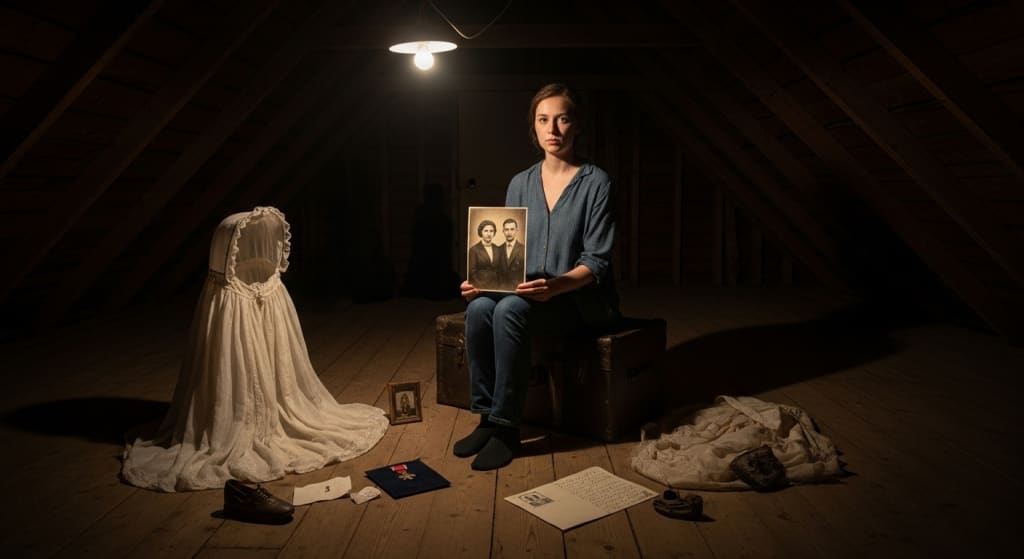
We inherit more than we know. More than the color of our eyes, the shape of our hands, the tendency toward certain illnesses. More than the furniture passed down, the photo albums stored in attics, the recipes written in hands we barely remember. We inherit something invisible and weighty—the wounds our parents could not heal, the fears they could not name, the patterns they could not break. And we carry these inheritances inside us, often without knowing, until one day we realize that we are living out a script we never chose, written by people we never fully knew.
This is the hidden curriculum of family: the lessons taught not in words but in silences. The child who learns that anger is dangerous because father's rage filled the house like smoke. The child who learns that love is conditional because mother's affection depended on performance. The child who learns that vulnerability is weakness because tears were met with dismissal. These lessons are not taught; they are absorbed. They become the architecture of the growing self, the assumptions so deep they feel like truth. And they are passed, unconsciously, to the next generation, and the next, until someone finally has the courage to ask: why do I keep repeating what I swore I would never do?
The patterns are as varied as families themselves. The perfectionist who learned that only excellence earned love, now raising children who cannot tolerate mistakes. The avoidant who learned that conflict was dangerous, now unable to have difficult conversations. The people-pleaser who learned that their own needs did not matter, now raising children who do not know how to set boundaries. The anxious one who learned that the world was not safe, now passing that fear like a contagion. Each pattern a survival strategy once, in a different context, for a different child. Each pattern now a prison, repeated unconsciously, until someone wakes up and asks: is this mine, or is this inherited?
I think about a friend who spent years in therapy trying to understand why she could not trust anyone who loved her. She would push people away just as they got close, would find reasons to doubt their affection, would sabotage relationships before they could sabotage her. She traced it back eventually, as these things are traced, to a mother who was warm one moment and cold the next, who gave love and withdrew it unpredictably, who taught her daughter that safety was an illusion. Her mother, she learned, had been the same way—raised by a father who disappeared for months at a time, who taught her that people leave, that dependence is dangerous. The pattern stretched back generations, an unbroken chain of wounded people wounding the people they loved most.
The recognition was painful. It meant seeing her mother not as the source of all wounds but as another link in the chain, another person who had inherited what she could not heal. It meant extending compassion to someone who had caused pain, while also taking responsibility for breaking the pattern herself. It meant understanding that forgiveness and accountability are not opposites but partners in the work of becoming free. She did the work. She broke the chain. Her children will inherit something different because she had the courage to look back, to see clearly, to choose another way.
This work of breaking patterns is among the hardest any human being can undertake. It requires looking at the people who raised us with clear eyes—seeing their humanity, their limitations, their own unhealed wounds—without losing the ability to love them. It requires acknowledging the harm done without being consumed by blame. It requires taking responsibility for what we will pass on, even though we did not choose what was passed to us. It requires, above all, the courage to become someone new in a family system that has been the same for generations.
The family systems we come from are not all wounding. They also carry gifts—resilience, humor, loyalty, faith, the capacity for joy. These too are inherited, often unconsciously, and they are worth celebrating and preserving. The laughter that echoes through generations. The stories that remind us who we are. The traditions that anchor us in something larger than ourselves. The love, imperfect but real, that held us when we needed holding. These inheritances are precious. They are part of us, and they deserve honor.
But the wounds also deserve attention. They deserve to be seen, named, understood. Not so that we can assign blame—blame is a dead end, a cul-de-sac of the soul. But so that we can choose differently. So that we can recognize the patterns as they arise, in ourselves, in our relationships, in the way we raise our own children. So that we can say, in the moment of reaction, "This is not mine. This is inherited. I can choose another way."
The work is daily and specific. It is the parent who feels anger rising and pauses instead of exploding, remembering how their own parent's anger felt. It is the partner who wants to withdraw but stays in the conversation, recognizing the pattern of avoidance learned in childhood. It is the person who hears themselves saying something their mother always said and stops, mid-sentence, to ask: is this true, or is this inherited? These small moments of awareness are the places where chains are broken. They do not make headlines. They do not earn applause. But they change the future, one choice at a time.
There is a particular grief in this work. It is the grief of recognizing that our parents could not give what they did not have, that their limitations were not choices but inheritances of their own. It is the grief of knowing that we will pass on something, despite our best efforts, because perfection is not possible and some wounds are too deep to fully heal. It is the grief of accepting that the family we came from is not the family we wished for, and that the family we create will also be imperfect, also flawed, also carrying shadows.
But there is also liberation. The liberation of knowing that we are not doomed to repeat. The liberation of seeing clearly enough to choose differently. The liberation of becoming, in however small a way, a place where the chain stops. Our children will inherit something from us—of course they will. But what they inherit will be shaped by the work we have done, the patterns we have recognized, the wounds we have begun to heal. They will inherit not perfection but awareness. Not freedom from pain but tools for navigating it. Not a clean slate but a slightly lighter load.
The woman in the attic, holding that faded photograph, she is every one of us at some point. She is looking at the past and trying to understand how it lives in her. She is holding images of people she partly knows, whose stories she has partly heard, whose wounds she has partly inherited. She is asking the question that matters: what do I carry that is not mine? What do I pass on that I could choose to stop? What would it mean to become the place where something ends so that something new can begin?
The answers will take a lifetime. They will require compassion for herself and for those who came before. They will require courage to see clearly and humility to accept what cannot be changed. They will require the willingness to become, in her own small way, a healer of generational wounds. But the work is possible. It is being done every day, by people in ordinary houses, having ordinary conversations, making ordinary choices that add up to something extraordinary: the decision to pass on something better than what was received.
The inheritance we never asked for is real. It lives in our bodies, our reactions, our fears, our patterns. But it does not have to be our destiny. We can look at it, name it, understand it. We can choose what to keep and what to release. We can become, in the words of one poet, the ancestor our descendants will thank. Not because we were perfect, but because we did the work. Because we looked back with clear eyes and forward with hope. Because we broke what needed breaking and mended what could be mended. Because we received the inheritance, named it honestly, and passed on something lighter to the ones who come after.
The chain stops here. The pattern ends now. The future begins with us.
About the Creator
HAADI
Dark Side Of Our Society
Six Things Women like More In Men Than Good looks
Physical attraction may spark interest, but it rarely sustains a meaningful relationship. While good looks can draw attention, they are not what build trust, emotional security, or long-term happiness. Many women value deeper qualities that make a man reliable, emotionally safe, and inspiring to be with. Here are six things women often like more in men than physical appearance.
By Ibrahim Shah 3 days ago in Families
There's A Hole in My Bucket
It’s a well-known fact that Liza Dufresne was always the brains in the family. She was the one who always came up with the brilliant schemes the Dufresne kids carried out when they were younger. Like when they tricked Mrs. Claybourn into paying for a trip to Disney World. Liza convinced her that their parents had been kidnapped and were being held for ransom for the total price of three tickets. In reality, they were away on a weekend getaway for their anniversary. When they returned, Liza told the Claybourns that they did not like to talk about the ordeal. Their parents never found out how they got the money. Mrs. Claybourn never found out that the Dufresne parents were never really in any danger.
By David E. Perry2 days ago in Fiction

Comments
There are no comments for this story
Be the first to respond and start the conversation.