

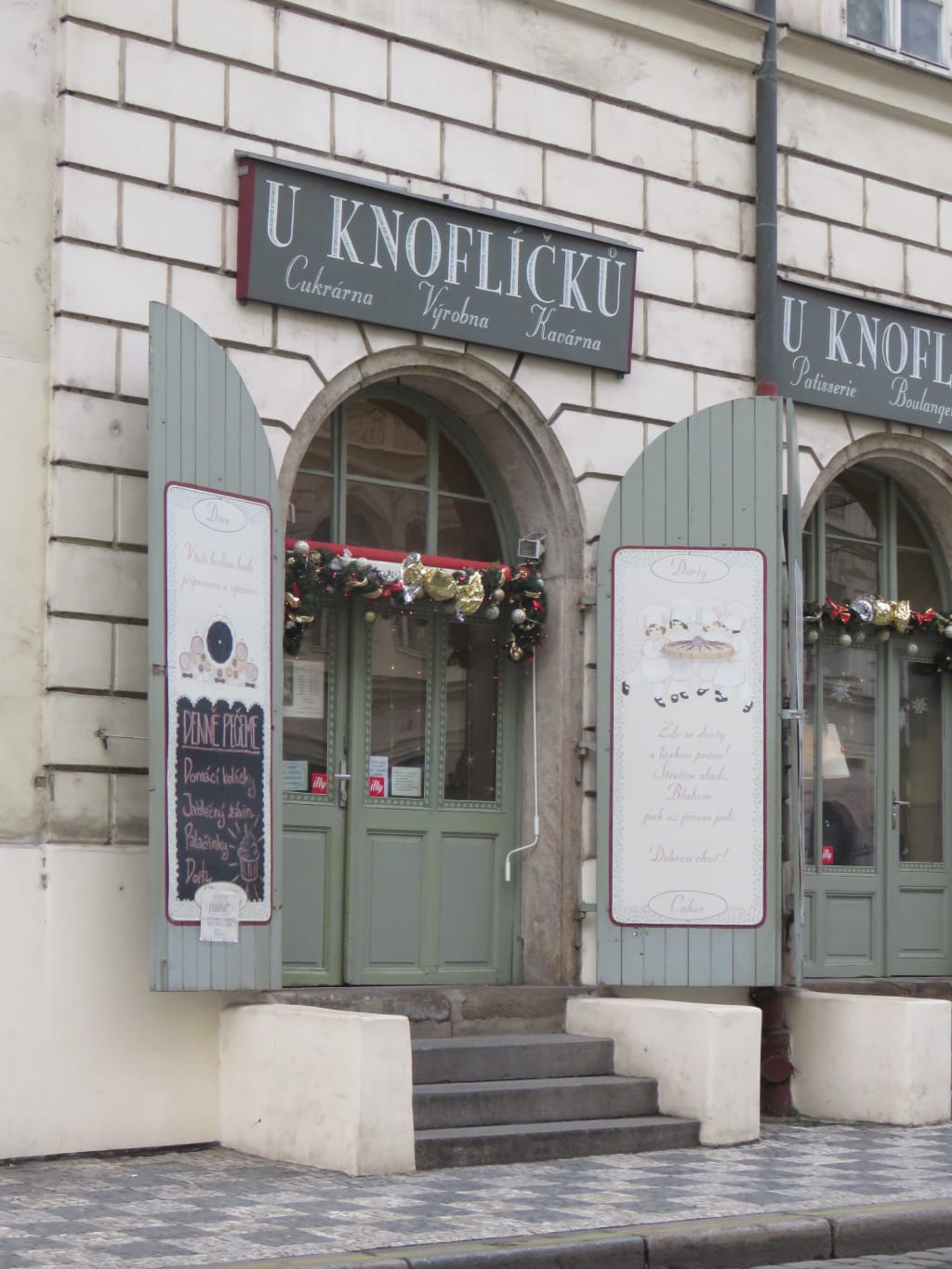
Just at the foot of Prague's famed "Lover's Hill" lies an inconspicuous little patisserie shop. Or rather, should we say, cukrárna, for that more fully describes its feeling, its smells and its warmth. It's unpretentious and honest. It's one of hundreds in the city. But this one is special. As soon as you walk in, you are greeted with the sweet smell of traditional Czech pastries. These are unlike ones you're likely to encounter anywhere else. They have peculiar names like little coffins or little windmills. Now, imagine yourself sitting there. You lift your foot over the small step that's so insignifcant and unexpected that it earns itself a little handwritten caution sign. You sit at a small table, the feet of which are supported with a bent cardboard beer coaster to prevent any further wobbling and your large window offers you a view of a tram track. Once in a while you will see the number 22 tram pass by. This tram provides unequivocally the most soul quenching tour of the city. You sip your Viennese coffee and nibble on a fresh crepe. This charming house has housed a number of businesses from a soapery to a wine cellar. But perhaps had things turned out a bit differently than they did, this little pastry shop would've gained the kind of global recognition it deserved. Perhaps. You can choose to believe the story that awaits you in the next several parapraphs, or you can choose to close the proverbial arched window shutters, sweep crumbs with the palm of your right hand into your left, leave the cukrárna, hop on the 22 and return to your reality. But I urge you to believe.
Let me take you back to 1831. Prague was and continues to be one of the most picturesque cities in the world. A walk through its streets is akin to traveling to a time when beauty was paramount and seemed to supersede functionality. Architecture, music, culture and invention thrived in such a beautiful nest for the soul.
Approximately 300 km from the City of Hundred Spires, Prague, lies yet another cultural and architectural gem. This is Vienna. Vienna is classic and classical. Vienna continues to have balls that see well-dressed contemporaries don garments relegated to historical costumes elsewhere in the world. In 1831 Vienna was well-dressed, filled with culture, art and music.
Vienna was and continues to be filled with luxurious cafes and salons. Pastries and coffee are paramount to the joy and happiness of the Viennese people. Sitting down for an apfel strudel and a coffee is more than a quick repose from the busy life. It's akin to a cultural experience. It was as if one was in competition with oneself to create the next, better, tastier morsel with which to enliven discussions held at the chandelier-lit parlours.
(If you're still sitting at our imagined table, take off your coat, sip your coffee and get comfortable. )
While by today’s standards, 300 km distance equates to a quick and comfortable ride, it was not so in 1831.
In 1831 a young student, whose name is not known and doesn't matter, but can be speculated on, was visiting Prague from Vienna on business. He was delivering a satchel of post. Love letters, postcards and parcels of all shapes and sizes. He cherished his position and was glad to be the human link between people’s hopes, memories and connections. Perhaps it was a postcard he delivered that gave a needed solace to an aching heart or perhaps it was a parcel he dropped off that satiated a home-sick child with home-made cookies from mom. It was more than delivery of things to him. It was, at least at the beginning, a calling he was happy to take on. But time changes things for everyone, doesn't it? Noone stays the same.
I should stress that he was not inherently a bad man. But like most, given the right pressures of life, he was looking for a way of expedite his journey towards wealth and travel, explore and learn of the world. Each foreign stamp he saw stoked the fires of his curiosity of exploring a world that was closed off to him. The stamps he saw made him drunk with selfish thirst for exploration. He told himself that he would continue his honest employ and would be a decent man, but would welcome any opportunity that would allow him to crack that window that looked into the opportunities of travel a little more each time. His savings from mail delivery were unlikely to do that.
It was the winter of 1831. Bundled up in overcoats and galoshes, his nostrils were sucking in the cold air and capturing the sweet scent of nearby mulled wine. How he wished he could one day just freely and nonchalantly spend a coin on a cup of this divine elixir to warm up. But it was not a necessity. Perhaps it was the cold and the misery of his situation that stirred up feelings of anger and injustice in his heart, whose ability to sort out emotions was yet untamed thanks to his youth. He was convinced that he deserved such spoils. He deserved the hot drink wine whenever his mood struck. He deserved to join the crowd of well-dressed gentlemen as they left the Wien Staatsoper, laughing lightly and regaling one another with the most poignant parts of the opera they just saw. He deserved to join the opulence of Vienna’s best cafes.
That’s when the devil on his shoulder finally threw an opportunity his way. As if to add more determination to his plan, the young man slipped on the slick, icy sidewalk right in front of an inconspicuous patisserie shop at the foot of Prague’s Lover’s Hill. His satchel flew open and spread postcards, envelopes and parcels across the wet cobblestones. Though he picked them up swiftly, the integrity of one small envelope was compromised by the wet snow and sleet.
Weakened, it spilled its content into his frozen palms. What fell out was a little black book. It was meant for the pastry chef of the very house in front of which he stood. He flipped it open and knew his life would change.
---
Objects have the beautiful capacity to gain value in the beholder’s eyes. What could be a simple trinket of costume jewelry gains incalculable value if it’s found to belong to a loved one. Suddenly, their memory is preserved in a piece of tarnished metal and glass. Clay gains value with the touch of a skilled potter who turns it into a vase. A sheet of lined paper in the hands of someone like Mozart or Smetana becomes music. And a little black book gains value with the contents within itself.
---
He wiped his running nose on the sleeve of his thick, woolen coat and pulled his hood to shield him from the wind. He knew he shouldn’t but he looked inside the little book. Inside was a recipe from a well-known patisserie chef, clearly being offered as a gift. Accompanying this, there was a note.
“Dear friend. I trust that this recipe is what will allow you to build a thriving patisserie like my very own. Prague deserves an artist like you. Please accept this gift.” Then the recipe followed.
Without fully understanding its value then and there, he stashed the little black book into his voluminous pocket and swiftly walked off into the dreary winter day. Later he thought that he heard the pastry chef calling after him, asking if he had received any mail. But he couldn’t be sure. Or perhaps his conscience would block out this memory to let him sleep at night. He recognized the name of the author and knew it had value. What he didn’t know yet was how he would seek benefit from it.
He had almost forgotten about his ill-gotten secret recipe when the spring blooms melted the last of the snow and with it, softened his resolve to do whatever it takes to take luxuries that life didn’t provide for him as his own.
Hands in pockets of his light jacket, he was carefree and happy. The episode of two months ago a distant memory.
But it was re-awaken as his daydream was interrupted by a loud disagreement taking place on a nearby bench.
An older man was gesticulating and whispering loudly with enunciated tones as his young apprentice was taking furious notes and nodding frantically.
The young man stopped mid-walk and tried to listen to the conversation. The two men were someone called Sacher and his pastry apprentice he would later learn. From their conversation, he gathered that the two were tasked with developing a dessert that the world hasn’t seen in order to impress Prince Metternich who would be visiting Vienna in the coming days. As of now, they had nothing that could impress the monarch.
The young man suddenly knew the value his little black book held. In today’s money, the value was exacted to $20,000. The dessert within it would become known as the "Sachertorte," with its exact recipe only known to the Sacher family and a young mailman. Over the centuries, the recipe would become a closely guarded secret, invaluable in price.
The dark chocolate covered cake gained fame, popularity and favour with the monarch’s family.
Since that day, the young mail man never had to work a day in his life. He traveled, he ate sweets he only dreamed of and he joined high society at balls and opera. His conscience, however, didn’t let him taste the sweetness, see the world or hear the music.
One day, ten years to the day of his theft, he was sitting at the Sacher café, trying to regain his taste with a slice of the famed torte he had helped to create.
Call it fate or call it coincidence, but he choked on his last bite.
About the Creator
Marketa Stastna
I studied journalism in Canada and abroad. I'm a working professional in communications, but on the side I like to write a bit about this and that and just get my exciting writing juices flowing.
Keep reading
More stories from writers in Feast and other communities.
Home-Cooked Dishes
Want to impress at the dinner table with dishes that are bursting with flavor, surprisingly simple to master, and visually stunning? Look no further. This collection of 10 home-cooked classics focuses on fresh ingredients, smart techniques, and vibrant presentations. From sizzling meat dishes to refreshing salads, these recipes will elevate your everyday cooking and turn any meal into a special occasion. Let's get started!
By yue . shui4 days ago in Feast




Comments
There are no comments for this story
Be the first to respond and start the conversation.