
The Night Time Stood Still
A chronicle of a party, a blaze, and shared vulnerability

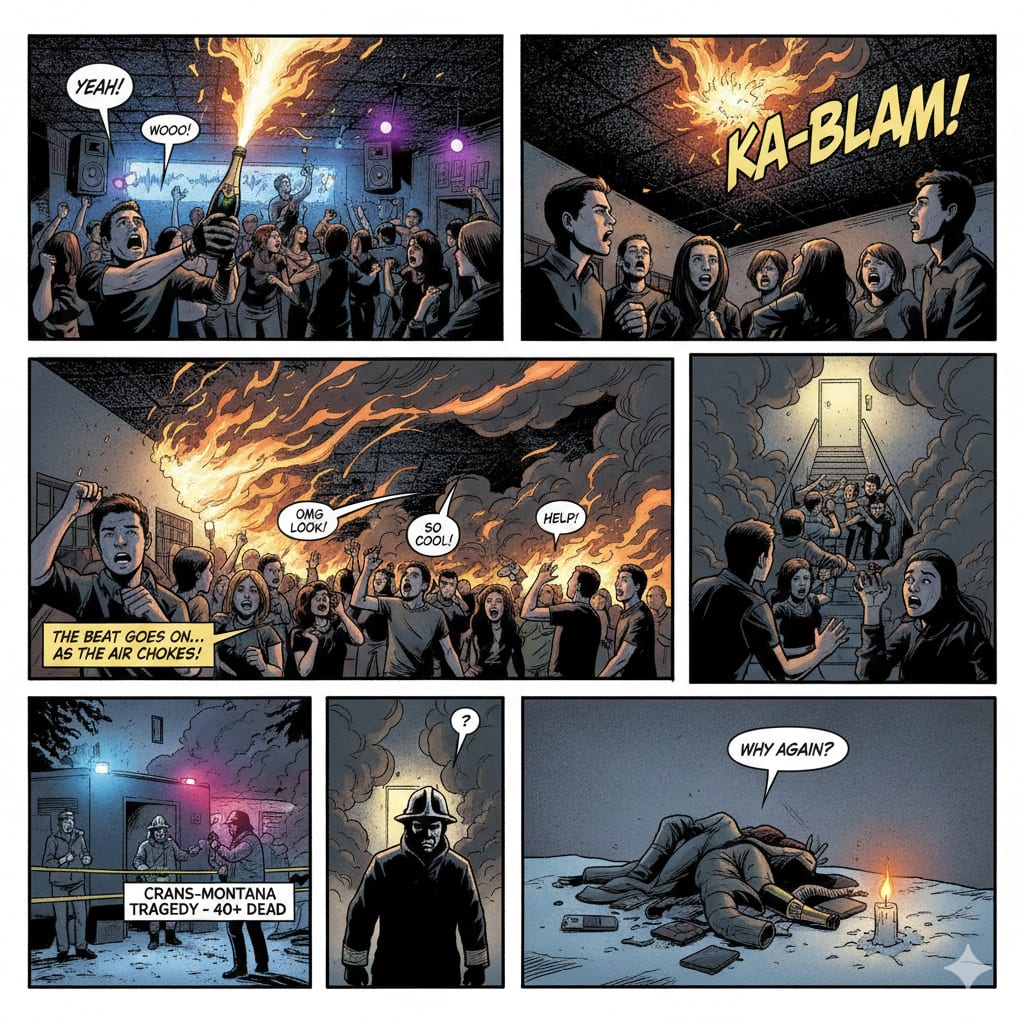
This New Year’s Eve began like so many others, driven by that collective urge to believe the hours could stretch out, filled with laughter and haunting beats. The kids crowding into this bar—because it was just a bar, not a real club with its neon grids and security checks—went there for one reason: to let go, meet up with friends, and leave their worries at the door. They weren’t there to play with fire, literally. Just to breathe, dance, and exist without a thought for tomorrow.
The venue fit that ephemeral vibe perfectly. Dim lighting that blurs the edges of things, sound that sticks to your skin, a ceiling lost in the blackness above. In these spots, architecture is ignored: you don’t notice the partitions; who thinks about the exits? The hidden cables, the soundproofing foam—all of it stays invisible. The party relies on the blind faith that others have handled the logistics. That the owner, the authorities, or someone, somewhere, checked the risks so you could just enjoy the moment.
It’s this sense of security that makes the aftermath so hard to stomach. Because when the flames erupt, it’s not in an empty warehouse: it’s right where everyone had lowered their guard. The fire doesn’t just scorch equipment; it shatters a bubble of trust. Much like at the Constellation bar in Crans-Montana, Switzerland, on the night of December 31st to January 1st, 2026: a packed lounge, mostly young people, crowded into a basement for an improvised celebration. Forty confirmed dead, over a hundred injured, including several French nationals—kids aged 16-25, minors included, with no real entry checks. The fire starts at the ceiling, sparked by those stupid pyrotechnic "fountains" strapped to champagne bottles by a waiter showing off. Cheap, flammable acoustic foam ignited in seconds, echoing the Colectiv in Bucharest in 2015 (64 dead) or the Pulse in Kocani, North Macedonia, in March 2025 (63 dead). It’s the same story as the 5-7 in Saint-Laurent-du-Pont, France, in 1970: 146 young people burned or asphyxiated by psychedelic plastic decor, with exits padlocked for business and zero serious inspections.
You have to grasp the sequence of events to avoid snap judgments. The videos show it raw: it starts high up, masked by strobes and booming audio. At first, people mistake it for a special effect, a flickering decoration. Bodies keep moving, phones come out to film—“look, this is wild”—no one registers the danger. Humans freeze when facing the unknown. The brain scans the room: “Is this serious? No one else is moving, so probably not.” In a crowd, it’s worse: everyone watches their neighbor, waiting for a collective green light. With the music pounding and the alcohol flowing, no one thought to cut the sound, kill the lights, or grab an extinguisher. On X and in witness accounts, it’s clear: the music played on for minutes, the DJ didn’t react, and there was zero staff to lead the evacuation. One witness said: “Flames on the ceiling, and they were still dancing.” Just like the Station Nightclub in the US in 2003 (100 dead): indoor pyros, foam ablaze, and a crowd that panicked too late.
The fire, however, doesn't wait for a consensus. It’s pure physics: it climbs, consumes oxygen, and belches toxic gases before the orange tongues even appear. What kills first isn't the heat—it’s the smoke. Lungs burning from the inside, vision failing, internal compass glitching. The body senses it before the cortex does, but by then, it’s over: a narrow basement, a single bottlenecked staircase, no smoke extraction. In France, "dancing" bars often bypass the strict ERP Type P norms (automated alarms, exits every 5m, fire-rated ceilings). This allows venues to dodge safety standards—much like the Cuba Libre in Rouen in 2016, where 13 youths suffocated in a basement. The UMIH Nuit trade group is blunt: in a real French nightclub, this would be impossible; here, it was an overcrowded bar with illegal foam and lax oversight (only 3 inspections in 10 years).
Inside, the clock deconstructs. From the outside, it looks instantaneous; inside, it’s a blur of flashes: a lost gaze, a scratchy cough, the shove of the crowd. No time for a Plan B. Outside, the post-mortem begins: failed safety codes, indoor pyros (illegal without fireproofing), a French owner claiming "inspections were OK," and the Valais canton opening a criminal negligence probe. It's a grim fact: indoor fireworks account for 40% of nightclub disasters (Brazil 2013: 242 dead; India 2025: 25 dead). But let’s be straight: regulations reduce risk; they don’t eliminate it. Fire is pure chaos—a combo of human error and physical variables. Fatality? Not resignation, just realism: you can't domesticate 100% of reality, despite the protocols.
The rawest part: lives cut down at their peak. Not thrill-seekers, just normal people who trusted the system—and rightly so, given how society promotes these "low-cost fun" spots. Those who have seen a fire say it: it’s not Hollywood-style, it’s a choking trap that turns a cozy room into a tomb. You feel like you have time; then suddenly, you have none.
What follows? The void. Investigations (Valais police questioning managers, analyzing materials), debates (X trending with “negligent homicide” and “why wasn’t it evacuated?”), and the temptation to find a single scapegoat. But the truth is a mix: inert staff, a crowd dazed by the atmosphere (alcohol, nitrous?), permissive authorities, and a greedy owner. Our collective failure is that we react slower than the flames.
This piece isn't about blaming or consoling. It’s about the crash between our social slowness and the speed of danger. The party versus raw physics. After the tears, the audits (France is tightening rules on dancing bars post-Crans), and the social media outcry, what remains is the need to remember. Safety is never a finished race; vigilance is admitting our own limits against the crowd and the killers in the ceiling. They didn't "fail": they were caught in an unstoppable chain reaction.
The beat has stopped. The lights are out. What remains is this night—not as a cheap moral lesson, but as a scar: a reminder of our boundaries when faced with the real world. Time folded over those who are gone, and a whisper that lingers: why again?
JLP
About the Creator
Laurenceau Porte
Chroniqueur indépendant. J’écris sur l’actualité, la société, l’environnement et les angles oubliés. Des textes littéraires, engagés, sans dogme, pour comprendre plutôt que consommer l’information.
Keep reading
More stories from Laurenceau Porte and writers in Feast and other communities.
Time Does Not Restart Chronicle of a Year Without Promises
The first morning of the year looks like any other, and perhaps that is where its small cruelty lies. The light is nothing new, it is no kinder, and the air retains that same grey consistency. Yet, one feels this light but persistent pressure, a moral obligation to feel different. We call this "the beginning," but it is a practical illusion, a collective invention that humans tell themselves to keep from drowning in the incessant flow of hours. The calendar is not a measurement tool; it is a way of storytelling. It does not point to real changes; it simply marks the moment we finally decide to look them in the face.
By Laurenceau Porteabout a month ago in Humans
Flavorful Feast
The Chinese New Year's Eve dinner, or Nian Ye Fan, is more than just a meal—it’s a cherished tradition filled with symbolic dishes that represent wishes for prosperity, health, and good fortune in the coming year. These ten classic homestyle recipes are perfect for creating that special festive spread at home. They balance flavor, meaning, and tradition, ensuring your family table is both abundant and auspicious. Let's get cooking!
By yue . shui2 days ago in Feast
One Hard Thing
Stop me if you’ve heard this one before: You have the number, you know your schedule- you’ve even picked out the perfect day and time to make this appointment. Shoot, you’ve even picked out alternative days and times just in case their schedules can’t accommodate you!
By Taylor Rigsby7 days ago in Motivation




Comments
There are no comments for this story
Be the first to respond and start the conversation.