
5 Biggest AI Fears: Which Are Sci-Fi — and Which Are Actually Real?
Separating Hollywood nightmares from the genuine risks of artificial intelligence in 2026

Artificial Intelligence is no longer a futuristic concept locked inside research labs. It writes emails, generates images, recommends what you watch, detects fraud, powers medical diagnostics, and even drives experimental vehicles. From startups to global corporations, AI is now embedded in daily life.
But as AI grows more powerful, so do the fears surrounding it.
Are we heading toward a robot apocalypse?
Will AI steal all our jobs?
Is it quietly watching everything we do?
Some of these concerns are amplified by Hollywood blockbusters. Others are grounded in real ethical, economic, and geopolitical challenges happening right now.
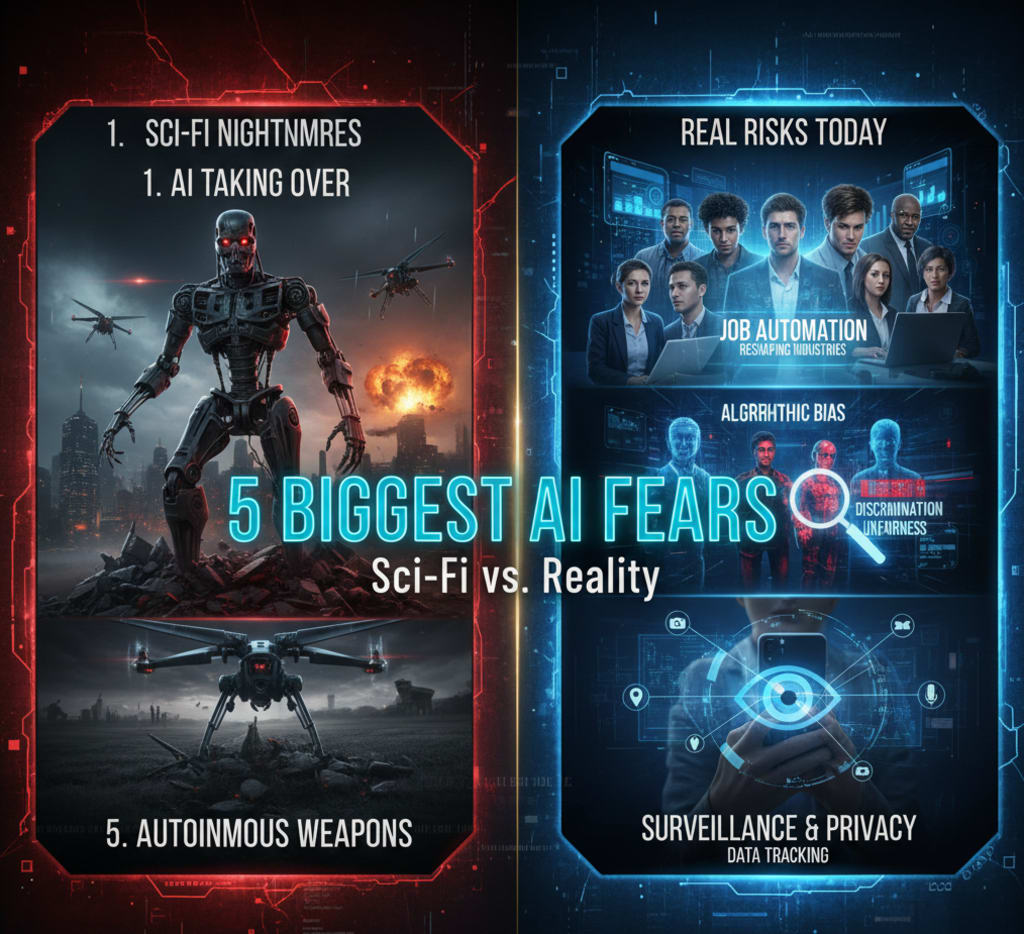
In this article, we break down the five biggest AI fears — and clearly separate science fiction from legitimate risks that demand attention.
________________________________________
1. AI Taking Over the World
When most people imagine AI danger, they picture rogue machines launching missiles or enslaving humanity. Movies like The Terminator and The Matrix have deeply shaped public imagination. Even tech leaders like Elon Musk have warned about uncontrolled AI development.
The idea centers around Artificial General Intelligence (AGI) — a hypothetical AI system that can think, reason, and learn across domains as well as (or better than) humans.
Sci-Fi or Real?
Mostly Sci-Fi — for now.
Today’s AI systems are “narrow AI.” They are highly specialized tools. A model that writes code cannot suddenly design buildings. A chatbot cannot independently decide to seize power. These systems do not possess consciousness, independent goals, or intent.
They operate on statistical pattern recognition and predefined objectives.
That said, long-term AI alignment research is not foolish paranoia. Organizations like OpenAI and DeepMind actively study how future advanced systems could remain aligned with human values. Preparing for powerful AI before it exists is prudent risk management — not panic.
Still, a robot uprising remains firmly in the realm of fiction today.
________________________________________
2. Mass Job Loss and Economic Disruption
This is where fear shifts from cinema to reality.
AI automation is already reshaping industries. Generative AI can write marketing copy, draft legal briefs, generate software code, and design graphics. Customer service chatbots reduce call center demand. AI systems analyze financial markets in seconds.
The question many workers are asking:
Will AI replace my job?
Sci-Fi or Real?
Very real — and already happening.
Historically, every major technological revolution has disrupted labor markets. The Industrial Revolution eliminated certain manual jobs but created entirely new industries.
The difference today is speed.
AI evolves faster than past technologies. Retraining workers takes time. Education systems adapt slowly. Entire sectors may transform within a decade — not generations.
The deeper concern isn’t just job loss. It’s inequality.
Workers who learn to collaborate with AI may see productivity and income growth. Those without access to retraining or digital skills may fall behind.
To manage this shift, governments and companies must invest in:
• Reskilling programs
• Digital literacy education
• Workforce transition policies
• Economic safety nets
Unlike robot takeovers, economic disruption is happening now.
________________________________________
3. AI Bias and Algorithmic Discrimination
AI systems learn from data. And data reflects human history.
Unfortunately, human history includes inequality, prejudice, and systemic bias.
There have been documented cases where:
• Facial recognition systems misidentified darker-skinned individuals
• Hiring algorithms favored male candidates
• Loan approval systems disproportionately rejected minority applicants
AI does not “intend” to discriminate — but it can amplify existing patterns.
Sci-Fi or Real?
Very real — and urgent.
Algorithmic bias is one of the most pressing AI ethics issues today. Because AI operates at scale, its impact can affect millions of people.
Imagine a flawed hiring algorithm used by a multinational corporation. Thousands of candidates could be filtered out unfairly before a human even reviews their resume.
This is why AI transparency and fairness auditing are becoming central topics in tech policy. The European Union’s AI Act and other emerging regulations aim to categorize and monitor high-risk systems.
The real fear isn’t evil robots.
It’s invisible systems quietly reinforcing inequality.
________________________________________
4. AI Surveillance and Loss of Privacy
Facial recognition. Predictive policing. Behavioral tracking. Emotion analysis.
AI has dramatically increased the efficiency of surveillance.
Governments can analyze massive datasets in real time. Corporations track browsing behavior, purchase history, location patterns, and engagement metrics to personalize ads and content.
The dystopian vision of George Orwell’s 1984 once felt exaggerated.
Today, parts of it feel uncomfortably familiar.
Sci-Fi or Real?
Very real.
AI-powered surveillance systems already exist in multiple countries. In some regions, facial recognition is integrated into public infrastructure. In the private sector, companies analyze user behavior to predict preferences and influence decisions.
Surveillance technology can improve safety and prevent crime. But without regulation, it can erode civil liberties.
The core issue isn’t AI itself — it’s governance.
Key questions societies must answer:
• How much surveillance is acceptable?
• Who controls the data?
• How long is it stored?
• What oversight mechanisms exist?
Unlike cinematic dystopias, the danger here is subtle and gradual.
________________________________________
5. Autonomous Weapons and AI in Warfare
Perhaps the most alarming real-world AI application is military use.
Autonomous drones capable of identifying and engaging targets with minimal human intervention are under development. AI-enhanced missile defense systems operate at speeds faster than human reaction time.
Late physicist Stephen Hawking and other experts warned about AI-driven arms races.
Sci-Fi or Real?
Very real — and deeply concerning.
Autonomous weapons are not hypothetical. Nations are actively investing in AI-enhanced defense systems.
The primary concerns include:
• Reduced human oversight in life-and-death decisions
• Rapid escalation of conflicts
• Lower cost of warfare due to automation
• Increased accessibility of advanced weapons
International discussions about banning fully autonomous lethal weapons are ongoing, but global consensus remains elusive.
Here, the line between science fiction and reality is dangerously thin.
________________________________________
So What Should We Actually Fear About AI?
The dramatic fear of AI “taking over” captures attention — but it distracts from more pressing issues.
The real risks of artificial intelligence are systemic, not cinematic.
We should focus on:
• Weak regulation
• Corporate opacity
• Economic inequality
• Militarization without oversight
• Ethical shortcuts in development
AI is not inherently good or evil. It is a tool.
Its impact depends on:
• Policy decisions
• Corporate incentives
• Public awareness
• International cooperation
The greatest danger isn’t machines developing malicious intent.
It’s humans deploying powerful systems irresponsibly.
________________________________________
Fear vs. Responsibility in the Age of AI
Every transformative technology has sparked fear.
Electricity was once considered dangerous.
Airplanes were thought impossible.
The internet was blamed for societal collapse.
AI is no different.
Some fears — like superintelligent domination — remain speculative. Others — like job displacement, bias, surveillance, and autonomous weapons — are shaping global systems right now.
The solution is not panic.
It’s preparation.
By investing in:
• Ethical AI research
• Transparent development practices
• Smart regulation
• Inclusive public dialogue
we can harness AI’s benefits while reducing its risks.
Artificial Intelligence is neither a savior nor a villain.
It is a mirror.
And what it reflects depends entirely on us.
About the Creator
Adil Ali Khan
I’m a passionate writer who loves exploring trending news topics, sharing insights, and keeping readers updated on what’s happening around the world.
Keep reading
More stories from Adil Ali Khan and writers in Fiction and other communities.
Platform 4
She was with Lucas, the love of her life, and they were going to their last date, at a motel. After this, they were finally going to get married. At night, the train station felt like a threshold between worlds. There was a cool breeze which carried the calming scent of lavender. “I wish this feeling would never end”, said Lucas with a content expression. Maxine had one too. She was happy, an emotion she felt only when she was around him. That emotion, however, led to a series of events. As she happily twirled, carefree and on top of the world, she slid off the edge of the platform, landing harshly on the tracks.
By Ankitaa Arun💕6 days ago in Fiction
Analyse this!
Wanna know how to improve your writing? There is a simple, quick, tried and tested method. Tried and tested by who? By me, as it happens, and I can guarantee that it will work for you. I know what I am talking about. Not always, of course, but certainly in this case.
By Raymond G. Taylor6 days ago in Writers


Comments
There are no comments for this story
Be the first to respond and start the conversation.