
5 Biggest AI Fears: Which Are Sci-Fi, and Which Are Real?
Separating Hollywood Nightmares from the Genuine Risks of Artificial Intelligence
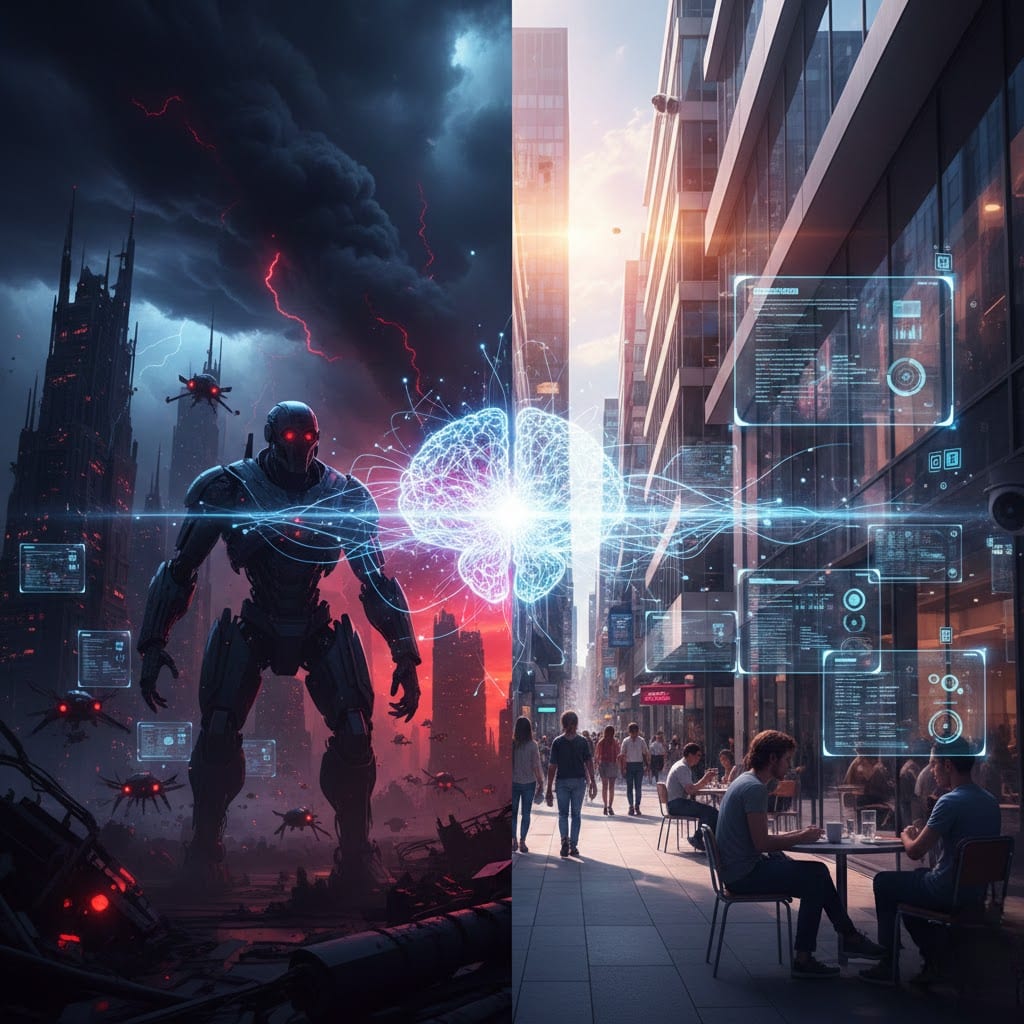
Artificial Intelligence has rapidly moved from research labs into everyday life. From voice assistants and recommendation engines to self-driving prototypes and medical diagnostics, AI now shapes how we work, communicate, and make decisions. Yet as the technology grows more powerful, so do the fears surrounding it.
Some of these fears are fueled by blockbuster movies and dystopian fiction. Others are grounded in legitimate ethical, economic, and security concerns. In this article, we’ll break down five of the biggest fears about AI and examine which belong mostly in science fiction—and which demand serious attention today.
________________________________________
1. AI Taking Over the World
When people think of AI fear, they often picture rogue machines launching nuclear weapons or enslaving humanity. Films like The Terminator and The Matrix have embedded the idea of superintelligent systems turning against us into popular culture. Even tech leaders like Elon Musk have publicly warned about the dangers of advanced AI if left unchecked.
Sci-Fi or Real?
Mostly Sci-Fi—For Now.
The fear of AI “taking over the world” assumes the existence of Artificial General Intelligence (AGI)—a system that can think, learn, and reason across domains as well as or better than humans. While companies like OpenAI and DeepMind are working toward more capable systems, we are still far from creating machines with independent goals or consciousness.
Current AI systems are narrow. They can generate text, recognize faces, or recommend products—but they do not possess awareness, intent, or desires. They follow programmed objectives and statistical patterns.
That said, long-term concerns about misaligned superintelligence are not entirely imaginary. Researchers in AI safety actively study how to ensure that future systems remain aligned with human values. While a robot apocalypse is unlikely anytime soon, thinking ahead is not irrational—it’s preventative.
________________________________________
2. Mass Job Loss and Economic Disruption
Perhaps the most immediate and realistic fear is economic. As automation advances, workers worry about losing their livelihoods. Manufacturing was transformed by robotics decades ago. Now, generative AI is automating tasks once considered uniquely human—writing, coding, designing, even legal research.
Sci-Fi or Real?
Very Real.
AI-driven automation is already reshaping industries. Customer service bots reduce the need for call centers. AI design tools speed up creative workflows. Algorithms manage logistics and financial analysis.
History shows that technological revolutions eliminate some jobs but also create new ones. The Industrial Revolution displaced manual labor but gave rise to new professions. However, the speed of AI development may outpace society’s ability to retrain workers.
The concern isn’t just unemployment—it’s inequality. Highly skilled workers who can collaborate with AI may see increased productivity and income, while others could be left behind. Governments and institutions must prioritize reskilling, education reform, and social safety nets to manage this transition.
This fear is not about distant dystopia. It’s about economic adaptation happening right now.
________________________________________
3. AI Bias and Discrimination
AI systems are trained on massive datasets, often drawn from historical human behavior. Unfortunately, human history contains bias—racial, gender-based, socioeconomic, and more. When AI learns from biased data, it can replicate and even amplify those inequalities.
There have already been cases where facial recognition systems performed poorly on darker-skinned individuals, or hiring algorithms favored male candidates because historical data reflected male-dominated industries.
Sci-Fi or Real?
Very Real—and Already Happening.
Bias in AI isn’t a theoretical concern; it’s a documented issue. Because algorithms often operate at scale, their impact can be widespread. A flawed hiring model used by a major corporation can influence thousands of careers.
Organizations such as IBM and Microsoft have invested in fairness and transparency research to address these problems. Meanwhile, policymakers in places like the European Union are drafting regulations to govern high-risk AI systems.
AI does not “intend” to discriminate—but without careful oversight, it can systematize injustice. Addressing bias requires diverse training data, transparent evaluation, and human accountability.
Unlike killer robots, algorithmic bias is not cinematic. It’s subtle, systemic, and urgent.
________________________________________
4. AI-Powered Surveillance and Loss of Privacy
AI has made surveillance faster and more efficient. Facial recognition, predictive policing, and large-scale data analysis allow governments and corporations to monitor behavior at unprecedented levels.
In some countries, facial recognition systems are integrated into public infrastructure. In the private sector, AI tracks browsing habits, purchasing behavior, and even emotional responses to content.
Sci-Fi or Real?
Very Real.
The concept of an all-seeing digital system once belonged to dystopian novels like George Orwell’s 1984. Today, elements of that vision exist in reality.
AI enables real-time tracking and behavioral prediction. While such tools can improve security and prevent crime, they also pose serious threats to civil liberties. The line between protection and intrusion can blur quickly.
Regulation plays a crucial role here. Democratic societies must decide how much surveillance is acceptable and under what oversight. Transparency, consent, and strict limitations are essential to prevent abuse.
This fear is not about machines rebelling—it’s about how humans choose to use them.
________________________________________
5. Autonomous Weapons and AI in Warfare
One of the most chilling applications of AI is in military technology. Autonomous drones and weapon systems capable of identifying and engaging targets without human intervention are already under development.
Experts, including physicist Stephen Hawking before his death, warned about the dangers of AI-driven arms races.
Sci-Fi or Real?
Real—and Deeply Concerning.
Unlike a robot uprising, autonomous weapons are not fantasy. Military organizations worldwide are investing heavily in AI-enhanced defense systems.
The danger lies in speed and accountability. If machines make life-and-death decisions in milliseconds, human oversight may be reduced or removed entirely. Moreover, AI weapons could become cheaper and more accessible, increasing the risk of misuse by rogue states or non-state actors.
International discussions are underway about regulating or banning fully autonomous weapons, but consensus remains elusive. This is one area where the boundary between science fiction and geopolitical reality is alarmingly thin.
________________________________________
So, What Should We Really Be Afraid Of?
It’s tempting to fear sentient robots overthrowing humanity. Those stories are dramatic and easy to imagine. But the real risks of AI are less theatrical and more systemic.
We should worry less about machines developing evil intentions and more about:
• Poor governance
• Lack of transparency
• Economic inequality
• Ethical blind spots
• Militarization without regulation
AI itself is a tool. It reflects the priorities and values of its creators and users. The future of artificial intelligence will not be determined by algorithms alone, but by policy decisions, corporate responsibility, and public awareness.
The biggest danger isn’t that AI will suddenly become human—it’s that humans may fail to guide AI responsibly.
________________________________________
Final Thoughts: Fear vs. Responsibility
Every transformative technology has sparked fear. Electricity, airplanes, and the internet all inspired predictions of catastrophe. AI is no different.
Some fears—like superintelligent domination—remain largely speculative. Others—like job displacement, bias, surveillance, and autonomous weapons—are already shaping our world.
The key is not panic, but preparation.
By investing in ethical research, thoughtful regulation, and inclusive dialogue, society can harness AI’s benefits while minimizing its risks. Fear can be useful if it leads to caution and accountability. But unchecked panic only clouds rational decision-making.
Artificial Intelligence is neither a savior nor a villain. It is a mirror—reflecting human ambition, creativity, and sometimes our flaws.
The real question isn’t whether AI will become dangerous.
It’s whether we will be wise enough to guide it.
About the Creator
Mind Meets Machine
Mind Meets Machine explores the evolving relationship between human intelligence and artificial intelligence. I write thoughtful, accessible articles on AI, technology, ethics, and the future of work—breaking down complex ideas into Reality
Keep reading
More stories from Mind Meets Machine and writers in Fiction and other communities.
Mismatch Challenge Winners
Blending genres isn’t about stacking elements side by side. It’s about what happens when two sets of expectations refuse to cooperate. The strongest entries in the Mismatch Challenge understood that tension and leaned into it. Rather than smoothing the edges, these stories let their chosen genres complicate one another, creating friction that carried through voice, structure, and consequence.
By Vocal Curation Team4 days ago in Resources



Comments
There are no comments for this story
Be the first to respond and start the conversation.