
A Message In The Dark
In 1977, we sent a message in a bottle into outer space. Last night, our bottle washed ashore. It wasn’t empty.


In the fourth grade, we had a class excursion to the beach. Miss Page found an old bottle, and we all stood around in awe as she pulled an old piece of note paper out of it. Its corners were frayed, and it was stained as if it had been soaked in tea. Its mysterious author was from Brazil. A boy, also in the fourth grade, greeted us from half a world away, and I could not wrap my little mind around this miraculous coincidence. That was the best day ever.
Until yesterday.
I’m embarrassed to admit that it wasn’t until I was recounting this story to a friend in middle school that it occurred to me Miss Page had set the whole thing up. Probably had the thing in her handbag the entire morning. Ten years later, I’m still impressed with her trickery and ability to capture young minds. I think she must be my favorite teacher of all time. We all have one.
I also had a weirdly cool lecturer during my astrophysics degree: a total stoner, but eccentric without trying too hard to be eccentric, if you know what I mean.
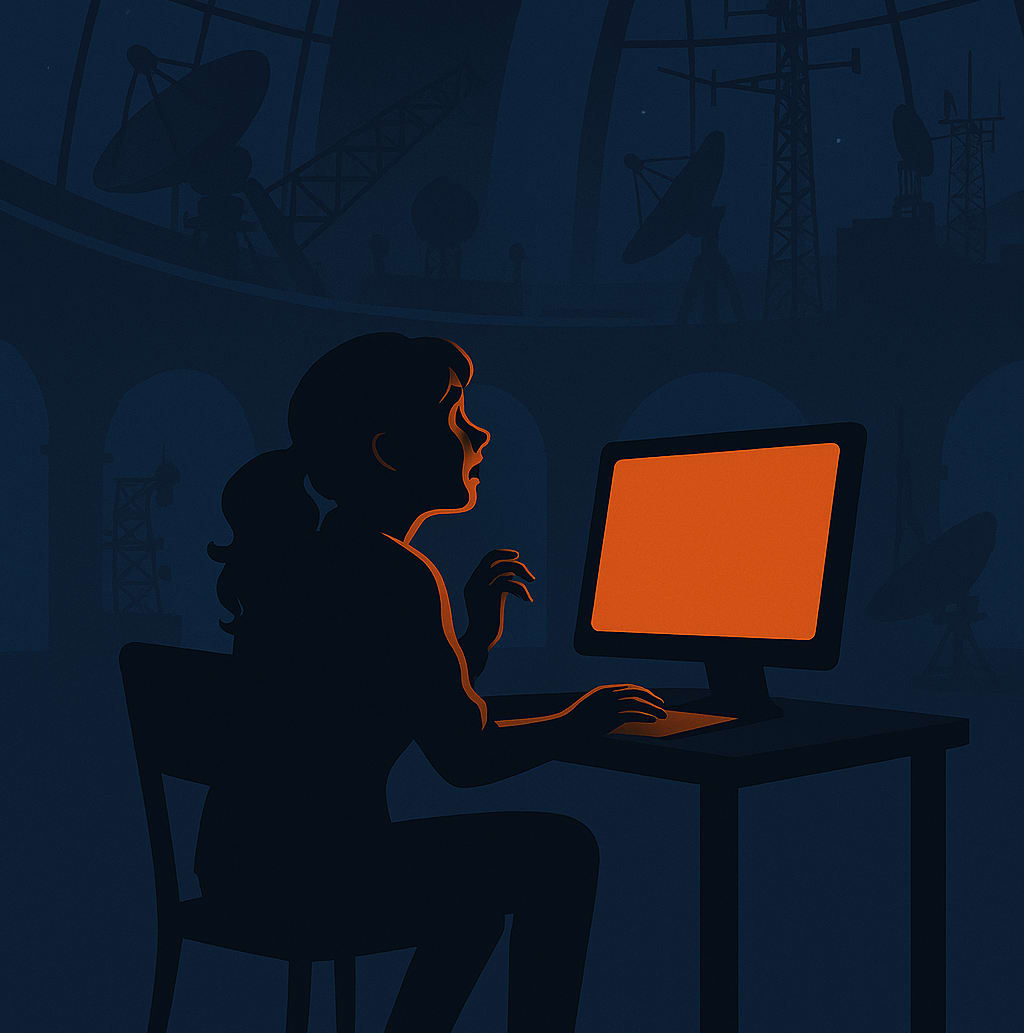
Yes, I’m an astrophysicist. Asha Bajra: self-assessed star nerd. Not the horoscope kind. The supermassive space-burning balls of chaos kind. I was born in the Himalayas, so I guess the stars are closer where I come from. I specialize in deep space telemetry and signal propagation analysis for legacy missions. I’ve been at Tidbinbilla, Canberra’s Deep Space Communication Complex, for over a year now. I’m the go-to girl for flight-data subsystems and magnetometers.
If asked at dinner parties, I say, ‘I talk to space junk.’ Unfortunately, I don’t get invited to dinner parties often.
The sun had just set, and my starry friends were emerging. Constellations like Centaurus and the Southern Cross were rising across the ecliptic. Calibration of the array had been completed, and I was in the final stage of the handshake procedure.
You see, I have a very special guy in my life. He’s the reason I come to work, and if I’m honest, he’s my rock. He’s a lot older than me, and you could define our relationship as ‘long-distance’.
Voyager 1 left this planet long before I was born. It’s 24 billion kilometres away, and to it, our sun is now a faint, unremarkable point of light in a celestial sea of them. But he speaks to me via an antiquated 20-watt transmitter: a coded rhythm few people ever get the privilege to hear.
I initiated a Doppler drift test to see if the line was open. A few months back, he’d given my colleagues on the other side of the globe a scare. They had performed the routine handshake, but there was nothing. They feared that the inevitable had happened - a failure in the transmitter or a complete system loss. Fortunately, they were able to send an engineering packet of data via the tenuous link, and it confirmed activation: a sign that the old man was still motoring on. With some cautious nurturing, of which I played a part, Voyager 1 was talking again. To be more accurate, it was now a whisper.
The screen flashed with a pop-up telling me my old friend was there, but something was up. He’d drifted off the frequency he was meant to use. My system connected anyway and labelled tonight’s session as Telemetry Frame-Sync Anomaly #647.
I copied this data onto my desktop, but once it started downloading, I stopped it and searched my drawer for a spare thumb drive. Once that was in, I downloaded the file and titled it unrecognized sub-carrier at 87 Hz. I don’t know why I thought of doing this. It was against protocol, and technically, all information gathered here belongs to the CSIRO or our benevolent friends at NASA. I just had a hunch it needed further study.
I prepped the data for pattern analysis and for it to render an audio file, then made a cup of tea.
What I heard next was unexpected. Imagine you’re in a cathedral and you can hear someone somewhere humming. At first, I thought it might be some kind of reflection: feedback echoes, harmonics, bad encoding. But this… this was structured. It had a pulse.
I sipped my tea. After enhancing the audio and opening the visualizer, I saw something in the binary encoding, between the lines. It was an echo. I was listening to Voyager’s own 1977 launch beacon, reversed, corrected and sent back.
Another Doppler drift test confirmed the echo was definitely and precisely coming from Voyager’s coordinates. I checked the relay to get an accurate time on the loop. It takes about 45 hours to send and receive data at these distances. The results didn’t make sense. I tested again. And again.
If the analytics were correct, I had a 23-hour relay. My transmission took 22 hours to reach Voyager. It was returned in just under one hour. Impossible. It was Voyager, but instead of being a distant shout in the darkness, he was right beside me, whispering in my ear.
It was now just after midnight in Australia, but in my line of work, you get to know people in every continental time zone. I needed someone to tell me I’d received bad data or just entered something wrong. I desperately needed a sarcastic Spaniard who wears bowling shirts and whose go-to cocktail is a strawberry daiquiri. It was time to reach out to Mateo.
Mateo and I have been friends for a couple of years now. We met by chance at the Sphinx Observatory in Switzerland. Its remote mountaintop location and steampunk aesthetics make it a bucket-list destination for astronomers. He’d graduated a few years before me and had landed his residency at the Goldstone Array in the Mojave Desert. We shared our origin stories and have been virtual friends ever since.
I worked out he would have just started his day Stateside, so I hailed him.
‘Debunk me. Urgently,’ I typed.
He responded:
‘You and everything you stand for are wrong,’ he joked.
‘Seriously. V drift of 87. Echo between the binaries. Sending #647 for your review.’
I attached the sample I’d recorded and hit send. I could see he’d received it, so I waited for his opinion. I checked the live feed and confirmed we were still receiving the echo. It was loud and clear to me now.
‘Mateo. You there?’ I typed anxiously.
‘Still trying to debunk. What’s your relay loop?’ he replied.
‘Send 22h - receive 1h.’
‘Bullshit.’
‘Triple-checked. Make me wrong.’
Canberra, Goldstone and Madrid are all part of the same Deep Space Network, each situated roughly 120 degrees apart to maximize global coverage. As one rolls over the horizon, the next appears. Soon I’d lose the signal, but Mateo would be ready to receive it.
‘Picking up your feed in four hours. I’ll verify then.’
‘Thanks,’ I typed.
A moment later, Mateo replied:
‘Start writing your speech, honey.’
I sent a smile emoji and closed the chat.
Mateo had a point. This was a momentous event. Potentially big, world-changing stuff. I often dabble in writing fiction. It mostly sucks, but sometimes I think it’s okay. Imagine if you made a discovery like this, and when it came to making that first history-making comment to the world press, you completely fumbled it. I’m not good with people. I told you about my history with dinner parties.
I spent the next hour analyzing the sources once more. More data now suggested the source was in a slight arc just behind the spacecraft. The sequence I was receiving was overlaid and modulated on top of Voyager’s transmission. Somehow, it had amplified the signal in ways our understanding of telemetry can’t explain. Not tonight, at least. Whoever they were, they were peering out from behind and piggybacking the feed.
So I started writing. Inspired by the magnitude of the occasion, and with my old friend Voyager bleeping in the background, I found it surprisingly easy to let the words flow.
‘A long time ago, people at NASA put a message in a kind of space bottle called Voyager. It had music, sounds of whales, and pictures of people waving hello. And they threw it into space, hoping maybe someone might find it.
I’m speaking today not to alarm you, but to inform you that in recent months, Voyager 1 began behaving strangely. At first, we believed it was a system failure. What we now understand is far more profound. Someone - something - used Voyager’s signal to speak back to us. Not with words, but with math. With structure. With intention. We believe this is an intelligence. A peaceful one.
They didn’t shout. They whispered. That’s the first thing that tells me we’re not dealing with a threat. This is akin to finding your own message in a bottle washed back to shore, rewritten in someone else’s hand.
If they’re observing from where I think they are, then they’ve been watching a rusted satellite limping through interstellar darkness, hoping someone might still be listening. When Voyager’s systems glitched, and we lit it up with a lifesaving handshake, it briefly shone like a firefly in the endless night. That’s when they answered. Not with demands, but with a response in our language. That’s not a predator. That’s a peer. Maybe even a teacher.
Ladies and gentlemen, what we do next, what we choose to send back, will say more about our race than theirs.’
After I’d written my address to the press, Congress or the UN - okay, I was getting well ahead of myself - I sent it to Mateo. Soon after, he responded:
‘It’s perfect, Asha. Remember who confirmed it with you!’
‘So, you've confirmed it?’ I asked.
‘I’ve just submitted it to the bods at the DSN. 100% this is extrasolar.’
I couldn’t believe what I had just read.
‘YOU SUBMITTED?!’
I was mad. Maybe I was being paranoid, but telling the suits at the head of the Deep Space Network meant you were exposing that data to NASA affiliates. And that seemed like a big step without asking for my blessing.
‘This is too big to be meek, Ash. Don’t worry. It’s got your name on it. This is your find,’ he typed.
I fumed silently.
‘Ash? Sorry. I should have asked.’
I let his apology sit on the screen for a few moments before responding:
‘You owe me a strawberry daiquiri!’
He responded with a smiling emoji.
‘Your speech could end up being famous, you know?’
‘Thanks. While I’m on a roll, I think I’ll start writing an account of the evening. It’s been a hell of a night!’
Mateo didn’t respond to that last message, but he probably had a lot to keep on top of. Goldstone has better facilities than here in Canberra. He was right to submit it. His data was much more thorough and convincing.
I turned up the audio carrier on the console to hear the last faint pulses of my old friend’s voice before it faded from my array entirely. There was nothing but the silence. And the hum of air conditioning.
After a couple of hours, two teas and a bad decaf coffee, I had finished my journal entry. I was keen to get Mateo’s thumbs-up and suggest he write his own account.
‘Got a neat story for you to read. How’s the signal?’ I typed.
‘Error. DSS-14 Goldstone Offline.’
That was all the message said. Deep Space Network facilities don’t just go offline, especially when they’re on the primary observational arc.
I dialed up our sister tower in Madrid.
‘Error. DSS-63 Madrid Offline.’
This didn’t make any sense. I looked around and noticed that there was faint light outside. How had it reached dawn so quickly? I walked to the window to see the cool blue hues on the horizon. The planet was spinning into illumination, and my head was spinning with it.
Where was Mateo? What about the message? What does this all mean for a civilization so preoccupied with trivial sensationalism and distraction?
Then, inexplicably, the lights went out.
________________________________________
I can see our closest star now. The sun is revealing itself in a miracle celestial event we get to witness every morning but rarely do. Sunrises are seriously underrated.
I’m still in the alcove of the large window facing the road that leads from the main building of Tidbinbilla. A car is approaching. Three cars, actually. I realize they’re not emergency vehicles coming to attend a power failure. It’s Australia’s Federal Police. They have jurisdiction here. The last car is an SUV. Unmarked.
The power is shut off, but my personal laptop still has juice, so I race to the desk and hotspot my phone. I’m online.
‘Mateo! Where are you?’ I type.
‘Ghosting me is not cool. I don’t like this,’ I add.
Goldstone is still offline. We’re all offline. A technical issue? Or is it deliberate? I check the cars again, and they’re pulling up right outside.
Forgive me for what I’m about to do. Desperate people do unhinged things. If this is about to go down like I expect, I need a community like this to share my story. It’s what we do here.
My name is Asha Bajra. I work at Tidbinbilla, Canberra’s Deep Space Communication Complex. Last night, just after sunset, Voyager 1’s transmitter was enhanced in a way we can’t explain by extrasolar intelligence with a specific intention: to contact us. It’s dawn now, and they’re coming for me. I fear for Mateo.
The Voyager reboot and signal anomaly are real. Google ‘Voyager anomaly’ if you need proof, but what you won’t find online is this: the original message. Unfiltered. Direct from the source. It hasn’t been decoded yet. That’s what comes next.
After that…?
VOY1-DSN:GSN-01142025-UTC23:04:17 PKT#00019 FREQ:8415.000MHz RATE:160bps
57 45 20 53 45 45 20 59 4F 55 00 00 FF 1D 1D 1D 7A 0F 3C 4D
1101011011010010 0100110100101011 0110110100100111 0000000000110110
NOTE: Unexpected ASCII sequence embedded in engineering telemetry.
This message cannot stay in the dark.
The door is opening as I upload.
I’m trusting you now.
Asha
About the Creator
Keep reading
More stories from Dean Bainbridge and writers in Fiction and other communities.
Mr Drake's Proposal
When the sky tore open and the pre-entry vapour clouds billowed out all pink and orange, it was like a psychedelic sunset. Olafur Olafursson assumed it was the end of times. How he prayed for the end of times. It had been thirteen long arduous years since his last conversation with a living human. If his faith had not forbidden the practice, he would have taken his own life long ago. Even when the alien craft descended into the frigid valley before him, Olafur believed it to be the work of his God. The hand of the mighty one had come to offer him salvation.
By Dean Bainbridge5 years ago in Fiction
One Unchecked Box
"Republished" because it was the only way to add the embed for the newly recorded audio version of this story due to the Top Story badge. Plus it serves as a nice, informal announcement of the podcast's revival for another season (go subscribe!):
By Stephen A. Roddewig6 days ago in Fiction
The Course of True Love
For months I have admired you from afar. Across the office floor, I drink in every detail of you as if you are a rich red wine. I dream of the life we could have together. I picture our first date, the wedding that will follow, our house, even the children we will have. A boy and a girl, one for me and one for you.
By Sebastian Swift3 days ago in Fiction


Comments (1)
Wooohooooo congratulations on your win! 🎉💖🎊🎉💖🎊