
Anna Akhmatova, Leading Soviet Poet, Is Dead
Her voice survived revolution, repression, and silence to become a symbol of Russia’s moral conscience.

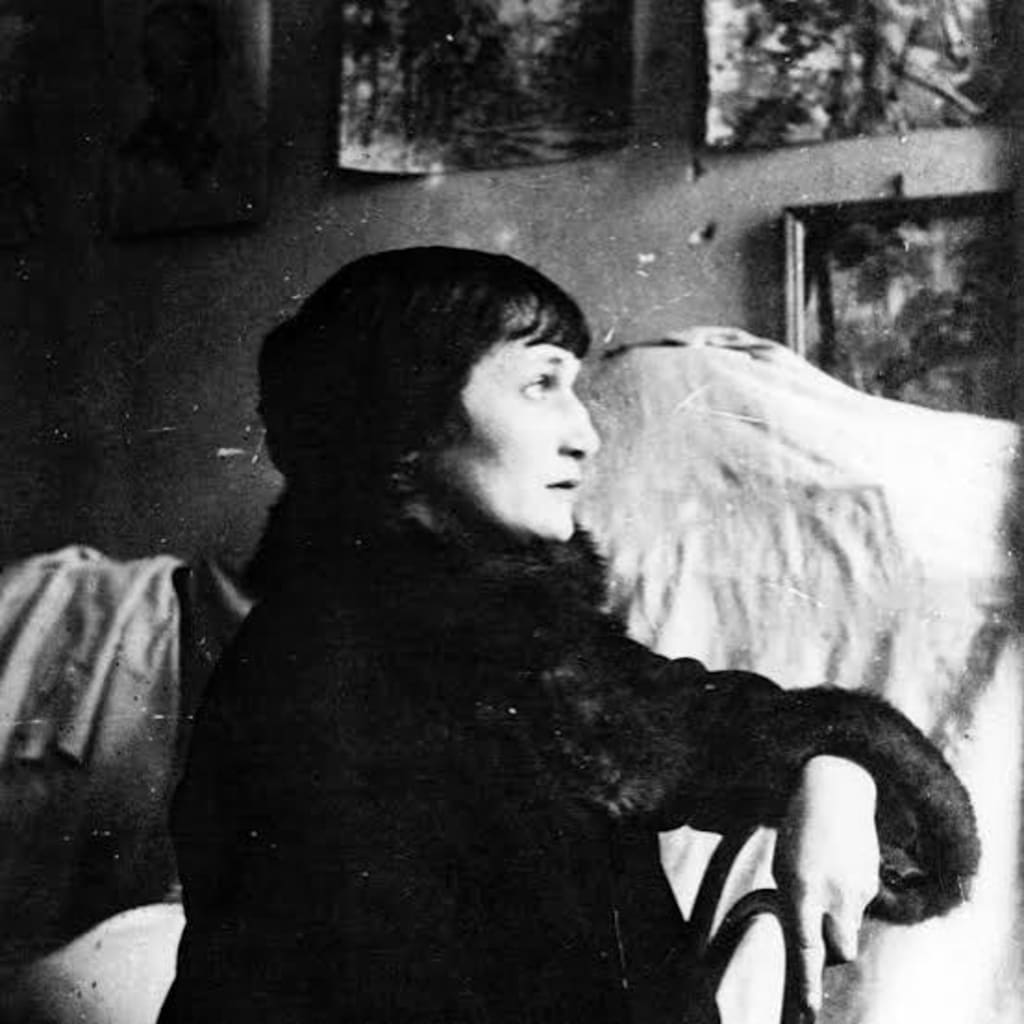
Anna Akhmatova, one of the most powerful and enduring voices of Russian literature, died yesterday at the age of 76 after a long illness. Revered by readers across generations and feared by Soviet authorities for her uncompromising moral vision, Akhmatova leaves behind a body of work that chronicles both private sorrow and the collective suffering of her people.
Born Anna Andreyevna Gorenko in 1889 near Odessa, she adopted the pen name Akhmatova in her early twenties and quickly rose to prominence before the Russian Revolution. Her first poetry collections, Evening (1912) and Rosary (1914), established her as a central figure of the Acmeist movement, known for clarity of language and emotional restraint. Her early poems explored love, betrayal, and spiritual yearning with a sharp, economical style that distinguished her from the mystical excesses of her contemporaries.
The Bolshevik Revolution transformed both her life and her art. While many writers fled Russia, Akhmatova chose to remain. That decision would cost her dearly. Her former husband, poet Nikolai Gumilyov, was executed in 1921 by the new regime, accused of counterrevolutionary activities. Her only son, Lev Gumilyov, spent many years in Soviet labor camps. These personal tragedies became inseparable from her poetic mission.
During the Stalinist purges of the 1930s, Akhmatova was officially silenced. Her works were banned from publication, and she survived largely through translations and the support of loyal friends. It was in this period that she composed Requiem, her most famous cycle of poems, memorializing the suffering of women who waited outside prisons for news of their imprisoned sons and husbands. The verses were too dangerous to write down; friends memorized them, and the manuscripts were burned to avoid detection.
For nearly two decades, Akhmatova lived in what she called her “years of silence.” Yet her reputation did not fade. Her poems circulated secretly in handwritten copies, and she became a symbol of moral endurance for younger writers who looked to her as a living link to pre-revolutionary Russian culture.
After the death of Stalin, her standing gradually improved. In the late 1950s and early 1960s, selected works were again permitted to appear in print. International recognition followed. She was awarded an honorary doctorate from the University of Oxford in 1965 and traveled abroad for the first time in decades, greeted as one of the great poets of the 20th century.
Akhmatova’s later masterpiece, Poem Without a Hero, reflects on the lost world of St. Petersburg society before the Revolution, weaving memory, guilt, and historical reckoning into a complex meditation on time and survival. Critics have compared her role in Soviet culture to that of a witness, recording events not through political slogans but through human voices.
Though frail in her final years, she continued to revise and organize her poetry, determined that her work would reach future generations intact. Friends describe her as austere yet warm, fiercely independent, and deeply conscious of her responsibility as a poet in a society that had sought to erase her.
Anna Akhmatova’s death closes a chapter in Russian literary history that began before the Revolution and endured through terror, war, and repression. Her poems stand as testimony to suffering without surrender and to the power of language in the face of silence. In the words she once wrote, “I was then with my people, there where my people, unfortunately, were.” That line now serves as her epitaph and her legacy.
About the Creator
Fiaz Ahmed
I am Fiaz Ahmed. I am a passionate writer. I love covering trending topics and breaking news. With a sharp eye for what’s happening around the world, and crafts timely and engaging stories that keep readers informed and updated.
Keep reading
More stories from Fiaz Ahmed and writers in Fiction and other communities.
The Pillar of Sand and Salt
There are phrases in literature that stay with you, echoing long after you’ve closed the book or scrolled past the page. “The Pillar of Sand and Salt” is one of those — a phrase that carries weight, sorrow, and mystery. It’s not just an image; it’s an allegory. A reflection of how fragile strength can be, how endurance often hides beneath layers of vulnerability.
By Fiaz Ahmed 3 months ago in Fiction
There's A Hole in My Bucket
It’s a well-known fact that Liza Dufresne was always the brains in the family. She was the one who always came up with the brilliant schemes the Dufresne kids carried out when they were younger. Like when they tricked Mrs. Claybourn into paying for a trip to Disney World. Liza convinced her that their parents had been kidnapped and were being held for ransom for the total price of three tickets. In reality, they were away on a weekend getaway for their anniversary. When they returned, Liza told the Claybourns that they did not like to talk about the ordeal. Their parents never found out how they got the money. Mrs. Claybourn never found out that the Dufresne parents were never really in any danger.
By David E. Perry3 days ago in Fiction




Comments
There are no comments for this story
Be the first to respond and start the conversation.