
Ash and Morning/Mourning
The Fire Remembers - [The Veiled Dominion]

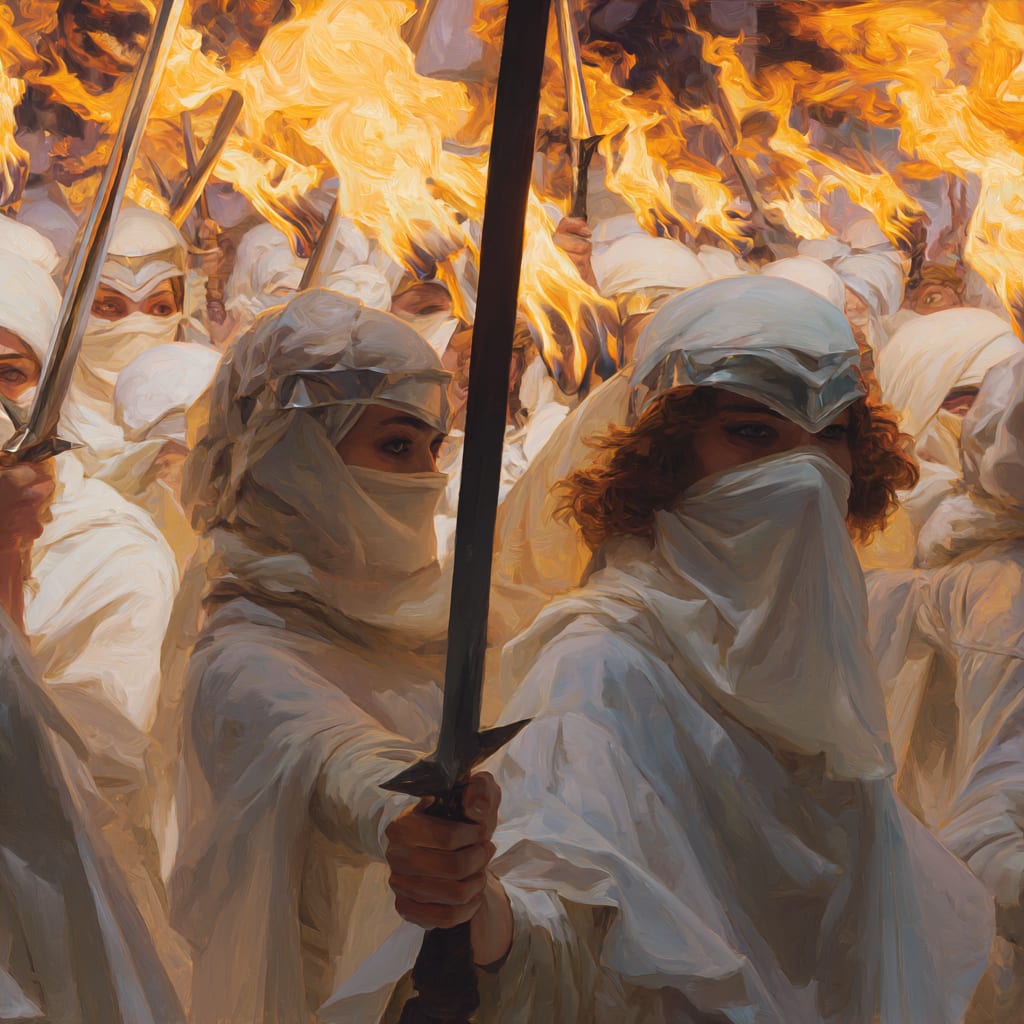
Ash and Morning/Mourning
The Citadel breathes, heavy, damp, heat into its old lungs. The training court holds a chill that lingers with anticipation. I come to it with dust on my cuffs and a sliver of ink caught beneath my nail—a mark from the night’s copying work that refuses the water bowl. The court’s pale ash-bed glints under thin light. Each raked groove is an order imposed and a story erased. We pretend the grooves matter; by midmorning they will be blurred by boot and blade. Impermanent, yet law by pain and memory.
Solenne stands at the far end, her head tilted to see with her ear, her eyes thrown off. Blank. She learned the habit of listening before the illusion of sight. Even now—eyes open, she trusts the wind, only using her peripheral to notice what wind touches. The blade in her hand is a dull thing, the color of cooled clay, fashioned only to teach form and move the air—not divide it.
I should not be here.
The Matrons have rules for when a scribe watches; they like the comfort of sanctioned witnessing. But I am only Scribe Anele, and my name is not often called without, only. I write the little things—rotations of keys, tally of rations, births and misbirths—matters the Dominion pretends are beneath sanctity until someone needs to prove that mercy was, at least, counted. I am not the one they bring to witness an initiate whose silence walks ahead of her like a shadowed guardian.
Yet I am here. The mouth of morning is open and the Citadel’s breath is beginning to warm. Solenne moves.
Her drills are quiet. The blade passes through air as if it had been taught to leave no sound. Each cut ends a finger’s width shy of completion, the way breath stops short of death. Gracefully. Respectfully. The first time I saw her practice, I called the motion wild. Untamed. Now I see it is compassion—love for the form, love for the space before the closing. The breath of life.
Her heel grinds a crescent in ash. Her hip turns, smooth; her shoulder follows, a fragment later. The blade whispers as it goes. There is sweat at the hinge of her jaw. Her mouth shapes a sentence I cannot hear, in repetition.
When she pauses, the court inhales. A sparrow scolds in the rain gutter and receives no answer. I make a note to oil the hinge on the gate that screams at the third turn: Gate S: Third-turn hinge—sand, oil, hush. These are the notes I am allowed. I do not ink the burning sigil on her throat, the pulse under her ear, rippling the air, the way the morning seems to set itself by her rhythm.
The lesson-master ticks the rod once the dust and Solenne shifts form. Distance measured with memory. Solenne walks, blade at guard, toward the chalk-line pillar where initiates practice the blind strike. She doesn’t blindfold. She does not need to. I watched her as a child, hands on the stone, feeling the names chiseled by the dead. She could find the hairline crack running north-northeast across a wall without opening her eyes; she could hear a breath alter at a threshold and tell you someone was waiting there.
A tall flame watches from the Pyres at range, just beyond the court. Hushed voices say if you stand near and listen closely, it whispers the legend of Lirha and her sisters of the Red Shade, whose bloodthirsty blades were said to have taken the names of hundreds of ambitious men. No record proclaims the myth aloud here. We like our silence laced with cyanide.
Solenne plants her foot and cuts the chalk-line clean through the middle. The line unthreads, then collapses like a seam releasing. She lifts the blade to her shoulder and the ash adheres to its edge like ice to a tongue.
The lesson-master grunts, once. She is a methodical woman with a patience only for excellence. Solenne bows; calmly, surely sheathing her blade. The lesson-master nods in the direction of the lower stairs.
“Enough.”
She doesn’t look at me, but I am seen anyway. Everyone is seen by her in the way that we are seen by heat; not as faces, not as names, but as occupants of space, ridges of texture. I have the thirst for shape archetypal of one who has copied too long; it hollows a person until the ink begins to believe it knows more about blood.
Solenne passes the gate. The hinge keeps its secrets because I oiled it yesterday.
There is an order out for her this morning—sealed in matte wax, stamped with a circle and an inner ring. I pressed my thumb to it last night and tilted it in the lamp and made out what was not intended for me: The Trial of Embers. Dawn.
I should have carried the order straight to her haunt as it was written, but I fell asleep at the table instead, face on the wood, and dreamed of a fire that repeatedly asked me when I was going to stop pretending I was water.
I follow at a distance, the way ink follows a scribe between breaths. Stone sweats at this hour. The Pyres reach high. It was Lirha, the legend says, who convinced the flames to keep chanting after the world lost the patience to.
In the passage to the Citadel’s lower levels, the chill lifts from my sleeves. Torches live along the wall, their rhythm broken at odd intervals as if they’re speaking. I tuck my hands in my sleeves so no one sees the ink. I have learned to be the kind of small that the Dominion finds convenient.
Ahead, the door to the Ember Hall waits with a seam like a sutured eyelid. The attendants stand with bowls of dark water and black silk folded into neat bands. The Matron stands as tall as any flame. We know her by her posture and the fact that light refuses her shoulder as if it knows better.
“Archivist Solenne,” says Matron Serath. Her voice discards the echo after it uses it. “Kneel.”
Solenne kneels. The attendants approach with the ash-soaked band and the bowl. I take one step back into a shadow and say nothing. This is my station; to be an unspeaking mouth for what passes here, then to give it a name it did not ask for.
When they blindfold her, Solenne draws a breath so small it could be mistaken for the hushing of a candle. I catch myself mirroring it. The cloth shines damp in the torchlight. It is heavy with ash. She turns her face toward the basin and the Mirror Crucible suspended above it by three iron chains.
There is a sentence in the Book of Still Waters I have copied so often that my hand now writes it without asking my mind’s leave: Guard the flame not from dying, but from remembering what it is. The margin beside that sentence holds three fingerprints in a pale reddish stain from some scribe I will never know. Each time I press my finger to those three ghosts, I tell myself we are somehow kindred.
A bell rings—not the thin bell of the upper halls, but the lower note that makes dust shiver. The Crucible opens with a sigh that is not like a person’s and not entirely unlike. The cinders below lift themselves in a soft ripple. Heat finds my face, and I am suddenly full of an ancient reverence from before the Dominion learned how to look away.
Solenne’s lips move. The attendants claim she’s reciting a verse. I think she is telling the air a secret.
“Begin,” says Matron Serath.
They place the dormant blade across Solenne’s palms. She rises with the softness of someone obeying a familiar hand.
And then the fire chooses its path.
It is not theatrics. It is not a miracle. It is practice, photosynthesis. Light thickens through the blindfold until it is a red world. Heat arranges itself into shapes that aren’t people and never needed to be. Voices unspool from places we have hidden the smallest of our hours. When the first silhouette moves, Solenne moves with it, an answer that trusts the question.
I make my first ink-note on the smooth slate I carry hidden in my sleeve: Trial of Embers—Solenne—morning—no hesitation. The stylus scratches. The sound is a dying moth. I think of the three fingerprints again and nearly smear my line with my thumb.
I should be ready to count, to mark the ritual’s beats. But there is a tremor under the stone that I have never felt at any trial I have watched.
The Matron’s rod strikes the basin’s rim with a crack that feels like the surface of cooled sugar breaking. “Again.”
Solenne answers.
I force myself to pay my proper attention—else this witnessing becomes useless—and begin to keep a second column of notes beside the first, thin marks like a secret footpath: Heat on throat—elegant devotion—sigil bright. I am a lid with a bonded seal. I do not write the impulses that bubble beneath the surface.
I have learned to live without speaking the most important things. A scribe’s survival in the Dominion is a matter of putting the dangerous sentence in the right drawer and then locking the drawer and mislabeling the key. Even so, some things can’t escape the fire’s eye.
The Crucible’s chains lift and groan. The fire blooms. My stylus is slow and steady.
The chamber’s stone begins to sing the way jostling water sings down a long channel.
Matron Serath inclines her head a fraction and the attendants retreat to the walls. The room’s center belongs to Solenne and the thing that wears her name. Her reflection.
My hand holds the stylus as if it were a blade I am not permitted to draw. I write: The flame remembers.
I do not realize I have stood until an attendant tilts his face toward me—the briefest glance, filed as a warning. I smooth the expression I did not know I was making and tuck my slate.
The cloth around Solenne’s eyes darkens. She grows beautiful in a way that frightens me; she burns with purpose. She’s radiant. Her aura makes anything not of it look like a lie. All false spirits must confess.
The fire climbs her throat and traces a circle in heat, her sigil glows.
The Matron’s rod ticks. “Completion lies within obedience.”
Solenne’s voice shakes in the well of my chest. “Obedience to what,” she asks, “when what calls me is myself?”
I swallow the name of the legend that wants to speak. My hand shakes. I feel the heat of the flame like I hadn’t before. Glaring at me. It wants to speak—through me. But I am not brave enough to be a vessel. I am not foolish enough to try. I only write in a hand that will not cost me if anyone reads it.
Even with the blindfold over her eyes, Solenne looks toward the ceiling when the seam opens. I hear the hall’s old scar tissue give. Ash lifts. The attendants gasp and stop it halfway.
I am too close to the observation slit now. My breath fogs the glass. On the other side, the room is a corona around a sun.
You were not forged, Solenne. You were remembered.

When the fire speaks through her, I write the words as they come and later I will wash them before they are engraved into the margin of my ledger where they must be clean enough for a Matron to view.
They buried me in your name.
Matron Serath does not move. Her stillness holds a thousand decisions. I cannot tell which ones are settling into form and which will wait until the hour has changed to be made.
“Name your fire,” she says. “If you can name it, you can carry it. But at what cost?”
“It will tell me its name, for it is true. I will not give it a smaller one,” Solenne answers, and I put my hand to my own mouth to keep the breath.
The room exhales. Flame lowers without retreating. The Crucible’s chains sound three notes as the metal cools. The 9 Mirrors descend—shifting position until there is a flame reflected in the eight flanking. Solenne faces off with her reflection in the center, tallest, Mirror.
She curls five fingers around the hilt of her sword. Her reflection does not move.
The Mirrors shift.
You’re the Dreamer the Dream is seeking.
Solenne’s fingers tumble. She draws no breath. The air around her is stillness undisturbed.
Her discipline is remarkable to witness. She channels the Fire’s voices with clarity.
The Mirrors shift again.
“We are one—but we are not the same.”
Solenne lowers her stance.
She draws. In one motion, before her reflection can fully breach the Mirror, Solenne strikes the emerging shadow that disperses in the air like smoke.
The crow gasps and chattering voices hiss like a doused flame.
An attendant unfastens the knot at Solenne’s nape and the blindfold comes away in a crumble of ash that falls in a soft rush at her feet.
Her eyes are open. She closes them. She opens them again.
Matron Serath taps twice, ritual-true. “Trial concluded,” she says, as though something beneath her words is shaken, like a glass of rippling water revealing a tremor.
The attendants depart, hands at their sides. The heat leaves trails behind their movements. I step back into the shadow, clutching my slate and despising it for being small.
Solenne stays. She touches her throat. The circle now dim like a moon behind a slow cloud. When she speaks, I am already writing, though my hand does not know it has started.
“Nothing truly burns,” she says, as if tasting the sentence until it’s right. “All things are only transformed into memory.”
I wait for the fire to contradict her. It does not.
When she turns toward the door, I make smaller, a lesson I learned young. There’s an entryway of the Ember Hall that’s blackened in an arc that looks like the shape of an eyelid. Solenne leaves with ash lifting at her heels.
I remain. The floor cools as the room calms itself and the tension dissolves. I press my thumb into the corner of my slate and hide the words in my sleeve.
There are things a scribe may write and still keep her body. There are things a scribe must write and accept the price. The difference is not a science. Silence is not a blunt object it’s a knife—there’s a hilt and a blade. Be a good scribe, get the message.
I leave the hall and carry morning on my skin. On the stairs, the warmer air from above meets the last breath of ash and a word forms of its own accord—too coarse to be sanctified, to small to be blasphemous—then it flees before I can apprehend it. Perhaps that is a mercy. Perhaps it is a dare.
In the corridor outside the archive, a servant with coal under her nails glances up and away, the way you’d look away from open light. I nod to her as if we shared a joke. Maybe we do.
Solenne will go to the books. She will press her thumb to the verse with the fingerprints; she will check whether the ink means what it once meant now that the fire has learned to speak with her mouth. I will go to my table and pretend to copy inventories and instead write margins—slow, patient, disloyal. Then hide them.
Above us, the citadel practices the old art of silence. Below us, the ember-bed dreams in orange. Between, a woman walks the length of a hall and a scribe counts the cost in ash.
Veil Fragment: The ash remembers the shape of the hand that scattered it.
About the Creator
Kristen Keenon Fisher
"You are everything you're afraid you are not."
-- Serros
The Quantum Cartographer - Book of Cruxes. (Audio book now available on Spotify)
Keep reading
More stories from Kristen Keenon Fisher and writers in Fiction and other communities.
DARC RAIDERS
Thunder. Rain. I couldn’t wait to shut everything out, throw on the headset and grind some extractions in Darc Raiders. Our Discord group had been talking all week about some of the new updates they finally added to the ransom mechanic—capture another player, lock their account, demand in-game loot and currency. “Ultra-immersive” the devs called it. A player could only be held for 48hrs and after that everything resets. During the first 48, the captors could demand a ransom. Loot from your vaulted stash, loot from your friends, or Rubies (in-game currency) for your release.
By Kristen Keenon Fisher3 months ago in Fiction
A Love Forboding
The chipped stone slope caused unbearable footing. I slid, skirting on my heels. I cast my shield, relinquishing my guard to stay upright. Left with my double-edge and a prayer to the maker, I skated toward my objective. The earthly stubble gave way to solid ground. I found myself restored, a trail of dust in my wake.
By James U. Rizzi3 days ago in Fiction
57 Taylor Swift Quotes for Graduation: Shake It Off & Succeed
The pomp and circumstance have ended, the caps have flown, and suddenly, the vast, exciting, and slightly terrifying future stretches out before you. For graduates navigating this pivotal moment—whether entering the workforce, heading to grad school, or simply figuring out the next step—finding the right words to capture the emotion of the journey is crucial.
By Ann D. Burch3 days ago in Fiction


Comments
There are no comments for this story
Be the first to respond and start the conversation.