
'FRANKENSTEIN' - A LONELY SOUL (REVIEW)
THE SAVED AND THE ONE WHO DOESN'T WANT TO BE RESURRECTED


In Guillermo del Toro's "Frankenstein", the monster created by anatomist Victor wants to be loved but is rejected.
Guillermo del Toro is a director of the unusual, who always finds beauty in the soul behind the unusual appearance. From Hellboy, The Shape of Water to Pinocchio, the characters, whether demons, mermaids or wooden puppets, all have kind hearts. In Frankenstein, a project that has been cherished for more than two decades, the Mexican director returns to the world of science fiction stories, but this time delves into the tragedy between father and son, between creator and created creature.
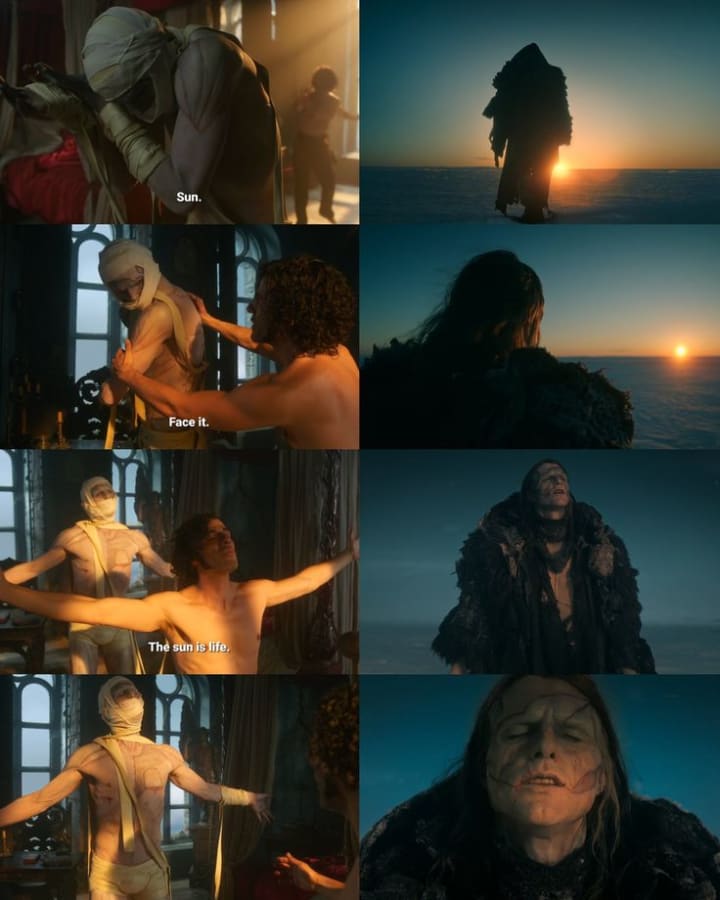
The film opens with a scene in the Arctic, where The Creature (Jacob Elordi) follows the trail of his creator - Victor Frankenstein (Oscar Isaac). The story then flashes back to the past when Victor ambitiously opens a new path for medicine.
The director kept the spirit of the original novel by writer Mary Shelley when asking the question: "What makes a person become a monster?". In the film, Victor declared that he wanted to "master life and death", even considering God as incompetent. He created life with electricity but did not think of the consequences. Del Toro used that image as a metaphor for the modern world, where many people chase after technology, produce new things but forget to take responsibility for what they create.
The filmmaker did not exaggerate the tragedy but instead dissected the actions of Victor and The Creature. The cruelty does not lie in appearance or crime but in the inability of humans to feel love. The director highlighted the message that only forgiveness and sympathy can help humans escape the cycle of pain.
The loneliness of the two characters comes from the same desire to be accepted by others. Both seek understanding, but the closer they get, the more they cannot reach. At first, Victor devoted himself to perfecting the experiment with a passion for creation, but when the creature actually came to life, that love turned to fear. He was not brave enough to see it as a sentient being, nor responsible enough to be the "father" it needed.
Actor Oscar Isaac portrayed Victor's passion and desire for research. The character believed he was serving knowledge but gradually sank into the illusion of power. The scene of Victor sitting alone in the laboratory among the incomplete human remains symbolizes the collapse of reason, when the creator no longer controls the dream.
Actor Jacob Elordi played The Creature with restraint in expression. The character's face was covered with scars but his eyes exuded innocence, showing the contrast between his rough body and his inner world. When protected and taught to read by the blind old man (David Bradley), the creature gradually became a true human. In the scene where the castle is engulfed in flames, The Creature desperately calls out to its master. The cry symbolizes the abandoned soul, hoping to be acknowledged by others. According to IGN, Elordi fully conveys the emotional transition, from naivety and anger to despair and empathy for others.
The work also expands the concept of love through the connection between The Creature and Elizabeth - Victor's younger brother's fiancée. She realizes that hidden under the ugly appearance is a pain that others cannot see, giving The Creature sympathy. Victor's feelings for Elizabeth are like salvation but can also destroy humanity.
The film has a non-linear structure with two parallel perspectives, starting and ending in the Arctic. In Victor's flashbacks is the past filled with hatred, while The Creature's growth process is lessons about love. Experts say the ending closes the cycle of hatred, helping the work go beyond the framework of horror films, becoming a story about humanity.
Del Toro's signature style is present in every frame. He set the scene in 1857, during the time when science was on the rise but religious beliefs still prevailed. The image of Victor's laboratory with its glowing batteries, damp stone walls and wooden tables covered with rotting leaves creates a classic and eerie feel. As Victor transfers electricity to the creature's body, thunderous sounds mixed with the soundtrack of composer Alexandre Desplat open up an overwhelming scene.
According to NPR, during the making of the film, the director minimized the use of digital sets and effects. He said he disliked "perfection" created by machines, while appreciating works that bear the artist's own mark. "Art needs to be created by people to nourish the human spirit," Del Toro said.
Production designer Tamara Deverell and costume designer Kate Hawley built a world covered in red, black and yellow-gray - familiar colors in Del Toro's films. Lighting is arranged like brushstrokes in a painting, making the characters' faces glow in the dark, suggesting they are stuck between reason and instinct.
However, the film sometimes overwhelms by wrapping many philosophical ideas and symbolic images in the same story line. The film's slow pace, lack of highlights and a duration of more than two hours make the emotions intermittent. According to Variety, although rich in images and ideas, the work is somewhat abstract, making it difficult for some audiences to accept.
As the film ends, we have time to reflect on everything that has happened and from here, a big question suddenly appears: who is really the monster?
Wearing his familiar black T-shirt, Guillermo del Toro happily chatted with the audience and ended the premiere with the statement "(Works) AI is shit!". That was when fans were excited to go to the cinema to see his work Frankenstein in October - the month of Halloween horror festival.
Guillermo del Toro, who has won countless major awards from Oscar, Golden Globe to Golden Lion for the film The Shape of Water released in 2017, is a name that is too familiar to cinema lovers.
Before that, his other films such as Pan's Labyrinth, Hell Boy were considered cinematic standards. Above all, he was an important figure in elevating the horror myth genre, captivating millions of audiences around the world with "the beauty of monsters".
Bringing the legend back to the silver screen
Mary Shelley's novel Frankenstein tells the story of Dr. Victor Frankenstein creating a monster by piecing together pieces of dead human bodies. The monster comes to life, is despised and hated by humans. It is angry, comes back to find Victor and kills his relatives in revenge. The two fight and chase each other until Victor dies, and the monster declares that it will burn itself.
The horror of the story resonated greatly and shaped the dark horror style. The image of a large, pale man with a body covered in stitches and a screw on his head has appeared in countless entertainment products, even the character of a dog revived from the dead Frankenweenie for children.
Choosing to make a film with a character that is already so famous is a huge pressure for both director and screenwriter, and Guillermo is in charge of both. It is difficult to build an interesting character without being accused of ruining the familiar image in the audience's mind.
Instead of just borrowing a little content or style, Guillermo decided to boldly keep the entire plot from the original work. Viewers are witnessing the whole event as Mary Shelley wrote in the 19th century. The difference is, this time they see a more subtle, profound perspective.
"Only monsters play God"
With Frankenstein, Guillermo delves deeply into the humanism of the novel, showing the audience the perspective of both characters: the creator - doctor Victor and the created - the monster.
Victor creates the monster with all his passion for research, which has been nurtured since he was a child. But when a life has formed, he does not know what to do with it next. His fear, disappointment, and hatred of the monster are metaphors for the powerlessness and irresponsibility of humans with what they create. Any dream and achievement without calculating the consequences can turn into a nightmare.
Victor thinks he has absolute power to control the monster, but the truth shows that an independent life has its own thinking and direction. The monster comes to life, and is not a machine that follows Victor's instructions. It carries within it a newly born young soul, trying to integrate with humanity, only to realize that life is much harsher than it thought.
And just as it cannot do everything Victor wants, in return, Victor cannot fulfill everything it wants. In the end, bitter and hurt, the monster takes out its anger on the starting point - the person who created it. Both of them thus wander in hatred for each other, pouring out on each other hatred nourished by disappointment and loneliness.
And it is a movie where all the main and supporting characters are a collection of people who are not ready. Victor - a father who is not ready to devote all his love and patience to his creation. William - Victor's younger brother - is not ready to face the blood conflicts with his brother. Elizabeth - William's fiancée - is not ready to step into marriage.
By describing the inner conflict in more depth, Guillermo made the monster in the film more real and close. Viewers cannot help but be moved when the monster can only call out Victor's name when abandoned, because that is the first and only support it knows. When the film ends, we have time to reflect on everything that happened and from here, a big question suddenly appears: who is the real monster?
Clean Horror, Dirty Fairy
Director Guillermo has a sincere passion for monsters. Since childhood, he loved to draw monsters, dragons and skeletons. He turned his home into a giant museum with strange works, statues, paintings and books that he collected or made himself. He especially loves the surreal works of Salvador Dali, so the horror in his films always goes hand in hand with surrealism in painting, soaring and haunting.
And so, unlike the usual horror genre, his films often do not intend to scare and startle viewers. The horror lies in the unusual, bizarre things in reality, not in images of blood flowing and heads falling everywhere. Even Dr. Victor in the film, after finishing the autopsy, cleans up and throws away the trash.
However, when witnessing the image of the blood vessel system on the human body being collected and preserved in a wooden board like the way people collect stamps, viewers cannot help but get goosebumps. Or the stitches on the monster's body are not just random lines but are sewn along the tissues and muscles, causing many people to unconsciously touch their calves.
On the contrary, although famous for putting fairy details into films, director Guillermo never intended to create a gilded version of a fairy tale castle. In Pan's Labyrinth, the "fairies" are shaped like goblins with long pointed ears, naked, gray skin and tattered insect wings.
He believes that the magical element needs to be attached to life, if it is too clean and neat, it will be too far away. So the setting in Frankenstein is similar: the splendid costumes are not far from the dirty scene, the magnificent castles always have a sad, lonely look...
In addition, his works are all associated with a real historical event, making the interweaving of reality and fantasy even more attractive, such as the detail of Dr. Victor and his colleagues walking over the piled corpses on the battlefield without much concern.
The metaphorical images that he painstakingly arranged in the film are also slices of human fate and attitude, and therefore, the process of watching this film is also a process of moments of contemplation.
The Father's Shadow
Director Guillermo, whose full name is Guillermo del Toro Gómez, grew up in Mexico in a middle-class family. When he was 10, his father won the lottery, became successful, and he was able to attend an expensive private school.
Businessman Juan Cumming, a classmate of Guillermo, shared with this writer about the environment at that time: a strongly patriarchal Catholic society, where the father held all the decisions in the family, no matter how unreasonable. The father-son relationship was built in the direction of mentor and disciple rather than blood relatives.
Perhaps because of growing up in such an environment, in all of Guillermo's works, the father character always has a motif: powerful, rigid, caring for children only at the level of indifference or excessive harshness. The mother is often gentle but weak, even short-lived.
In Frankenstein, the character of Doctor Victor also experienced a relationship lacking love from his father, and he himself was an irresponsible "father" to the monster he created. However, unlike the original story where Victor hated the monster until the end of his life, the character Victor in the film had a different ending to close the Frankenstein story peacefully, perhaps similar to what director Guillermo had in mind and wished for: a peaceful father-son relationship, so that no more monsters would be born.
About the Creator
HieuDinh
- Loves nature, likes to grow ornamental plants such as succulents, lotus (participates in volunteer activities to plant forests, protect forests in the locality)
- Loves dogs and cats (participates in local wildlife rescue activities)
Choose Your Own Adventure: St Helena Station
*****Preface***** I have been obsessed with Choose Your Own Adventure stories since I was a kid. I credit them with my love of reading and writing. I've been struggling to get my own kids to embrace words the same way I have but they love video games and our occasional Dungeon's and Dragon's game... which gave me an idea. I'll write an interactive story. So far its working; my middle son loves it and can't wait for the next section to come out.
By Sandor Szabo6 days ago in Fiction


Comments
There are no comments for this story
Be the first to respond and start the conversation.