
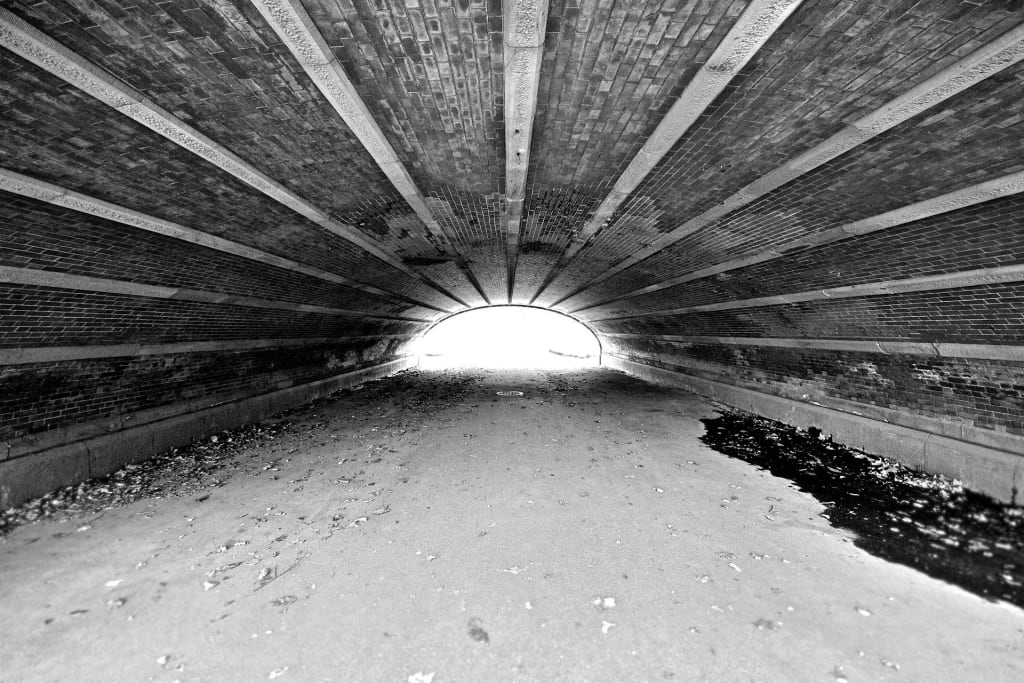
“I wish it had been as simple as a nuclear war,” her aunt said when Pim was old enough to ask what happened.
“They used to say war is in our nature, but it turns out, we weren’t destined to go extinct in a sudden blaze of glory,” said the auntie who had lived through the end of the world. “Instead it was a slow, predictable march to self-destruction.” Pim, then a young 6 years old, blinked up at her without understanding. Auntie sighed.
“We put people in charge who weren’t interested in saving us. That’s what happened.”
Now Pim looked up at the cavernous doorway yawning before her. On the other side was a last remnant of the civilized world, her deliverance — if she could get in.
As she grew older, Pim learned more of the story, gathered in bits and pieces from the dying few who still remembered.
From a toothless old man, Pim first heard of something called ‘Hypo-Inflayshin.’ She wasn’t sure she quite understood it, but she knew it meant people paid a lot more for a lot less. It got so bad that the toothless old man said he once paid 100 bucks for a gallon of milk.
Even in the world after, Pim couldn’t imagine trading just one deer for some milk. Of course, there weren’t many deer left in Pim’s world, so maybe they had been easier to come by before.
She swayed where she stood, dehydrated from the heat and a painful journey through hell and back, all to get here. It was supposed to be a paradise, the other side , where technology of the old world still lived, where food and water were plentiful.
If the price to get there was steep — and it had been — the price to get in was said to be even higher.
Her thumb traced along the small crack that now ran through her last possession, a dying gift from her mother.
A strong-willed woman, her mother; very no-nonsense. Pim had always looked up to her, in the way people look up to those they could never live up to. It had been a surprise when, on her deathbed, Pim’s mother gave her the locket. Before that night, she had never seen it. Never saw it around her mother’s neck, or heard mention of its existence. But since that day, Pim had kept it close.
Caked blood showed through the ripped and torn clothing that had turned into little more than rags on her bowed shoulders. Sunburned, cut, bruised and beaten, without coin, food, or anything of value to the world at large, she limped forward into the tunnel.
The night before, she had nearly lost the necklace. Up to that point, she had made it through thieves, corruption, creatures of the wasteland — it was a band of wild boys simply looking for amusement that had nearly been her downfall.
She let her guard down, so near to the end of her journey. It still made her sweat and her heart beat fast, remembering how the scoundrels had come upon her in the dark. They threw her down, kicked her over and over again, yanked her pack away as she tried with all her might to hang on.
It was as one of the straps of her pack broke off in the savage tug-of-war, the locket caught on a flailing limb and popped off her neck.
She scrabbled after it in the hard dirt, but the biggest of the bunch saw and scooped it off the ground.
“Hwoo, that’ll fetch a nice price,” said one of the others. The boy turned it over in his palm. He smirked, then laughed.
“It’s nothing but crappy plastic,” he said, then dropped the locket, and looking Pim in the eyes, ground it beneath his heel. She could hear the plastic crack as she looked on helplessly. Plastic. The one thing in the world after with absolutely no value at all.
Everything else they took: all her water, food, supplies.
The only thing she held onto was the battered necklace now clutched in her shaking hand.
Often she suspected that those she quizzed about the end of the world were playing with her, or else losing their minds. Another old man told her that hundreds of thousands of people traded all their money for a made-up currency that only existed on computers.
Around the same time, worldwide sicknesses scourged the planet. They became as regular as rain — which, incidentally, became much less regular. Apparently the planet had already been dying for a while, but nobody really did anything about it.
It seemed beyond belief to Pim that such an advanced civilization would let all that happen, but looking around at her world — dried up, diseased, dying — all those stories started to add up.
She survived by moving around. Sometimes she could find work, other times she begged, and sometimes she stole.
Along her travels, people glorified the legends of bounties paid for entry through the Gates of Utopia. The paradise on the other side had its own currency, but there was no hope of getting any. It was common knowledge that their money came from the clouds.
Instead, people traded resources. A truck full of oil, a whole convoy of vegetables, an actual bar of gold — Pim had even heard the story of a man who traded his own daughter.
She vaguely wondered if 100 bucks would have gotten her in. It didn’t matter, because she didn’t have food, or gold, or anything else except the gift left to her by her mother. The small plastic locket, now cracked, was all she had left in the world. She just hoped it would be enough.
Gripping the locket tightly, she limped forward into the dark tunnel.
It was a long walk. More than once, she wondered if all that suffering had only been to fall short and die this close to the end. She thought too, stumbling along in the dark, that the whole thing might be a fable, and this tunnel simply went on forever until anyone who entered it died of exhaustion.
Eventually a distant light shimmered into existence ahead. Her heart started pounding. So much that in her weakened condition, it made her lightheaded. But now that she saw literal light at the end of the tunnel, she was determined to know for sure.
She emerged into a small ravine. Ahead, a wall of concrete and railroad ties extended from one rock face to the other, so high she couldn’t make out all the metal objects cobbled together at the top.
At the base were a handful of soldiers. She knew they were soldiers, because they all wore similar clothes and carried rifles. But when they saw her, they didn’t shoulder their guns, jump up screaming and yelling, or react to her at all.
Most of them sat around a small table, holding bits of rigid paper and passing them around. One soldier slapped down his pieces and the group broke into jovial ruckus.
She continued forward, holding out the locket, letting it dangle from a now-useless string.
One of the soldiers saw her and came forward slowly, begrudgingly.
Without a word he snatched the swinging pendant out of the air. After so long keeping it close, it hurt Pim to see it handled so, but she didn’t try to stop him. The soldier turned it over in his hand.
The locket had an intricate design, but crude, like a clever child saw the real thing and tried to imitate it with clay. It was made of a rigid but weak plastic, and it was warped around the edge, having once gone too near a flame.
When the soldier got a close look, he smirked, just like the boy.
“Sorry kid, that won’t get you through.” He tossed it back to her carelessly and turned away.
Pim caught it and shuffled after him breathlessly, “Wait!” Fumbling, she dug short, splintered nails into the crack piercing her plastic heart, and pried it apart.
As it continued to crack, nearly breaking in two, a small black rectangle fell out into her hand. It too was plastic, but not the cheap, fragile kind of the locket. This was hard, flexible plastic, interrupted by a series of small metal slats on one end.
The soldier turned and saw the memory card in her hand. Curious, he walked back over, pulling out a small handheld device from his pocket. He took the card and inserted it.
All Pim could see was a flash of numbers crawling across the screen, but the soldier’s eyes widened in surprise.
“Well I’ll be damned,” he said. He looked up at Pim in something close to awe. “I guess you can come on in.”
She smiled, hearing her mother’s last words in her ear: “Hold on to this locket, Pim. It’s the most valuable thing left in the world. If you lose everything else, hold on to this. It might save you, someday.”
And Pim walked through the Gates of Utopia. Tying the broken ends of string around her neck, she walked through with her mother’s locket, cracked but whole, around her neck.
About the Creator
Keep reading
More stories from writers in Fiction and other communities.


Comments
There are no comments for this story
Be the first to respond and start the conversation.