
How the Conflict Nearly Escalated into Full War
A Deep Military Analysis of a Night the Region Will Never Forget

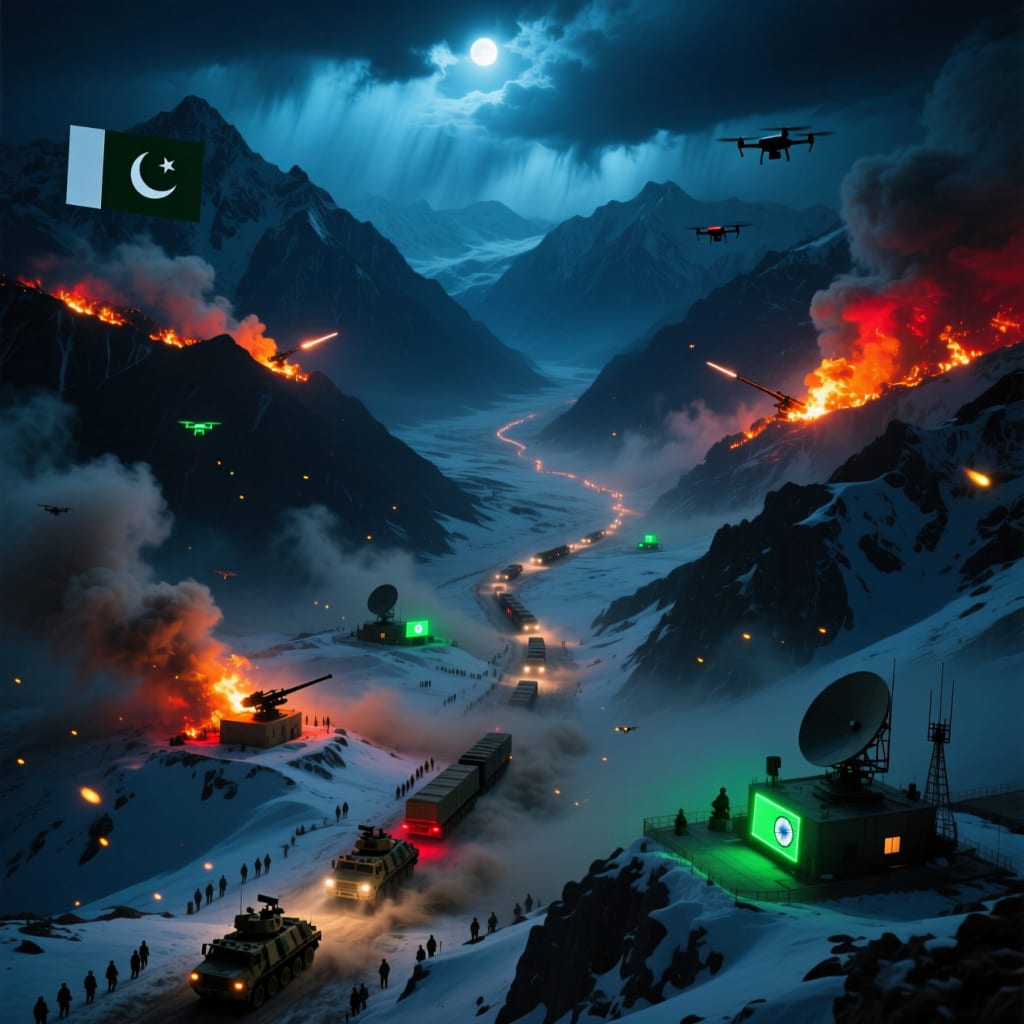
How the Conflict Nearly Escalated into Full War
For years, the region had lived under a cautious balance—an invisible thread of pressure between Pakistan, India, and Afghanistan. Diplomats called it “controlled tension,” generals called it “the edge,” and civilians prayed it would never snap. But last week, the impossible nearly happened. For seventeen hours, the region stood just one wrong move away from a full three-front war.
This is the inside story of how it began, how it escalated, and how it was stopped at the last possible moment.
The First Spark
It began just before sunrise, when a series of unidentified drones crossed into disputed territory. Their origin was unclear—no markings, no communication signals, no known flight path. Radar operators in Pakistan spotted them first, tracing their movement over the rugged mountain ranges.
Within minutes, India detected the same drones coming from another angle. Afghanistan, still struggling with its own internal issues, also reported strange aircraft over its eastern ridge.
Three countries. One unknown threat. Zero clarity.
Each military assumed the drones belonged to the other.
The First Response
Pakistan scrambled its air-defense units. India activated rapid-intercept jets. Afghan border forces went on high alert. What should have been a coordinated investigation turned into confusion and suspicion. Messages were sent but not answered quickly enough. Radar locks appeared. Troops shifted positions.
In a region where mistrust runs deep, even silence becomes dangerous.
The Escalation
The first explosion changed everything.
A drone crashed near a Pakistani outpost, triggering a small fire. No soldiers were harmed, but the impact was enough to trigger full defensive protocols. Warning shots were fired into the air. Across the border, this was misread as aggression.
India responded by moving armored vehicles closer to the line. Afghanistan began relocating its mountain units. A tense but still manageable situation suddenly became unstable.
For the first time in years, all three borders braced for a confrontation.
The Moment of Panic
By mid-afternoon, satellites picked up large-scale troop movement on both sides of the Pakistan-India border. Artillery units were repositioned. Command bunkers were activated. Communications traffic surged as senior commanders prepared for scenarios they had long feared.
It was the kind of chain reaction military analysts call a “flashpoint”—a moment when misunderstanding becomes momentum and momentum becomes danger.
The region’s entire future teetered on the edge.
Inside the Command Rooms
Sources reported frantic activity in all three military headquarters. Pakistani commanders were convinced the drones were a provocation. India believed the sudden movement across the border meant something bigger was coming. Afghanistan, caught between two larger neighbors, prepared to defend its frontier.
Diplomatic channels were burning with urgent calls:
“What are your forces doing?”
“Who launched the drones?”
“Pull back your artillery or we cannot guarantee stability.”
But armies react faster than diplomats. And the border was heating up fast.
The Turn of Events
By evening, new intelligence arrived—visual proof that the drones were not from Pakistan, India, or Afghanistan. They appeared to be modified commercial drones, likely operated by an unknown third group trying to ignite conflict.
This changed everything.
Within minutes, emergency communications were established. Troops were told to hold position. Intercept jets pulled back. Artillery was ordered to maintain silence. A carefully coordinated de-escalation began.
What could have become a war became a wake-up call.
The Seventeen Hours That Shook the Region
When the night ended, all forces were still in place, but the danger had passed. Analysts now call this the closest the region has come to large-scale conflict in over a decade.
It was not caused by armies.
It was not caused by governments.
It was caused by miscommunication, suspicion, and the fast pace of modern warfare.
What Comes Next
As the dust settles, intelligence agencies across the region are searching for whoever launched those drones. Diplomats are pushing for a new agreement to prevent similar incidents. Civilians remain anxious, knowing how close they came to a catastrophe that could have reshaped the entire map.
The world saw only the headlines.
But those who watched the borders that night will never forget the truth:
War almost began—not because someone wanted it, but because no one could stop it fast enough.
About the Creator
Wings of Time
I'm Wings of Time—a storyteller from Swat, Pakistan. I write immersive, researched tales of war, aviation, and history that bring the past roaring back to life
Keep reading
More stories from Wings of Time and writers in Fiction and other communities.
The Day Three Borders Burned
When Pakistan Faced Two Fronts Nobody expected the morning of 26 November to become the most frightening day in recent memory. Life in northern Pakistan began as usual—children preparing for school, shopkeepers opening their shutters, farmers heading toward fields still wet with dew.
By Wings of Time 2 months ago in Fiction
Our Song
Evening has given way to night. Gently, I settle next to you on the comfortable, old love seat and reach for your hand. You snatch it away, again. It cuts me to the quick, but I hide the pain, understanding that the reaction is but part of your demented state. Since the accident, your presence here in our cozy home has been clouded by a haze I can't see. Nevertheless, I feel the frigidity of your expressions and it serves as an excruciating reminder of the immeasurable distance between us.
By Dana Crandell4 days ago in Fiction
Jars
Jim sat in his favorite rocker, beams of late afternoon sun draped over his lap instead of stabbing him in the eyes like on Billy’s side of the porch. He twirled a lollipop between his fingers, occasionally popping it in his mouth. He’d been doing this since he stopped smoking. The young’uns didn’t remember the cloud of Pall Mall that used to shroud his face as he told his tales. The kids were playing in the yard and under the porch, out of the September heat in the cool sand, sun shining between the shadows of the slats. Presently, a grubby face appeared over Jim’s shoulder. The kids wanted to go down to the creek to play.
By Harper Lewis5 days ago in Fiction
Writing About Writing: The Rainbow Trap
The good thing about living in modern times is that LGBTQ representation in media is increasing. Not just in niche and Independant media, either, but also in mainstream media. Books, movies, TV shows, comics... they're finally catching on that LGBTQ+ people form a significant part of their audience, and deserve to see themselves on screen and in fiction, not just as victims in documentaries and true crime shows.
By Natasja Rose4 days ago in Writers




Comments
There are no comments for this story
Be the first to respond and start the conversation.