
Salt for the Name-Price
What the sea learned when Odysseus said he was Nobody

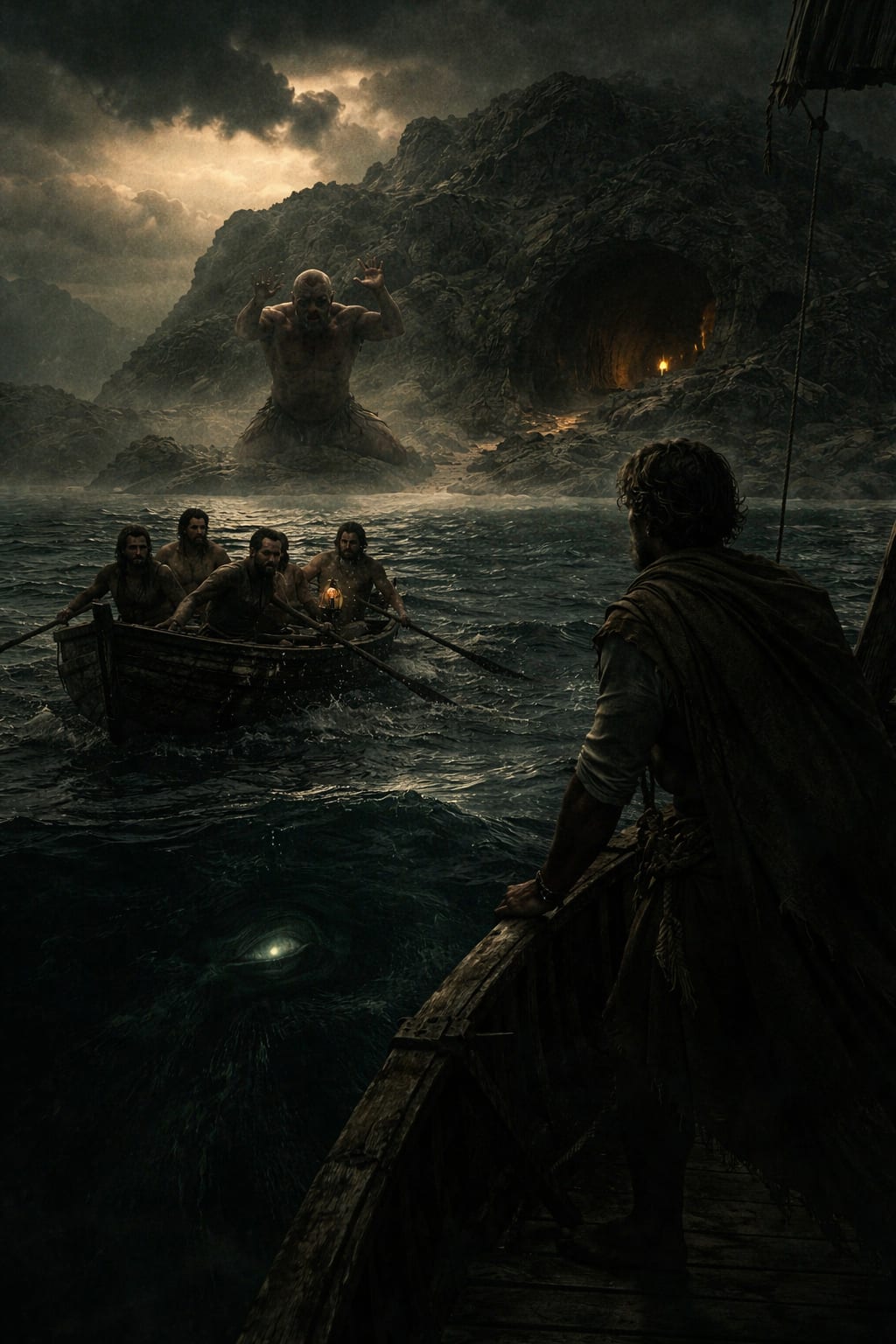
Everyone remembers the stake.
They remember the olive-wood spear, hardened in fire, the way it went into the Cyclops’ eye while he slept. They remember the roar, the trembling cave, the men shouting in terror and triumph.
And they remember the cleverness.
“My name is Nobody.”
It’s a perfect line. It makes the story neat. It makes Odysseus sound like a man who could outthink the dark itself.
But nobody ever asks what happens to a word after you say it.
Nobody asks where it goes.
I was there when Odysseus said it.
I was the one carrying the salt.
Not cooking salt. Sailor’s salt. Wrapped in leather, kept close so the damp couldn’t ruin it. Salt for preserving meat. Salt for sealing wounds. Salt for reminding the sea that you still belonged to yourself.
When we found the cave, Odysseus wanted to stay.
It was full of food. Cheese stacked in woven racks. Sheep penned behind low stone walls. Signs of ownership.
Eurylochus whispered, “We should take what we can and leave.”
That was the sensible thing.
Odysseus shook his head.
“We stay,” he said. “The owner will offer gifts.”
He believed the world worked that way. That danger could be negotiated with, if you were clever enough.
We waited.
The Cyclops came at dusk.
He filled the cave entrance, massive and silent, his one eye reflecting the last of the dying light. He rolled a boulder across the entrance with ease. It landed with a final sound.
We were trapped.
He saw us.
He did not ask why we were there.
He simply reached down, picked up two men, and killed them. Quickly. Efficiently.
Not in anger.
In hunger.
That night, we huddled together while he slept, his breathing thick and wet.
Odysseus whispered his plan.
“We’ll blind him,” he said. “And when he asks who did it, I’ll tell him my name is Nobody.”
The others nodded.
They always nodded.
I did not.
“Names are not empty,” I said quietly.
Odysseus looked at me.
“They’re sounds,” he replied.
“They’re anchors,” I said. “They attach things.”
He smiled slightly.
“That’s the point.”
He didn’t understand.
Or he understood and didn’t care.
He poured the Cyclops wine the next day. Strong wine. Undiluted.
The Cyclops drank deeply. His eye grew heavy.
“What is your name?” the Cyclops asked.
Odysseus did not hesitate.
“Nobody.”
The word left his mouth and entered the world.
I felt it move.
Not through air.
Through everything.
The Cyclops laughed and promised to eat him last.
When he slept, we drove the stake into his eye.
His scream shook the cave.
Other Cyclopes gathered outside, shouting questions.
“Who hurt you?”
“Nobody!” he screamed.
They left.
The trick worked.
That’s the part people love.
But something else happened.
The cave itself seemed to listen.
The island heard the word repeated.
Nobody.
Nobody.
Nobody.
A name shaped like absence.
A thing defined by not being.
In the morning, we escaped beneath the bellies of the sheep.
The Cyclops stood at the entrance, running his hands over their backs, feeling for us.
He did not find us.
We reached the ship.
We pushed into the water.
We were free.
That should have been the end.
But Odysseus couldn’t leave it unfinished.
He stood at the stern and shouted.
“It was Odysseus who blinded you!”
He gave the world his name.
The Cyclops screamed a prayer to Poseidon.
That part is true.
The curse followed.
But the curse was not the beginning.
It was the echo.
The real damage was already done.
Because the world had heard Nobody.
And the world had accepted it.
—
At first, the changes were small.
A man went missing on an island.
Not unusual.
Odysseus asked his name.
No one could say it.
They remembered his face.
His voice.
His laugh.
But his name slipped away.
It had shape in their minds, but no sound.
Like something had taken the part that made him real.
Odysseus frowned but said nothing.
More men disappeared over time.
Not violently.
Quietly.
Like they had stepped slightly out of alignment with the world.
One night, I leaned over the ship and listened to the water.
Something moved beneath us.
Not swimming.
Following.
Learning.
The sea is patient.
It does not rush to use what it learns.
It waits.
—
The fog came weeks later.
Not a storm.
Not wind.
Just fog.
It surrounded the ship completely.
The water grew still.
Then came the whispers.
Names.
Soft.
Familiar.
Men lifted their heads.
“They’re calling me,” one whispered.
“No,” I said.
But he stepped forward anyway.
He leaned over the edge.
And disappeared.
No splash.
No struggle.
Just gone.
Others followed.
Each one responding to something only they could hear.
Odysseus shouted their names.
But the names failed him.
His voice broke around them.
Like the words had been hollowed out.
The fog shifted.
And then something answered.
Not a voice.
A presence shaped into sound.
“Nobody.”
Odysseus froze.
For the first time, his cleverness had been taken from him.
The trick no longer belonged to him.
The sea had learned it.
—
I scattered my remaining salt into the air.
Salt preserves.
Salt holds form.
The fog recoiled slightly.
Not in fear.
In recognition.
The whispers faded.
The sea loosened its grip.
But it did not forget.
It never forgets.
We escaped.
But the ship was quieter afterward.
Men stopped saying names aloud.
They spoke carefully.
As if language itself had become dangerous.
Odysseus still insisted on naming things.
He needed the world to know him.
To remember him.
But I saw something change in him.
Sometimes he would stop mid-sentence.
Searching for a word.
His own name sitting heavily behind his teeth.
As if he feared what might happen if he lost it.
Or worse—
If something else claimed it.
—
That is what the myth does not say.
It tells you Odysseus tricked the Cyclops.
It tells you Poseidon cursed him.
It tells you the sea punished his pride.
But it does not tell you that Odysseus gave the sea a new idea.
He taught it what Nobody meant.
He taught it that identity could be removed.
That a man could exist and not exist at the same time.
The sea did not invent that idea.
Odysseus did.
He spoke it first.
And the sea listened.
Even now, long after his bones became dust, the sea remembers.
It waits beneath ships.
It listens beneath names.
And sometimes, when someone stands at the edge of the water and whispers, “I am nobody,”
the sea answers.
Not in anger.
Not in rage.
But in recognition.
As if greeting something it has been waiting to reclaim.
About the Creator
Lawrence Lease
Alaska born and bred, Washington DC is my home. I'm also a freelance writer. Love politics and history.
Keep reading
More stories from Lawrence Lease and writers in Fiction and other communities.
The Conference Room With No Windows
Every Monday at 9:00 a.m., the team met in Conference Room B. It had no windows. No one remembered when it had stopped having windows. Most people were sure it used to have at least one. Possibly two. Facing east. Or west. The direction shifted depending on who was speaking. But now the walls were seamless, uninterrupted drywall, painted a neutral beige that never reflected enough light to confirm the time of day.
By Lawrence Leaseabout 5 hours ago in Fiction
Valentine's Day Sucks
Valentine’s Day sucks. Boyd sighed as he saw Charlie sidle up to the bar and order a beer. A few feet away sat his girlfriend. This was a problem. His friend Charlie ran a standard Valentino scam on vampires: He would seduce them and then kill them. He was good at it. However, he had a healthy libido, so occasionally he would fall for a target. This could cause complications.
By Jamais Jochim3 days ago in Fiction
The Pride Flag and the Diversion
For nearly a decade, the LGBTQIA Pride Flag rippled in the wind at Christopher Park, a kaleidoscope of color staked into the soil of America’s first national monument to LGBTQIA+ liberation. That flag came down this week. Federal officials, citing new guidance from the Trump Administration, silently lowered the rainbow flag from its pole across the street from the Stonewall Inn. The birthplace of the modern gay rights movement now flies only the United States flag.
By Tim Carmichael5 days ago in Pride


Comments
There are no comments for this story
Be the first to respond and start the conversation.