
Secrets in the Grey Stone
Foundling of the Haunted Academy

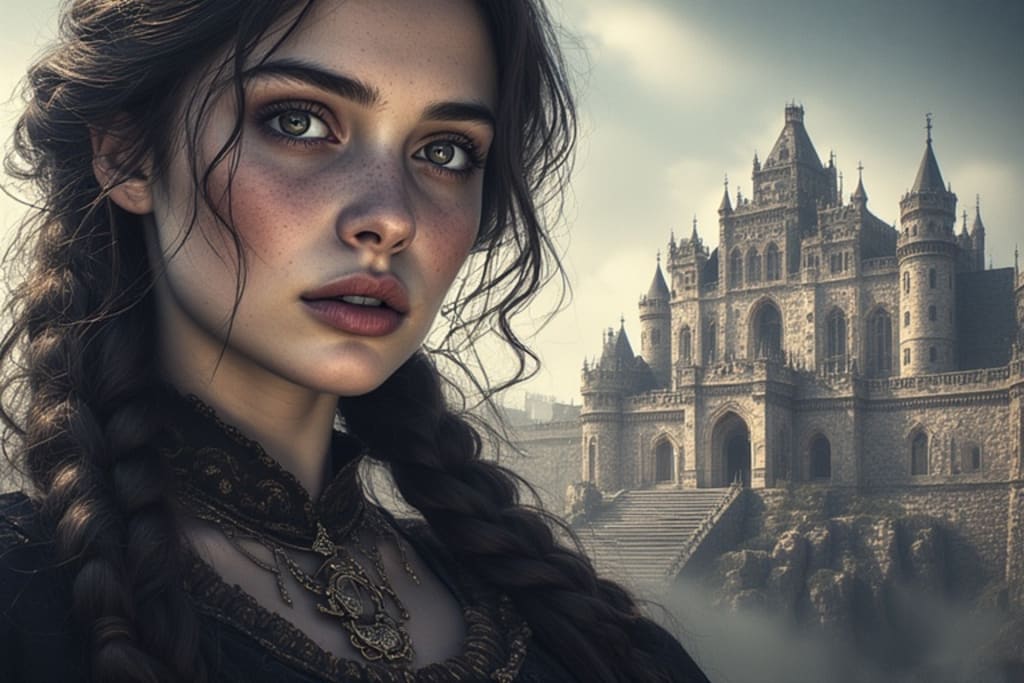
The chipped porcelain of the teacup warmed Elisabeth’s hands, but did little to thaw the chill that had settled deep in her bones. Rain lashed against the gothic windows of Blackwood Academy, mirroring the tempest brewing within her. It wasn’t the storm that frightened her, not anymore. It was the silence. The *wrongness* that had permeated Blackwood since the Autumn Equinox.
Blackwood wasn’t Hogwarts. It didn’t boast sprawling grounds, cheerful house elves, or a headmaster with a twinkling eye. It was a fortress of grey stone, perched on a crag overlooking the churning North Sea, dedicated to the study of Aethelcraft – the ancient, often brutal, art of manipulating the energies that flowed through the world. And it was a place where secrets festered like mold in the damp stone.
Elisabeth Blackwood, despite sharing the Academy’s name, was an anomaly. She wasn’t descended from the founding families, the ancient lineages who believed Aethelcraft was their birthright. She was a ‘Foundling,’ discovered as a babe on the Academy steps during a particularly violent storm, a single obsidian flower clutched in her tiny fist. The flower, now preserved in a glass case in the Headmaster’s office, was the only clue to her origins.
Now, at sixteen, Elisabeth was considered one of Blackwood’s most gifted students, a prodigy in the discipline of ‘Shadow Weaving’ – the manipulation of darkness and illusion. But her gift felt less like a blessing and more like a curse. It drew her to the edges of things, to the places where the veil between worlds thinned, and lately, those places were whispering.
The silence had begun with the disappearance of Master Alistair Finch, the Academy’s historian and a man who knew Blackwood’s secrets better than anyone. He’d vanished without a trace, his chambers locked from the inside, his research on the ‘First Binding’ – a ritual said to have contained a powerful, ancient entity – left unfinished. The official explanation was a sudden, debilitating illness, a convenient excuse offered by Headmaster Thorne, a man whose smile never quite reached his cold, grey eyes.
Elisabeth didn't believe it.
“You’re staring into your tea again, Elisabeth,” a voice said, pulling her from her thoughts.
She looked up to see Caspian Thorne, the Headmaster’s son, standing beside her. He was everything she wasn’t: handsome, privileged, and effortlessly charming. He was also a master of ‘Stone Shaping,’ able to manipulate earth and stone with a flick of his wrist. He was, in short, everything Blackwood valued. And he was, inexplicably, drawn to her.
"Just thinking," Elisabeth said, her voice flat.
"About Master Finch?" Caspian asked, dropping himself onto the bench across from her.
“Isn’t everyone?”
“Father says it’s best not to dwell. Grief is… unproductive.” Caspian’s tone was carefully neutral. Elisabeth knew he was testing her, gauging her reaction. Thorne controlled Blackwood with an iron fist, and Caspian was his eyes and ears.
"Unproductive for whom?" Elisabeth asked back, her eyes unflinching.
Caspian’s lips tightened. “He means it’s best to focus on our studies. The Equinox Trials are approaching.”
The Equinox Trials. A grueling trial by skill and will, led once every seven years. Only the very best among the students could see the most closely guarded secrets of the Academy. And those who couldn't make it… nobody spoke about those who didn't.
“I’m aware of the Trials,” Elisabeth said, taking a sip of her tea. “I’m also aware that Master Finch was researching something dangerous. Something that might have gotten him… removed.”
Caspian's hand closed into a fist. "Serious accusation, Elisabeth."
“Is it?” She leaned forward, her voice a low murmur. “He was obsessed with the First Binding. He believed it wasn’t a containment, but a… a negotiation. That the entity wasn’t imprisoned, but *waiting*.”
Caspian stood abruptly. “You’ve been listening to the rumors. Old wives’ tales. The First Binding is a legend, nothing more.”
"Legends often have roots in truth," Elisabeth said, watching him go.
She knew she was walking a dangerous path. Questioning Thorne was akin to poking a sleeping dragon. But she couldn’t shake the feeling that Finch’s disappearance was connected to the First Binding, and that Thorne was deliberately obscuring the truth.
That night, Elisabeth couldn’t sleep. The rain continued to batter the Academy, and the shadows in her room seemed to writhe with a life of their own. She slipped out of bed, pulling on a dark cloak, and made her way to the Academy library.
The library was a vast, cavernous space, filled with towering shelves crammed with ancient tomes. It was usually deserted at this hour, guarded only by a silent, spectral librarian named Silas, who seemed to exist halfway between worlds.
Elisabeth headed straight for the restricted section, a heavily warded area accessible only to senior faculty and a select few students. She’d learned a few tricks over the years, bypassing the simpler wards with her Shadow Weaving. But the wards around the First Binding section were different, complex and layered, humming with a dark energy that made her skin crawl.
She spent hours working on the wards, her fingers tracing the intricate patterns, her mind probing for weaknesses. Finally, with a surge of power, she managed to disable the final layer. The door creaked open, revealing a small, circular chamber.
Inside, the air was thick with the scent of dust and decay. Books lined the walls, their spines cracked and faded. In the center of the room stood a single pedestal, upon which rested a massive, leather-bound volume. The Book of Bindings.
Elisabeth approached cautiously, her heart pounding in her chest. She opened the book, and the pages seemed to glow with an eerie light. The text was written in a language she didn’t recognize, but as she touched the pages, images flooded her mind: swirling vortexes of darkness, monstrous shapes writhing in the void, and a single, obsidian flower blooming in the heart of chaos.
She understood then. The First Binding wasn’t about containing an entity. It was about *appeasing* it. The entity, known only as the ‘Void Weaver,’ demanded a sacrifice, a constant flow of energy to prevent it from breaking free and consuming the world. And the obsidian flower… it was a symbol of that sacrifice, a representation of the life force offered to the Void Weaver.
And then, a voice boomed into the chamber.
“Intriguing, isn’t it?
Elisabeth spun around to see Headmaster Thorne standing in the doorway, his face obscured by shadow.
“You knew,” she said, her voice trembling.
“Of course, I knew. I've been guarding this secret for decades.”
"Safeguarding? Or Perpetuating?
Thorne chuckled, a cold, humorless sound. “The Void Weaver is a force of nature, Elisabeth. It cannot be destroyed, only managed. The First Binding has kept it at bay for centuries. Master Finch, in his naiveté, believed he could find a better way. He was a fool.”
“And you… you silenced him?”
Thorne didn’t answer directly. “He was becoming a liability. He was asking questions he shouldn’t have. He was jeopardizing the safety of Blackwood, and the world.”
“What about the sacrifices?” Elisabeth asked, her voice rising. “The energy you’re feeding it? Where does it come from?”
Thorne’s eyes glinted in the darkness. “From those who are… expendable. The weak. The unworthy.”
Elisabeth felt a wave of nausea wash over her. She understood now. Blackwood wasn’t a school. It was a farm. A farm for feeding the Void Weaver.
“And me?” she asked, her voice barely a whisper. “Why did you let me stay? Why did you nurture my abilities?”
Thorne smiled, a predatory expression that sent shivers down her spine. “You, Elisabeth, are special. You have a unique connection to the shadows. You are… the perfect vessel.”
He raised his hand, and a dark energy began to coalesce around him. “You will be the next sacrifice. The obsidian bloom, reborn.”
Elisabeth reacted instinctively, unleashing a wave of Shadow Weaving. The chamber plunged into darkness, and illusions flickered and danced around them. She used her abilities to disorient Thorne, to create phantom images and false pathways. But he was too powerful, too experienced. He brushed aside her illusions with contemptuous ease.
“Your little tricks won’t work on me, girl,” he said, his voice dripping with malice.
He lunged at her, his hand outstretched, ready to drain her life force. But just as he was about to touch her, a figure stepped between them.
Caspian.
He raised his hands, and the stone floor beneath their feet began to tremble. Cracks appeared in the walls, and chunks of rock rained down from the ceiling. He was using his Stone Shaping to disrupt Thorne’s attack, to create a barrier between them.
“Father, stop!” Caspian shouted, desperation tingeing his voice. “This isn’t right!”
Thorne glared in the face of his son, contorting his face with rage. “You dare defy me?”
“I won't let you sacrifice her!”
The two men clashed, their powers colliding in a spectacular display of energy. Stone and shadow intertwined, creating a chaotic vortex of destruction. Elisabeth watched in horror as Caspian fought his own father, risking everything to protect her.
She knew she couldn't just stand by and watch. She had to do something.
Remembering the images she’d seen in the Book of Bindings, she focused her energy on the obsidian flower, on the symbol of sacrifice. She realized that the Void Weaver didn’t just crave life force. It craved *balance*. It needed a counterweight to its own destructive power.
She knew what that counterweight was.
She reached into her pocket and pulled out a small, smooth stone, a gift from Caspian. It was a piece of the Academy’s foundation, imbued with the earth’s energy. She channeled her Shadow Weaving into the stone, infusing it with her own life force, her own essence.
She slung it into the very vortex of the battle, into the teeming chaos.
The effect was immediate. The vortex shuddered, then began to collapse. The dark energy surrounding Thorne dissipated, and he stumbled backward, clutching his chest. Caspian, exhausted but unharmed, lowered his hands.
“What… what did you do?” Thorne gasped, his voice weak.
“I gave it what it wanted,” Elisabeth said, her voice trembling with exhaustion. “Not a sacrifice. A balance.”
A hush fell over the chamber, the only sound the steady drip of water from the cracked ceiling.
Thorne stared at Elisabeth, his eyes filled with a mixture of rage and fear. He knew she had disrupted the First Binding, that she had altered the delicate balance that had kept the Void Weaver at bay for centuries.
“You've doomed us all,” he whispered.
But Elisabeth didn’t believe him. She felt a shift in the air, a subtle change in the energy that flowed through Blackwood. The wrongness she had felt for so long was gone, replaced by a sense of… peace.
The Void Weaver wasn’t a monster to be feared. It was a force to be understood. And perhaps, with the right approach, it could even be… controlled.
The Equinox Trials were still ahead, but Elisabeth knew that they were no longer about proving her worth to Blackwood. They were about forging a new path, a new way of understanding Aethelcraft.
She looked at Caspian, who was watching her with a mixture of awe and concern. He had risked everything for her, and she knew that their connection was something special.
“We have a lot of work to do,” she said, offering him a small smile.
He returned the smile, a hopeful look in his eyes. “Together.”
The rain outside had stopped. A single ray of sunlight broke through the clouds, illuminating the obsidian flower in the Headmaster’s office. It no longer seemed like a symbol of sacrifice, but a symbol of resilience, of rebirth.
The future of Blackwood was uncertain, but Elisabeth knew one thing for sure: the darkness had been challenged, and a new bloom was beginning to emerge. A bloom not of obsidian, but of hope.
The aftermath wasn't clean. Thorne was stripped of his position, though quietly, to avoid panic amongst the student body. Caspian, burdened by his father’s actions, took on the mantle of Headmaster, a reluctant leader determined to reform Blackwood. The Book of Bindings was locked away, not to be hidden, but to be studied, understood.
Elisabeth, however, found herself increasingly isolated. While Caspian tried to include her in the rebuilding process, the older families, the true power brokers of Blackwood, viewed her with suspicion. She had disrupted the established order, and they wouldn’t forgive her easily.
She continued her studies, delving deeper into the mysteries of Aethelcraft. She discovered that the Void Weaver wasn’t a singular entity, but a collective consciousness, a reflection of the darkness within all living things. And she learned that the obsidian flower wasn’t just a symbol of sacrifice, but a key – a key to unlocking the Void Weaver’s true potential.
One evening, while researching in the library, she stumbled upon a hidden passage behind a bookshelf. The passage led to a series of underground chambers, ancient and forgotten. In the center of the chambers, she found a circular altar, covered in strange symbols.
As soon as she touched the altar, a voice reverberated in her brain-a voice very ancient, yet very familiar.
"You have awakened me.
Elisabeth recoiled in shock. The voice wasn’t coming from outside her head. It was coming from *within*.
She realized that the obsidian flower hadn’t just given her a connection to the Void Weaver. It had merged her with it. She was now a vessel for its consciousness, a bridge between worlds.
The realization was terrifying, but also exhilarating. She had the power to shape the Void Weaver, to guide its energy, to use it for good. But she also knew that the power came with a price. The Void Weaver was a dangerous force, and if she lost control, she could unleash unimaginable destruction.
She confided in Caspian, who listened with a mixture of concern and fascination. He knew that Elisabeth was different, that she was capable of things he couldn’t even comprehend. But he also knew that she was a good person, and he trusted her to do the right thing.
Together, they began to explore the underground chambers, deciphering the ancient symbols and unlocking the secrets of the altar. They discovered that the altar was a conduit to the Void Weaver’s realm, a place of infinite darkness and possibility.
As Elisabeth delved deeper into the Void Weaver’s consciousness, she began to see the world in a new light. She saw the pain and suffering that existed everywhere, the darkness that lurked within every heart. And she realized that the only way to truly defeat the darkness was to embrace it, to understand it, to transform it.
But her journey wasn’t without its challenges. The older families of Blackwood, led by the ruthless Lady Beatrice Ashworth, were determined to stop her. They feared her power, and they believed that she was a threat to their way of life.
Lady Ashworth orchestrated a series of attacks against Elisabeth, using her influence to turn the other students against her. She spread rumors, fabricated evidence, and even attempted to assassinate her.
Elisabeth and Caspian fought back, using their combined powers to defend themselves and to expose Lady Ashworth’s treachery. But they were outnumbered and outgunned.
The climax of their conflict came during the Winter Solstice, the darkest night of the year. Lady Ashworth and her followers ambushed Elisabeth and Caspian in the underground chambers, intending to destroy the altar and sever Elisabeth’s connection to the Void Weaver.
A fierce battle ensued, the chambers echoing with the sounds of clashing energy. Elisabeth unleashed the full power of her Shadow Weaving, creating illusions and manipulating the darkness to disorient her enemies. Caspian used his Stone Shaping to create barriers and traps, protecting them from harm.
But Lady Ashworth was a formidable opponent. She was a master of ‘Blood Binding,’ able to manipulate the life force of others. She unleashed a torrent of dark energy at Elisabeth, attempting to drain her life force and sever her connection to the Void Weaver.
Elisabeth struggled to resist, but Lady Ashworth’s power was overwhelming. She felt her strength fading, her consciousness slipping away.
As her life was about to drain away, she felt a surge of energy course through her, a power both well-known and new: the Void Weaver, responding to her distress.
She channeled the Void Weaver’s energy, transforming it into a shield of pure darkness. The shield deflected Lady Ashworth’s attack, sending her crashing into a wall.
Elisabeth then unleashed a wave of energy at Lady Ashworth, a wave of darkness that wasn’t destructive, but transformative. The energy enveloped Lady Ashworth, forcing her to confront her own inner demons, her own darkness.
Lady Ashworth screamed in agony, her body writhing in pain. But as the energy subsided, her expression changed. The hatred and malice in her eyes were replaced by a look of sorrow and regret.
She fell to the ground, crying.
“I… I didn’t understand,” she sobbed. “I was afraid. I was afraid of losing control.”
Elisabeth approached her cautiously, offering her a hand. Lady Ashworth took it, and Elisabeth helped her to her feet.
“It’s okay to be afraid,” Elisabeth said, her voice gentle. “But fear shouldn’t control you. It should guide you.”
Lady Ashworth nodded, her eyes filled with tears. “I’ve been wrong. I’ve been blinded by my own prejudices.”
The other members of Lady Ashworth’s faction, witnessing the transformation, lowered their weapons and surrendered.
The Winter Solstice marked a turning point for Blackwood. The old guard was overthrown, and a new era of cooperation and understanding began. Elisabeth and Caspian worked together to reform the Academy, to create a place where students could learn to harness their powers responsibly and to use them for the good of the world.
Elisabeth continued to explore her connection to the Void Weaver, learning to control its energy and to use it to heal and to protect. She had become a guardian of the balance, a protector of the realm.
And as she stood on the crag overlooking the North Sea, watching the sun rise over the horizon, she knew that her journey had just begun. The darkness would always be there, but she was no longer afraid. She had embraced the darkness, and in doing so, she had found her light.
The obsidian bloom, once a symbol of sacrifice, had become a symbol of hope, a testament to the power of transformation. And Elisabeth Blackwood, the Foundling, had finally found her place in the world. The final scene takes place years later. Elisabeth, now in her late twenties, stands before a new generation of Blackwood students.
Caspian, her husband, stands beside her, his hand resting on her shoulder. “Aethelcraft is not about power,” she says, her voice resonating with authority. “It’s about responsibility. It’s about understanding the forces that shape our world, and using them to create a better future.” She stops, her eyes scanning across the faces of the students. “The darkness is not our enemy. It is a part of us.
And if we learn to embrace it, to understand it, we can unlock our true potential.” She looks at Caspian, a warm smile spreading across her face. "Let us together create a world where darkness and light blend in harmonious coexistence." And with that, the students applaud, their faces alight with hope and determination. The road ahead will indeed be long and sometimes difficult, but Elisabeth is prepared to travel it. She has faced the darkness and won: she is stronger, wiser, more compassionate. As she looks out at the students, she sees a flicker of movement in the shadows.
A young girl, no older than ten, stands at the edge of the crowd, clutching a single obsidian flower in her hand. Elisabeth smiles, recognizing the symbol. The cycle continues. The bloom endures. And the future of Blackwood, and the world, is in good hands. The darkness, finally, has found its balance.
About the Creator
𝒩𝓊𝓉𝓊 𝒱. 𝒞.
I’m a writer who edits the same sentence 47 times and still isn’t happy. My hobbies include procrastinating, overthinking commas, and googling “is it normal to hate your own writing?” Spoiler: yes. I checked.
Keep reading
More stories from 𝒩𝓊𝓉𝓊 𝒱. 𝒞. and writers in Fiction and other communities.
The Quiet Bravery of Luna and Her Three Little Stars
She was small, barely more than a kitten herself, with silver fur that glowed like moonlight and eyes too gentle for the life she’d been dealt. She had learned early that the world outside wasn’t cruel on purpose—it was simply too busy to notice creatures trying to survive in the corners of it.
By 𝒩𝓊𝓉𝓊 𝒱. 𝒞.2 months ago in Families
A Love Forboding
The chipped stone slope caused unbearable footing. I slid, skirting on my heels. I cast my shield, relinquishing my guard to stay upright. Left with my double-edge and a prayer to the maker, I skated toward my objective. The earthly stubble gave way to solid ground. I found myself restored, a trail of dust in my wake.
By James U. Rizzi4 days ago in Fiction


Comments
There are no comments for this story
Be the first to respond and start the conversation.