
"The Bridge at Halvor Creek"
"When Sentiment Collides with Safety: A Town's Lesson in Choosing Logic Over Legacy"

You ever hear about the Bridge at Halvor Creek?
No? Well, let me tell you—it ain’t in the history books, but it taught me a lesson I carry like a compass: objectivity over emotions.
It was the summer of 1996. I was fresh outta college, full of opinions and energy, and newly hired by the county engineering department. My job? Oversee infrastructure assessments in the backwoods towns where nobody else wanted to go. That’s how I ended up in Halvor—population 412, maybe 420 if it had been a good harvest season.
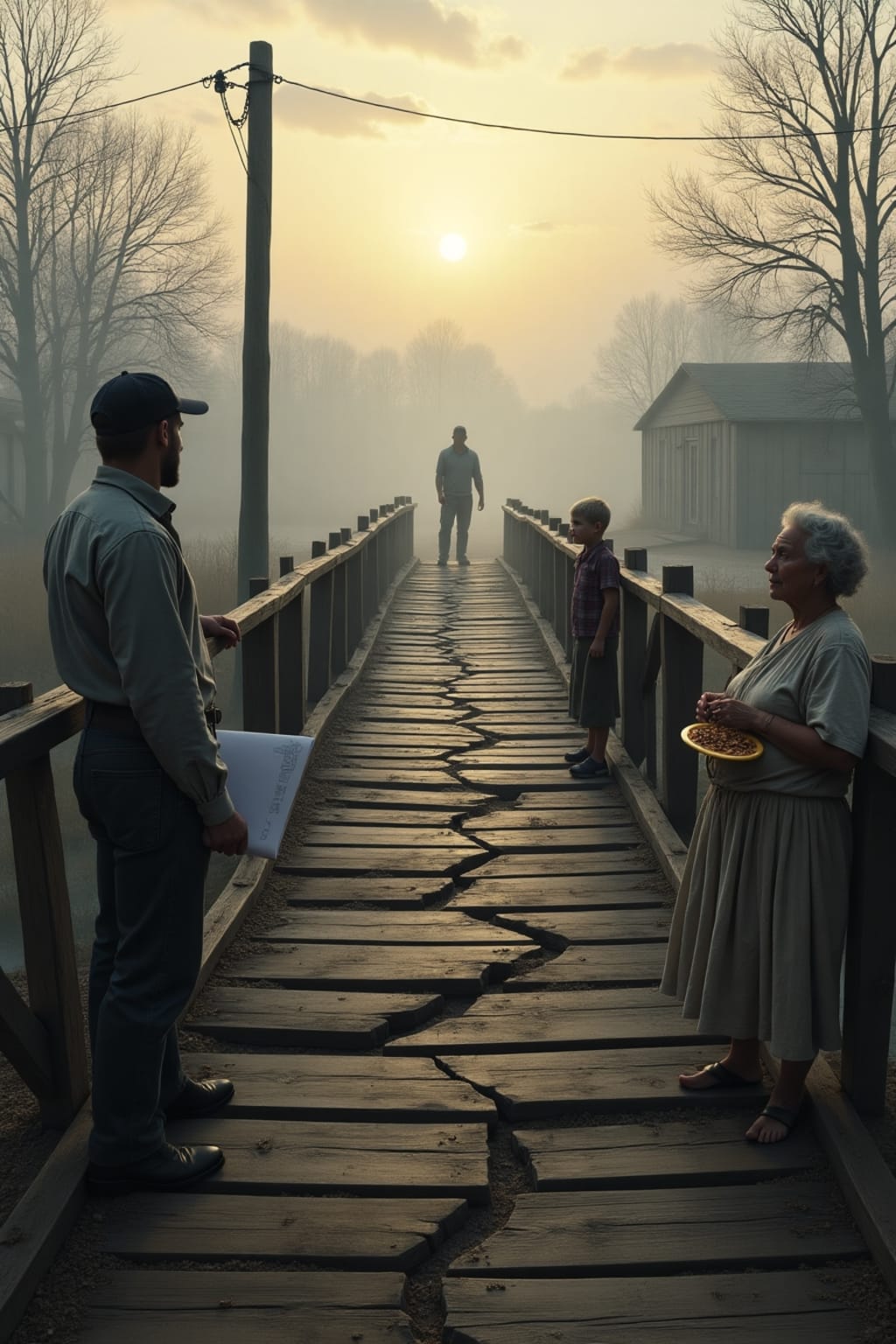
Now Halvor had this old wooden bridge—weathered, groaning, and a little too proud of its years. It crossed Halvor Creek, the only way in and out for most folks. School bus used it, ambulances, farmers hauling hay, the lot.
Problem was, the bridge was dying. I ran a stress test, tapped some nails, did the math. Bottom line: one more good rain, and the thing would collapse like a tired mule.
So I did what any good engineer does—I wrote up the report. Declared it condemned. Unsafe. Needed replacement.
Simple, right?
Wrong.
Word spread fast. By noon, I had half the town lined up outside the little trailer they’d given me as an office. The mayor—Mrs. Lorna Beecham, sharp as a tack and tough as boot leather—came storming in with a pie in one hand and fire in her eyes.
“You can’t shut down our bridge,” she said.
“It’s dangerous,” I told her. “Liability’s off the charts.”
“That bridge,” she said, “was built by our grandfathers. My daddy walked me across it to school. My son proposed to his wife standing in the middle of it.”
Now, you might think: That's sweet. I did too. I almost folded.
That’s when I realized—their emotions weren’t just strong. They were blinding. The bridge wasn’t a structure to them; it was memory, identity, even love.
But emotions don’t carry weight loads. Emotions don’t hold up against floods.
So I said, gently but firmly, “Ma’am, I understand this bridge means a lot to you. But it’s going to kill someone if we leave it open.”
That didn’t go over well. The next morning, someone slashed my truck tires and nailed a hand-painted sign to my trailer: OUTSIDERS DON’T GET HALVOR.
And I’ll admit—part of me wanted to back down. I was angry, hurt, frustrated. I’d grown up being taught to listen to people, honor their feelings. But the numbers didn’t lie. The wood was rotting. The support beams were termite-riddled. A kid riding a bike across that bridge could fall through and disappear before anyone even noticed.
I had to make a choice: cave to emotion, or stand by objectivity.
So I filed the paperwork to close the bridge immediately. No detour plan. No transition period. Just hard, cold necessity.
Two days later, a storm came. One of those Midwest summer tantrums—sheets of rain, river surging like a beast. And just like that, the bridge snapped clean in two and floated downstream like a coffin lid.
Nobody died. Because nobody was on it.
When the water receded, the town saw what I’d seen: jagged ends, shattered timbers, the truth laid bare. Objectivity, as cold and clinical as it can seem, had saved lives.
The weeks that followed weren’t easy. Folks were bitter. But they rebuilt—stronger, safer, with steel and concrete and—begrudgingly—a plaque that read: To the memory of what was. And the wisdom to let go.
Mrs. Beecham brought me another pie a month later. This one with less fire in her eyes.
“You were right,” she said. “But I still hate how it felt.”
“I get it,” I said. “But feelings don’t hold bridges.”
---
Now, I tell you that story not just to entertain—but to remind you:
Objectivity isn’t the enemy of emotion. But in a crisis? It’s the compass that points true north.
Feelings are the wind—they move us, shake us, sometimes carry us away. But objectivity? That’s the anchor. The quiet voice saying, “Stop. Think. Look again.”
Doesn’t mean we ignore emotions—they matter. But when the stakes are high, when lives are on the line, or decisions shape futures, we’ve gotta do what’s right, not just what feels right.
That’s the story of the bridge at Halvor Creek.
And if you ever find yourself at a crossroads—torn between what your heart aches for and what your head knows to be true—remember:
Bridges don’t stand on feelings. They stand on facts.
About the Creator
Keep reading
More stories from Muhammad hassan and writers in Fiction and other communities.
"The Prince, the Princess, and the Spellbound Throne
In a time when the stars were believed to guide the fate of kings, two kingdoms stood divided by a river of magic. To the west lay Aralith, a realm of warriors and wisdom, ruled by King Alden and his son, Prince Kael. To the east shimmered Liora, the land of moonlight and enchantment, ruled by Queen Elira and her daughter, Princess Seris.
By Muhammad hassan7 months ago in Fiction
The Lesions of Devotion
Every day I set myself down on the freshly cut lawn and strip myself bare. I take my guitar and finger the frets and pick at the strings, listening for dissonance. My life is dissonance. I twist the tuning pegs until each string sounds bright. Then I kneel, calves pointing behind me, kneecaps facing forward. All exposed to the breeze. I close my eyes and play the melody.
By Paul Stewart3 days ago in Fiction
Should We Not Try to Get Too Political?
Here's something you often hear people say, "I try not to get too political." I understand the sentiment and I sympathize with it... while at the same exact time, I completely disagree with the notion. Whether it's referring to social media or wherever, it's kind of unavoidable. You can attempt to sidestep it, not engage, leave the less important things for actual politicians to discuss... you can want it to not take over your life, your conversations, your relationships, and that makes perfect sense.
By Stephen Kramer Avitabile4 days ago in Writers



Comments
There are no comments for this story
Be the first to respond and start the conversation.