
The Chair by the Red Door
A Story of Forgotten Moments and Unwritten Letters

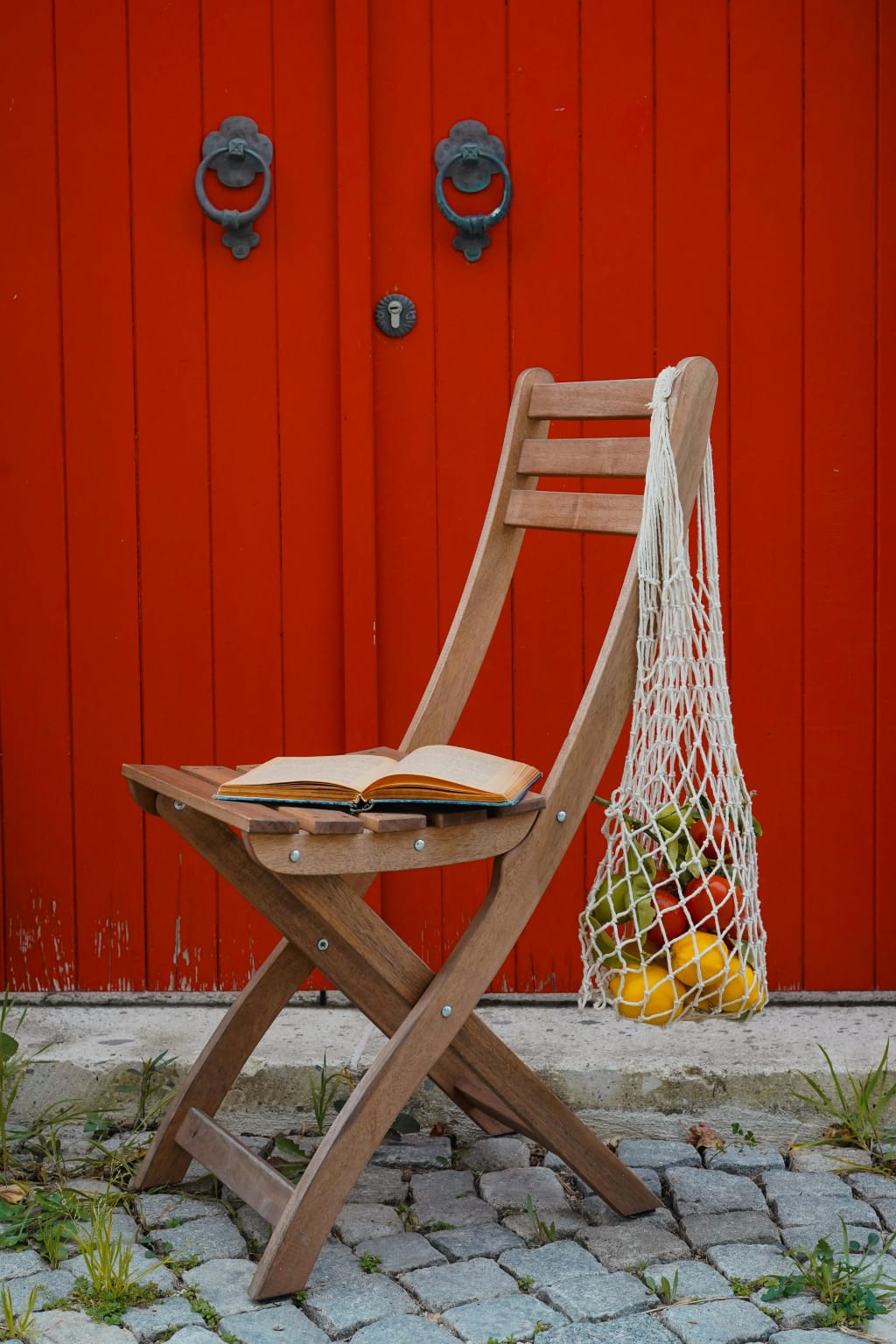
There it stood, as if it had always been there, existing beyond anyone’s recollection of when it first appeared. The wooden chair, sturdy yet visibly worn, sat quietly outside the crimson-red door at the far end of Olive Street. Some townspeople may have remarked on it in casual conversation—perhaps a place to briefly rest a heavy grocery bag or to flip through the pages of an old magazine. But, in truth, few truly saw it; few truly noticed.
Except for her.
Clara had lived her entire life in Mapleford, a town where the summers bore the sweet perfume of lemon balm and the winters arrived gently, like a soft hush of a lullaby. The red door, tall and grand, had a regal air about it, framed by lush ivy and crowned by tarnished iron knockers that hinted at fabled eras long gone. Even as a child, Clara had paused more than once to let her gaze linger on the door’s unique hue—a bright, arresting shade of red, neither too dark nor too garish. It always felt like it contained a secret.
Yet the chair had always captivated her more than the door itself. As she grew older and her morning walks turned into hurried commutes, then morphed again into leisurely afternoon strolls after work, the chair remained a steady presence. When she was five, she would wonder: Did the chair belong to someone with a penchant for quiet reading outdoors? When she was fifteen, she’d speculate about whether a reclusive artist lived inside that red door. Even at twenty-five, the chair awakened a sense of curiosity that her routine life couldn’t quell.
Clara never once saw a figure entering or exiting the red door.
But the chair was in constant flux.
One day, it might cradle a half-read novel, its pages flapping in the breeze, tempting passersby to turn a page. Another day, it could support a small wooden crate filled with fragrant wildflowers or fresh herbs. Occasionally, a thin blanket or a delicate shawl appeared draped over its back, as though placed there by a friend who had stepped away momentarily, never to return. The chair’s silent transformations seemed almost whimsical, like chapters in an ongoing story that only the keenly observant could follow.
For Clara, it was more than a mere piece of furniture—it was a silent storyteller, narrating an untold tale through subtle clues.
Chapter I: Echoes of the Unsaid
A crisp spring morning found Clara walking her usual route along Olive Street, the chill of dawn seeping through her light jacket. That particular day, a whisper of a breeze stirred the newly bloomed blossoms. As Clara approached the red door, she noticed the chair was supporting an open book, its pages fluttering with each gust of wind. Something about the way the book lay open struck her. It felt like an invitation.
Unable to resist, Clara stepped closer, her eyes catching the title on the top of the page: Letters Never Sent. She knew the book—an obscure collection of imagined letters between lovers who, in the narrative, never physically met. It was a literary curiosity, beloved by those who found meaning in yearning.
Beneath the visible pages, tucked between the leaves, was a slender note written on creamy parchment. She lifted the top page gingerly and read the neat, cursive handwriting:
“To the one who always glances, perhaps someday you’ll pause.”
Her heart fluttered. The message suggested a deliberate act, a recognition of her habit of stealing looks. Someone, perhaps the same unknown caretaker, had noticed her silent admiration. What once felt like a one-sided fascination had begun to feel like a whispered dialogue in the middle of a quiet street.
That night, Clara found sleep elusive. She dwelled on the words, replaying them in her mind until they merged with the gentle hum of the old radiator in her bedroom. Who had written the note? Did they watch from behind curtains as she passed each day? Or was it a playful gesture intended for any curious soul?
By morning, she had resolved to reply. The next day, she returned to the chair, a simple letter of her own tucked discreetly inside an envelope. She carefully slid it into the book’s pages and left it there, feeling both nervous and exhilarated.
Chapter II: Words Without Faces
In her letter, Clara introduced herself. She refrained from divulging too many personal details, but she confessed her fascination with the red door and the ever-changing chair. She wrote of how she felt the door was the subject of many stories, but that the chair always seemed to be the true narrator.
“I’ve always wanted to know the story behind the door,” she concluded, “but the chair felt like a better narrator.”
In the following days, the book’s pages moved, and new letters took shape. The caretaker—still unseen—responded with short messages that were sometimes philosophical, sometimes playful. Through these intermittent exchanges, Clara gleaned bits of the writer’s identity: a fondness for figs, a habit of scribbling poems on napkins, and a memory of dancing in the rain outside a music festival in Verona.
A strange closeness formed between them, yet no names were revealed. They remained strangers bound by curiosity. The chair served as a discreet mailbox, bridging two lives that intersected only in that particular corner of Olive Street.
As the weeks rolled on, Clara discovered more about her unnamed correspondent’s sense of wonder and quiet reflection. They wrote about the different textures of loneliness, how the silent edges of night could be both comforting and haunting. In turn, Clara revealed her own uncertainties—the fear of unfulfilled dreams, the longing to escape a place that felt too small for her ambitions. Each letter was a puzzle piece, shaping the image of a friendship that felt simultaneously brand-new and deeply familiar.
Chapter III: The Memory in the Photograph
Their epistolary dance took a surprising turn one bright afternoon in late spring. Instead of a book, Clara found a small black-and-white photograph pinned to the chair’s seat cushion. Its corners were tattered, suggesting it was older than she was. The picture depicted the same wooden chair, only in front of a slightly different backdrop. It was less worn, the grain of the wood more pronounced. Seated upon it was a woman reading to a young boy nestled in her lap.
On the back, written in faint pencil, was a note: “1994. She read every day. He listened once.”
The photograph tugged at Clara’s heart. She recognized the iron knockers on the door, but the surrounding ivy was far less overgrown, indicating a simpler time. The woman wore her hair in a loose bun, reminiscent of how Clara often tied up her own hair when she wanted to focus. The boy gazed at the pages of the book with rapt attention, sporting an inquisitive expression that likely mirrored Clara’s own sense of wonder.
That evening, a new letter waited for Clara, slipped between the photograph and the chair’s seat:
“I sat here before I ever understood what it meant to be seen.”
The next day, Clara penned her reply:
“And I saw this chair long before I understood what it meant to feel understood.”
Their words began to hold a tender resonance, as if speaking to secret parts of each other’s hearts. The whimsical exchange of letters evolved into an intimate conversation about identity, memory, and a longing to see beyond the mundane routines of daily life.
Chapter IV: The Storm and the Stillness
Life is rarely so kind as to let a gentle story unfold without chaos. One Thursday afternoon, heavy clouds began to gather over Mapleford. By sundown, the sky rumbled with thunder, and sheets of rain started to pummel the streets. The wind howled through the narrow alleyways, sending fallen branches skittering across sidewalks. The local bakery on Olive Street, renowned for its croissants and custard tarts, had to close early as the storm’s ferocity intensified.
Clara, huddled by her kitchen window, watched the swirling vortex of raindrops and thought of the chair. The notion of it lying abandoned and at the mercy of the elements tugged at her, like a beloved pet caught in the cold. Without much thought, she grabbed an umbrella and dashed into the tempest.
By the time she reached the red door, her hair was plastered to her forehead, water seeping through the seams of her coat. Yet all thoughts of personal discomfort vanished at the sight of the chair knocked over in a shallow puddle. One leg was badly splintered, and the open book—along with any notes—was gone. The door loomed tall and unyielding, droplets running down its painted surface like tears.
Kneeling, Clara gently uprighted the chair, feeling a pang of loss she struggled to articulate. Something precious had been broken—not just the chair, but the trust and connection built through silent words and subtle gestures.
The wind nearly snatched her umbrella away as she stood, water rivulets racing down her arms. She lingered a moment longer, hoping for any sign of the caretaker. Perhaps they would fling open the door and help her carry the broken chair inside. Perhaps they would offer her a towel, and they would finally see each other face to face. But no such moment came.
Shivering, Clara returned home, the hollow ache in her chest echoing with the storm’s fury.
Chapter V: A Door Opens
In the aftermath of the storm, Mapleford wore its usual subdued palette of damp roads and gray skies. Branches littered sidewalks, and the bakery’s sign dangled precariously. Clara felt a reluctance to walk past the red door, afraid to see an empty space where the chair once stood. Still, a part of her yearned to know if any remnants of their secret correspondence remained.
Days stretched into two weeks. She avoided Olive Street, taking detours whenever possible. The tension gnawed at her—an unanswered question, a story left incomplete. Her mind conjured vivid daydreams: had the caretaker rescued the book in time? Were they angry with her for not protecting the chair sooner? Or were they simply gone?
Finally, on a cloudless Tuesday morning, Clara gathered the courage to face the house once more. The storm’s evidence had mostly been cleared away; fresh gravel lined parts of the road, and newly planted flowers waved in the breeze. The red door looked as formidable as ever, radiant under the late spring sunshine.
Then she saw it: a small package resting on the doorstep, sealed with simple twine. She approached cautiously, scanning the windows for movement. With trembling hands, she peeled back the paper wrapping. Inside was the wooden chair, repaired and polished. The splintered leg had been expertly mended, and the surface even bore a fresh coat of varnish. It looked rejuvenated, as though given a second chance.
At the very bottom of the package lay a short note:
“You gave me back a piece of myself. And in doing so, found your own. Shall we meet, or let the story remain beautiful in its distance?”
Heat rushed through Clara’s body. There was a choice to make. She could leave another letter, continuing their intangible bond. She could walk away, preserving the delicate mystery that had colored her daily life for months. Or she could knock.
With painstaking care, Clara set the chair upright. She smoothed her hands over its surface, feeling the subtle ridges where old memories lingered beneath the new varnish. Finally, she took a deep breath and sank onto the seat, facing the red door head-on. For the first time since she was a child, she allowed herself the chance to wait.
Chapter VI: Facing the Threshold
The minutes crawled by. Sunshine warmed Clara’s shoulders as she studied the door’s details: the worn metal of the knockers, the hairline cracks in the paint, the subtle warping of the wood around the threshold. Birds chirped overhead, and the faint rumble of a passing car underscored the quiet hush of the neighborhood.
But no one emerged.
An hour passed. Clara’s legs began to cramp, yet she remained determined. She thought of everything she had shared and everything that had been reciprocated. Little confessions of daydreams, revelations of hidden wounds, fleeting glimpses into a stranger’s heart. They had formed an odd but profound kinship through penned words. Was it worth risking disappointment for a face-to-face meeting?
She glanced at her watch—two hours. In that time, she saw the mail carrier pass, a cyclist whiz by, and a child scamper down the street with a kite. None paid any attention to the lonely figure by the door. She began to wonder if the caretaker was even watching. Perhaps they had traveled. Perhaps they were uncertain themselves, battling their own internal debate about whether an actual introduction would shatter the magic they’d built through letters and notes.
Clara thought about how many narratives ended once the main characters actually met. The beauty of imagination sometimes faltered under the weight of reality. Yet she couldn’t shake the feeling that their bond was real enough to withstand the truth of who they were.
A small part of her even felt that the real meeting had already happened, in a sense, through shared vulnerabilities. The open, honest words they exchanged had reduced the distance between two beating hearts far more effectively than any surface-level greeting could. Maybe that was enough. Maybe that was the entire point.
Nonetheless, she remained seated, each passing minute forging a new memory of patience and silent hope. She pictured the caretaker inside, equally hesitant, standing behind a curtain or a small window. In her mind, they were balancing longing with fear, yearning to open the door but afraid of losing the sweet illusion that connected them.
Time slipped through her fingers. Afternoon shadows lengthened, and a cooler breeze signaled the approach of evening. In the end, Clara rose, her muscles stiff from inactivity. She ran her fingers along the chair’s back one final time, as if to absorb some lingering essence. Then, with a voice barely above a whisper, she spoke to the door:
“Thank you.”
A sense of calm overcame her as she turned and walked away, leaving the chair behind, intact and strong, just as she felt within herself.
About the Creator
Alpha Cortex
As Alpha Cortex, I live for the rhythm of language and the magic of story. I chase tales that linger long after the last line, from raw emotion to boundless imagination. Let's get lost in stories worth remembering.
Keep reading
More stories from Alpha Cortex and writers in Fiction and other communities.
The Corner Store at the End of the Hill
Hyun pressed his back against the small retaining wall, noticing how the late afternoon sun cast an elongated shadow across the asphalt. Just beyond his outstretched legs stood the corner store—an unremarkable building unless you were from this neighborhood. Its bright orange sign, emblazoned with the words “미니스토아,” caught the light of the descending sun. Beneath that, in faintly chipped numerals, was a telephone number no one called anymore. The sign’s edges had begun to curl and fade, like an old photograph left too long in the sun.
By Alpha Cortex11 months ago in Fiction
Choose Your Own Adventure: St Helena Station
*****Preface***** I have been obsessed with Choose Your Own Adventure stories since I was a kid. I credit them with my love of reading and writing. I've been struggling to get my own kids to embrace words the same way I have but they love video games and our occasional Dungeon's and Dragon's game... which gave me an idea. I'll write an interactive story. So far its working; my middle son loves it and can't wait for the next section to come out.
By Sandor Szabo6 days ago in Fiction



Comments
There are no comments for this story
Be the first to respond and start the conversation.