

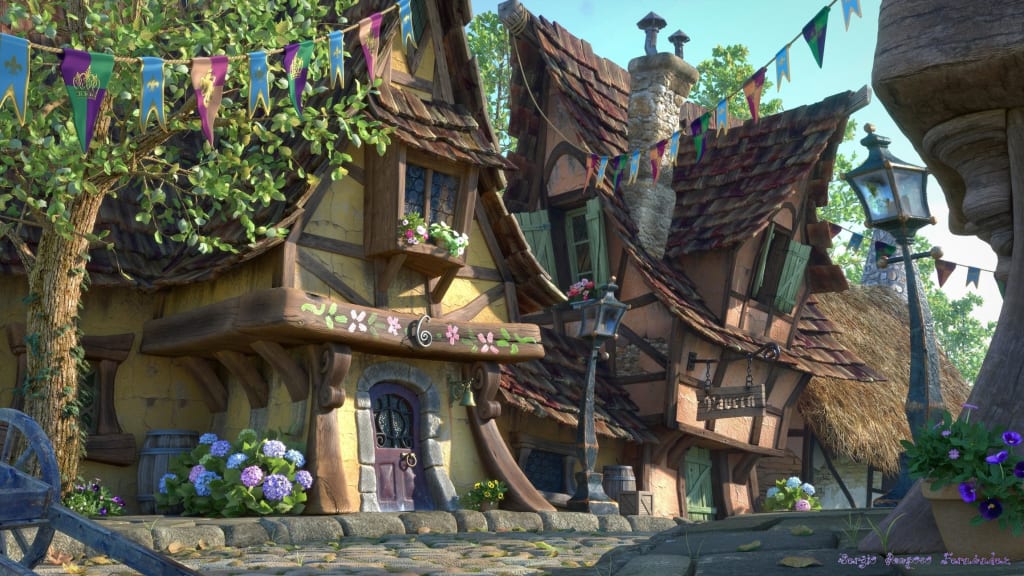
Once upon a time, there was a girl named Mìkala. She was the most beautiful creature anyone had ever seen. From the time she was born, her mother and father and everyone who saw her knew there was something special about her. She seemed almost mystical as she grew into the loveliest, kindest, and wisest person the town had ever known. “How can this be?”, the townspeople asked. Is she a witch?” Finally, after years of pondering her beauty, they decided she was simply beautiful, inside and out. And they thought such beauty should be rewarded. So, they named their little town after her. They called it Mikala’s Village.
Mìkala was thrilled such an honor was bestowed on her. She was so proud and happy, she wanted to do something for the people who had given her such an honor. She thought to herself, “A festival would be a perfect celebration.” Being that the town was small, and she wanted everyone to participate, the town square located in the center of their village would be the perfect place for the festival. The women could bring their best foods and goods, and the men their best wares. And they could and make beautiful decorations for their eyes to see and share with one another. You see, as much as everyone loved Mìkala, Mìkala loved everyone. So, she named the festival, “The Festival of Beauty”.
As the day of the festival neared, everyone was preparing for it. From house to house and shop to shop everyone in the Village was busy getting ready. The children were excited too. They sang songs and played amidst the bustle, while every now and then sampling a morsel of bread or cake their mothers handed them.
Now by this time, people in nearby townships and villages had heard of the Festival of Beauty and wanted to share in the good spirit. And to see the beautiful Mìkala. When they traveled there, no one was ever disappointed. Mikala’s Village enchanted everyone. So much so, everyone who visited there wanted to stay. And most of them did.
The festival was only two days away. But instead of being full of joy, the villagers became worried and sad. The town square had filled up with people who’d come from miles around to see Mìkala ’s Village and the Festival of Beauty. But they had no place to stay when they arrived. So, they set up camp right in the middle of the town square where the festival was going to be held. To the villager’s dismay, it had filled up with people, animals, hay, furniture, bedrolls, tents, and campfires. There was no room for anything else. The beautiful flower garlands and wreaths and delicious offerings Mìkala ’s villagers were preparing to present for their festival now had no place. The town square had become a grotesque melting pot for everything the town didn’t stand for and did not want in their little village.
How unhappy Mìkala ’s villagers grew. They had never seen anything so unsightly before and didn’t know what to do about it. There had never been a set of laws or law enforcement in Mìkala ’s Village. Everyone who lived there knew what was beautiful and fair and kind and clean and always went about their daily lives that way. Very disheartened, they decided to ask Mìkala what to do.
A small group of villagers went to Mìkala’s house. When they arrived, Mìkala was not home. There was a note on her door saying, ‘I will be back tomorrow”. Wondering where she’d gone, they helplessly turned away. Their long faces expressed a sorrow never before felt in the village as they went quietly back home.
The square was booming with raucous affairs. It was the day before the festival. By afternoon everyone in the square was drunk and dirty awaiting the morrow. When evening fell and everyone was just about to go to bed for the night, a full moon rose over the village. It was a pale blue color like no one had ever seen before. The people in the square were puzzled by such a bedazzling moon as were the townspeople. They all looked on in amazement when suddenly the strangest thing happened. In the shadows appeared a figure cloaked in black from head to toe. When the people in the town square saw the figure, they became so frightened, they fell to the ground and covered their faces. The dark figure stepped out of the shadows and into the cowering crowd. When it found its way to the center of the square, it stopped and turned, making sure to see everyone. After a minute or so, the people in the square tried to take a look at this thing to figure out what it was. The townspeople, looking out from their windows, were in awe trying to figure out the same. As they all watched, the hood of the creature’s cloak began to rise over its head and in an instant fell to its shoulders. Everyone in the square started screaming and hiding their faces under each other as if they’d seen the devil himself. Mìkala’s villagers saw it too and were very scared. The creature had red beaming eyes and black skin that seemed to have been charred from fire. Its teeth were green, with fangs hanging down both sides of its mouth. And a tongue like a snake. Raising its arms up, the creature howled at the moon in a loud terrifying voice saying, “Who will be my supper, who will be my child, who will satisfy me in just a little while?” By the time the creature finished its words, there was no one left in the square. They had all run away screaming in horror. All that was left in the square was what was left behind in the dust. The villagers, peeping through their windows, wondered if the creature would come for them. Trembling in fear, they saw the creature put the hood of its cloak back over its head and walk toward the woods. It disappeared in the shadows as suddenly as it had appeared. After a few moments, relieved this thing was gone, each villager closed their window shutters and doors tightly as they retired for the rest of the night hoping the creature would not return.
The next morning, the day the festival was to be held, the villagers came outside surprised to find the town square as it used to be. Clean and tended with care. The visitors were gone. There was not even a trace of them. They walked around in amazement trying to figure out what happened when just then, Mìkala appeared. “Hello everyone”, she said. “Isn’t it a beautiful day?” Everyone answered happily, “Yes!” Then one of the children asked, “What happened to all the people who were in the square?” Mìkala answered whimsically, “Why… I don’t know.” She then held up a big sack. Out of it she took a long black cloak with a hood and put it on. It covered her body from head to toe. The villagers gasped and clutched each other as they heard her laughing from underneath the cloak, remembering the horrible creature they had seen the night before. After a few seconds, Mìkala took the hood of the cloak down from her head resting it on her shoulders. She wrinkled her forehead and then stared at everyone looking out from under her eyebrows. Then looking up with her head tilted back just a bit, she laughed cunningly. The tension the villagers felt subsided with the sound of Mìkala ’s laughter though they turned toward each other puzzled and shocked looking for answers. ‘Could that horrible creature have been Mìkala?’, they questioned themselves. Mìkala settled down from her laughter and looked at all her friends and family in the beautiful way she always had and said, “Shall we prepare for our festival?” Trusting Mìkala, and relieved things were back to normal, everyone cheered, “Yes… Hooray…Yes…Hooray”, lifting their arms up in excitement. Mìkala ’s villagers were happier than ever after having thought their plans for their festival had been destroyed. They were joyful and thankful for the uncanny visitor who saved their festival and their beautiful Mikala. The Festival of Beauty would prevail.
About the Creator
Linda Aubert
Composer/Musician, Lyricist, Poet, Playwright writer from New Orleans, LA pursuing her gifts. Presently, Music Director for two churches and primary Music Artist/Owner of New Genesis Music Company, writing literature as often as I can.
Keep reading
More stories from Linda Aubert and writers in Fiction and other communities.
No Picnic After Dark
I woke up and found myself lying face down on the ground. Lifting my head, I used my hand to wipe off the dirt stuck to my eye lids and looked around to see where I was and get my bearings. In a flash, I remembered warnings of a fallout from earth’s rejection of 10G communications systems predicting fatal devastation worldwide for months. As I gained my focus and strength, I stood up slowly and looked around in disbelief for what my eyes were seeing. Everything was charred black from radiation. There was ash, and soot and rubble everywhere. Tall buildings had sunken into the ground with only rooftops showing at ground level. What were once city streets looked like mountainous peaks and valleys of concrete and asphalt. I stood there, still, and barely breathing.
By Linda Aubert5 years ago in Fiction
A Love Forboding
The chipped stone slope caused unbearable footing. I slid, skirting on my heels. I cast my shield, relinquishing my guard to stay upright. Left with my double-edge and a prayer to the maker, I skated toward my objective. The earthly stubble gave way to solid ground. I found myself restored, a trail of dust in my wake.
By James U. Rizzi3 days ago in Fiction


Comments
There are no comments for this story
Be the first to respond and start the conversation.