
The Flame of Sunlight
A short fantasy story about power, sacrifice, and the moment you realize the sky is running out of time

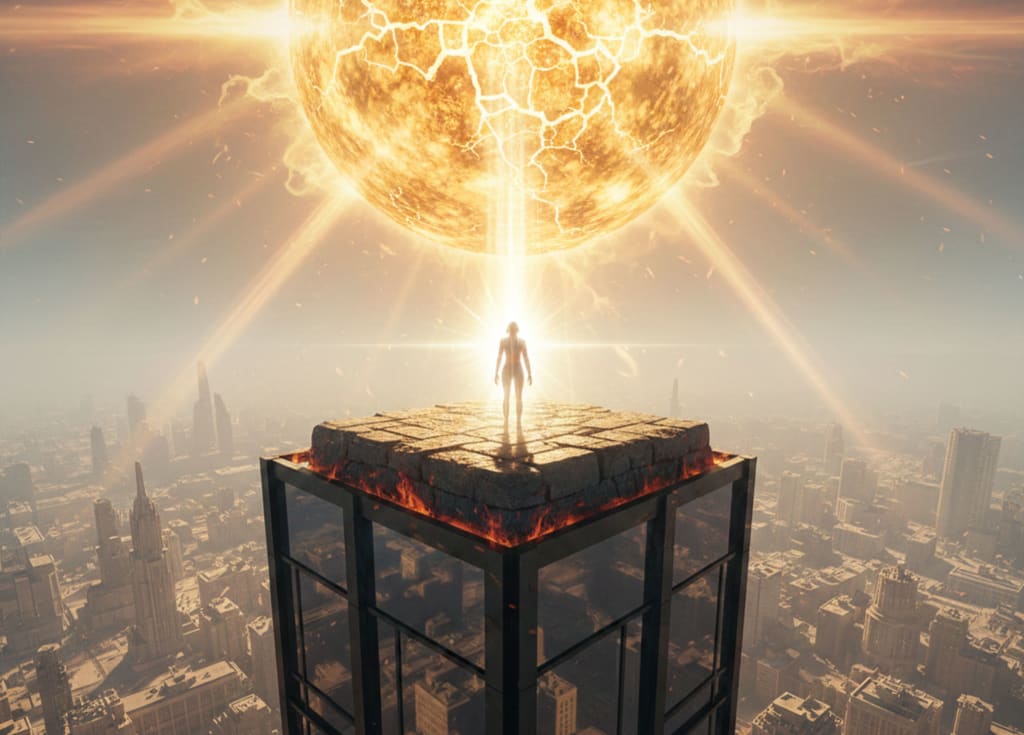
The day the sun cracked, I was hanging laundry on the roof.
Not a poetic “sunset” crack, either. It was a sound, a real sound, like ice giving way on a frozen river. The sky went white, then thin, then wrong—colors leaking through where blue used to be.
The clothespin slipped from my fingers.
Every shadow in the city flickered at once, as if the world were a candle about to lose its nerve.
We all pretended, at first, that it was nothing. A trick of atmosphere. A joke from the gods. The priests said the light was just “changing.” The astronomers, who had been warning us for months, didn’t bother saying anything at all.
They just started building the tower.
And that’s how I found out the sun was dying, and my name had been written on the list of those expected to save it.
Or burn with it. The difference was mostly academic.
When the Sun Started Counting Down
You can tell a civilization is in trouble when everyone suddenly becomes an expert on the sky.
Before the crack, nobody looked up unless they were praying or bored. After the crack, that’s all we did—squinting at the daylight, arguing about how much dimmer it looked compared to last week.
The city changed quietly at first.
Candlemakers doubled their prices. Glassworkers started making mirrored plates again, the old kind our grandparents used to angle out of their windows “just in case the Great Alignment returned.”
It had returned. Only this time, it wasn’t an alignment.
It was a countdown.
The astronomers called it “photonic decay,” which sounded like something you could patch with the right spell and enough stubbornness.
But underneath the lectures and sketches, the truth was simple and raw: the sun was burning itself out. Too fast. Wrongly. Like a body devouring its own muscles in a panic.
The Council held closed-door meetings. People whispered about evacuation, as if there was anywhere else to go.
And then they announced the Flame of Sunlight.
Not as a theory. As a choice.
The Flame That Needed a Body
There’s a word we use for magic that doesn’t politely sit in books and talismans.
We call it hungry.
The Flame of Sunlight was that kind of magic—old, forbidden, and ridiculous in the way only desperate ideas are. A ritual that anchored a piece of the sun’s fire inside a living host, then fed that fire until it grew strong enough to be thrown back into the dying star.
A jump-start, they called it, like the sun was just a lazy carriage refusing to roll.
The host wouldn’t survive, of course. Everyone was very polite about that part. They used terms like “total energetic conversion” and “ascending to pure radiance.”
What they meant was: you would burn from the inside out, until there was nothing left but a memory and a column of light.
The calculations also showed something else, something only the High Astronomer dared to say aloud:
“Even if we succeed, we may not be saving the future. We may be buying time for the present.”
Three generations, if the ritual worked perfectly. Maybe four, if we were lucky.
That was the real price.
Not just a life, but the knowledge that your sacrifice was a delay, not a cure.
Who volunteers for that? Who chooses to die for a world that will still end—just not quite yet?
Apparently, I did.
How My Name Got On the List
I wasn’t brave.
I was just born wrong in a way the tower found useful.
Some people are born with an affinity for water, for stone, for growing things in cracked soil. I had an affinity for light—annoyingly literal, according to my teachers.
Lamps flared when I passed. I didn’t cast a proper shadow until I was twelve. When I was angry, glass windows brightened around me, as if the world were wincing.
It made me good at small magics.
I could coax light into tight beams for surgeons. I could thicken it into a gauze for reading maps at midnight. Once, I accidentally turned a solemn funeral into a kaleidoscope when every candle in the hall erupted into color.
Everyone was very impressed. Nobody asked if I wanted any of it.
So when the astronomers went searching for potential hosts for the Flame of Sunlight, they tested every light-attuned soul in our territories.
They measured heat tolerance and aura density and radiative potential.
They made us stand barefoot in mirrored chambers until we tasted metal on our tongues.
Some candidates panicked. Some fainted. One boy burst into flames, which the researchers marked in their notebooks as “promising.”
I didn’t burn that day.
I just stood there, watching the light gather in my palms like it had been waiting, all these years, for an invitation.
The tower chose three of us in the end.
Three torches, they said, in case the first two went out too soon.
My mother cried when my letter arrived.
My father didn’t speak for three days.
I pretended I didn’t notice either of those things, because the truth was already gnawing at my ribs:
I wanted to go.
The Quiet Selfishness Inside Sacrifice
People like to pretend that sacrifice is pure.
They talk about “duty” and “honor” and “for the greater good” like fear never brushes their teeth in the morning, like dread doesn’t curl up in their chest at night.
That’s not how it felt.
The day I left, my little sister slipped a ring onto my finger. It was bent and ugly, a loop of copper with a cloudy stone.
“For luck,” she said.
“You don’t believe in luck,” I said.
“I don’t,” she answered. “But you do.”
She was right.
I believed in luck, and chance, and the stupid, selfish hope that if anyone had to drag fire through their body and fling it into a dying sun, it would be me, not her. Not my parents. Not the old woman who sold me figs in the market and always tucked an extra into my bag when my hands shook.
I told myself I was going to the tower to save the world.
What I didn’t say out loud was that I was also going because the idea of staying behind, watching the sky fade day after day, knowing I had been chosen and refused—that felt worse than burning.
Maybe that’s the ugliest truth about sacrifice: sometimes we choose it because we can’t bear the weight of being spared.
Inside the Tower Where They Make Suns
The tower wasn’t ancient.
It had been thrown up in a year and a half, all angles and mirrored surfaces, a spine of arrogance stabbing into the sky.
Inside, everything hummed.
Runes crawled across the walls in pale gold ink. The air smelled like ozone and hot dust. Every hallway seemed to lead to another observatory, another sky-lens, another robed figure too tired to pretend they weren’t afraid.
They trained us in shifts.
Mornings were for physical endurance—learning how to breathe in thin air, how to move when your bones ached as if filled with molten glass.
Afternoons were for control.
We sat in circles, palms up, while our instructors fed us carefully measured threads of light drawn from the sun’s thinning rays. We had to hold it, shape it, and then release it without spilling.
Sometimes we failed.
When that happened, the light didn’t explode outward like fire.
It sank in.
Your heart would race. Your skin would glow faintly through your sleeves. You’d feel everything in your body trying to make room for something that didn’t fit.
The first time it happened to me, I thought I would dissolve.
“Breathe,” my instructor said quietly, his own hands trembling. “The body is more generous than you think.”
He was right.
Eventually, my heart found a new rhythm. My cells made their uneasy peace with the extra light until it left, tearing through my fingertips in a soft white spray.
I spent that night curled on my bunk, fingers aching, staring at the cracked plaster on the ceiling.
This was only practice.
The ritual itself would be more. Much more.
Enough to turn a person into a conduit. Or a funeral pyre.
The Other Chosen Torches
There were three of us.
Me, with my shaky control and ugly copper ring.
Lyr, who could trap sunlight in jars like fireflies and open them days later, still blazing.
And Cassian, whose light never misbehaved. His aura was so stable it made the researchers giddy. If magic had a favorite child, it was him.
We shared a dormitory and a kind of awkward, brittle closeness.
At meals, we traded stories from home, as if saying the names of our streets and rivers made them harder to lose.
At night, when the tower’s windows dimmed and the sky flickered with sickly stars, we lay awake and listened to the building breathe around us.
“Do you think it will work?” Lyr asked once, voice barely more than a exhale.
“Something will happen,” Cassian said. “The equations are sound.”
“That’s not the same as working,” she whispered.
I didn’t answer.
I was thinking about the way the sun’s light set differently now. It didn’t fade—so much as stumble.
As if each evening, it had to remember how to leave.
The Day They Asked Who Would Go First
No one liked to talk about the order.
There had been arguments in closed rooms, I’m sure. Ethical debates, heated words about consent and fairness and statistical probability.
In the end, they did something both terrible and kind.
They asked us.
We were brought to the highest chamber just before dawn, where the glass ceiling showed a sky already too pale, as if someone had washed it too many times.
The High Astronomer’s voice shook, but only once.
“The ritual is… demanding,” she said. “We believe we can attempt it more than once. But not indefinitely. We cannot command you into this. You must choose.”
She laid three objects on the table between us.
A strip of cloth. A length of chain. A feather.
“Whoever takes the chain will go first,” she explained. “The cloth, second. The feather means you decline entirely. There will be no punishment if you do.”
I thought of my mother’s hands, stained from years of tending soil.
I thought of my father, who carved sun symbols into our doorframe every year, “for luck,” even when my sister rolled her eyes.
I thought of the ugly copper ring on my finger, warm against my skin.
Lyr’s hand shot out first.
She grabbed the strip of cloth, knuckles white.
“I’ll go second,” she said, voice rough but steady. “I’m better at adapting mid-stream than starting anything.”
Cassian stared at the objects for a long moment.
Then he picked up the feather and slid it gently back into the Astronomer’s hand.
“I can do more good down here,” he said. “If you succeed, you’ll need someone to help the world adjust. If you fail—”
He didn’t finish.
He didn’t need to.
He would be the one to measure what was left.
I looked at the chain.
Heavy. Plain. Waiting.
My hand didn’t tremble when I picked it up.
The fear came later.
Becoming the Flame
The ritual chamber was built like a question.
Circles within circles, gold inlay spiraling toward a stone platform at the center. Mirrors angled to catch the sun from every possible direction, all of them funneling toward the spot where I would stand.
They dressed me in white, which felt cliché, but I didn’t argue.
My sister’s ring looked strange against it, the copper dull and stubborn.
As the chanting began, I realized how quiet the world had become outside.
No birds. No city noise. Just the low hum of spellwork and the faint, uneven throb of the sun pushing light down the tower’s throat.
The first touch of it was almost gentle.
Warmth on my skin. A brightness behind my eyes. I’d felt this before, in training, in smaller doses.
Then the second wave hit.
I have no measured words for that.
It was not pain, not exactly. It was density.
Light pressing in from all directions, looking for every gap in my body, every hollow, every forgotten space, and filling it. Blood became syrup. Bones became glass rods vibrating with a pitch I could almost hear.
Someone shouted. Another circle of runes ignited.
“Hold,” a voice ordered. “She’s slipping!”
I wasn’t slipping.
I was dissolving.
The part of me that remembered my name started to melt at the edges, memories blurring in the heat.
I saw my street as a smear of color. My parents as outlines. My sister’s face sharp and bright and then—too bright.
“Please,” I tried to say, though I don’t know who I was talking to. The astronomers. The sun. Myself.
The world responded by giving me more light.
At some point, my hands stopped being hands.
They were streams, conduits, pillars of raw sun fire shooting upward, bending into the lenses, then flaring out into the sky.
I didn’t feel my body catch fire.
I felt it unhook.
From weight.
From gravity.
From the solemn drag of being something that could die.
A Conversation in the Fire
It would be easy to say I became the sun.
That’s not quite right.
I became a question the sun had to answer.
As my essence shot outward, riding a column of light into the shuddering heart above us, I felt something ancient and tired reach back.
Not a voice, exactly. More like a pressure, a presence.
You are small, it seemed to say.
So are you, I answered.
I didn’t mean it as an insult. Just a fact.
All stars end.
All fires burn out.
But for the first time since it began burning, someone was pushing back. Pouring themselves into its exhausted lungs, forcing another breath.
I felt the sun’s weakness, the thin parts where its fire had gone brittle. I felt the cores of planets warmed by its touch. Oceans glittering. Fields asleep under snow, waiting.
So much waiting.
The temptation to pour everything in at once was overwhelming.
To empty myself so entirely that there would be no “me” left to hurt or hesitate.
But that wasn’t what the ritual was built for.
It needed control. Shaped sacrifice, not simple self-destruction.
So I did something I hadn’t been very good at, in life.
I held back.
I fed the sun in pulses, in measured waves, the way we had practiced with our tiny light threads in the tower.
The star drank greedily.
Color bled back into its corona. The crack I had heard months ago, hanging laundry on the roof, began to knit itself along invisible lines.
There was no promise. No booming celestial assurance.
Just… more light.
Stronger. Warmer. Spilling outward like a sigh of temporary relief.
Three generations, I remembered.
Maybe four.
It didn’t feel like enough.
But it felt like something.
What Survives After You Don’t
I don’t know exactly what happened to my body on the platform.
I imagine it went as they predicted—burning from the inside out, leaving little behind but scorched stone and a new chapter in some astronomy text.
What I do know is this:
People looked up that day.
In the city, in the fields, on distant islands and high mountain ridges, they paused and shaded their eyes as the sun flared—not with the harsh, dangerous glare of an imminent explosion, but with a clean, clear brightness nobody had seen in years.
Shadows sharpened.
Colors deepened.
For a heartbeat, everything looked almost painfully alive.
Some dropped to their knees and cried. Some laughed, too loud and wild.
Some just stood there, quiet, feeling the warmth on their faces and thinking, in some small private corner of their mind:
We are not done yet.
Cassian would stay to measure what that “not done” meant.
Lyr would carry the knowledge of the ritual, should the sun falter again sooner than they hoped.
My parents would grow old under a sky I bought them a little more time to enjoy.
My sister would tug metal from riverbeds with her bare hands and make new things out of what was left behind.
Somewhere in a tower that now felt too big but still necessary, someone would look up at a blank patch of air on the wall where my name used to be and wonder, for a moment, if I had been afraid.
I had been.
Fear doesn’t cancel out sacrifice.
It just makes it honest.
The Part You Carry With You
You don’t need a dying sun and a tower of mirrors to understand power and sacrifice.
Most days, it shows up in quieter ways.
In the parent working a shift they hate so their kid can have one more choice than they did.
In the friend who answers the midnight call, again, even though they have to be up at dawn.
In the person who walks away from a life that looks perfect from the outside because staying would mean dimming some essential part of themselves to almost nothing.
We like to tell ourselves that real sacrifice has to be total, dramatic, world-saving.
It doesn’t.
Most of the time, it looks like this: you giving up a piece of your comfort, your time, your certainty, to throw a little more light into someone else’s dark.
Knowing it won’t fix everything.
Knowing the world will still be fragile and unfair and finite.
Doing it anyway.
Because sometimes the only power we really have—the only magic that is truly ours—is the choice to spend ourselves on something that will outlast us, even if only for a while.
A relationship.
A community.
A kid who grows up kinder because of how we showed up for them.
A small, stubborn patch of hope in a timeline that doesn’t guarantee anything.
The sun is not immortal.
Neither are we.
But somewhere between the first crack in the sky and the final fading of the light, there is room for what we decide to burn for.
That’s the part that lingers.
That’s the flame we get to choose.
About the Creator
abualyaanart
I write thoughtful, experience-driven stories about technology, digital life, and how modern tools quietly shape the way we think, work, and live.
I believe good technology should support life
Abualyaanart
Keep reading
More stories from abualyaanart and writers in Fiction and other communities.
Berganashio - Chapter 32
Keenwai and Kunya had consoled Larkin and Villi to the best of their ability. They knew that that the time had come for them to leave though. Grinyella and Podder agreed that the best course of action was for them to return home to the burrowlands. They were concerned that there could be another raid from the vengeful sea-wolfs who had already attacked them once before. With the merfarie king and queen gone now, they especially did not feel any obligation to remain at the merfarie gardens. Before they left to return home, the merfaries sang several songs. The splendor of the vines and plants that sprang forth from the singing was mesmerizing to the meerbirds. There was a melancholy tilt to some of the singing because they were mourning the destruction of the throne room and the abduction of the merfarie king and queen. The meerbirds were most grateful to eat the luscious vines and colorful flowers that were produced by the singing of the merfaries in the courtyard. The song started with one merfarie warrior who was clearly grieving the loss of the merfarie king and queen. These were some of the words that he sang before the rest of the merfaries joined his solemn solo.
By Rowan Finley 6 days ago in Fiction
Where there's Art there's Heart
Here's a stupid thing: I adore art, but I start to panic whenever I step into a gallery. In the one place I should be at my contented best - surrounded by walls teeming with creative expression - I fall apart. What ought to be an enriching experience, tacitly designed to facilitate the exploration of human empathy and perspective, is for me an overwhelming purgatory of anxiety that compresses me to the point I cannot breathe. At the same time, I experience a sense of extraction, as though my head is being prized open to create a hole so big my sanity could evaporate. Somewhere between these two opposing forces of vice and vortex, I feel myself dissolving in a stream of panic that makes me want to cry; and I feel so daft feeling this way, that all I want to do is run for the hills.
By Caroline Jane5 days ago in Humans


Comments
There are no comments for this story
Be the first to respond and start the conversation.