

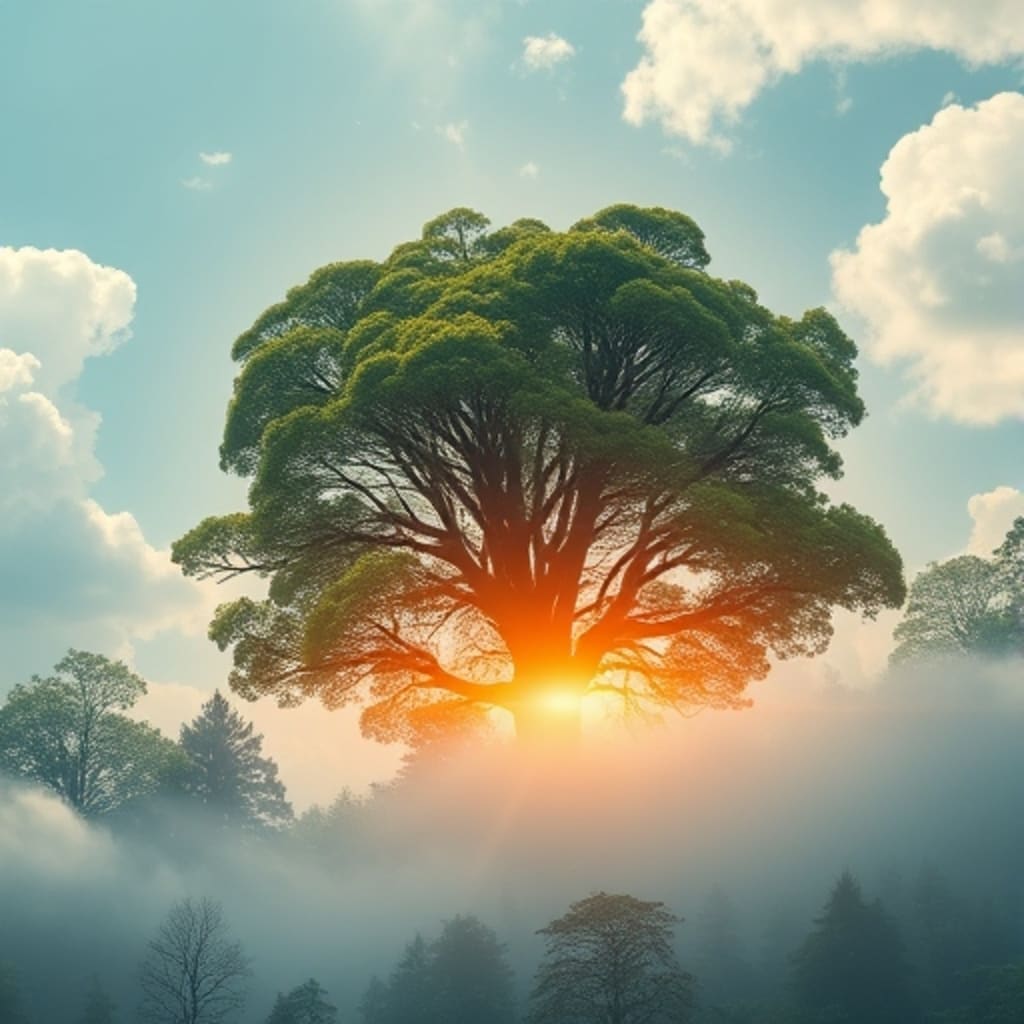
The setting sun painted the ruins of Old Manhattan in hues of amber and gold – a cruel reminder of what had driven humanity to the brink. Marcus stood at the edge of the underground bunker's entrance, watching his daughter Terra collect bioluminescent mushrooms that now thrived in the shadows of fallen skyscrapers. Twenty years had passed since the Great Resource War of 2030 had reduced Earth's major cities to radioactive ash.
It began with the discovery of the world's largest gold deposit, deep beneath the Antarctic ice. The find should have benefited all of humanity, but instead, it became the catalyst for our downfall. Nations turned against nations, alliances shattered, and in just eighteen months, nuclear weapons transformed our civilization into dust.
"Papa, look!" Terra held up a glowing mushroom, its blue light reflecting in her eyes. At fifteen, she'd never known the world before the war. To her, these ruins were simply home.
Marcus smiled, remembering the irony. The gold that everyone fought over lay untouched, buried under miles of ice, while humanity learned to value different kinds of wealth: clean water, fertile soil, and the knowledge to rebuild.
Their community, Nova Concordia, had started five years ago when survivors from different bunkers, mountain refuges, and forest settlements began finding each other. What began as a handful of families had grown to over three thousand people, living in a network of underground facilities and restored surface structures.
Dr. Sarah Chen, their lead scientist, had developed a revolutionary method of decontaminating soil using genetically modified fungi. These same mushrooms that Terra collected not only provided light but were gradually cleaning the earth of radiation. Nature, it seemed, had answers that gold could never buy.
"Time to head back down," Marcus called to his daughter. The evening radiation levels were rising, according to his wrist monitor – another innovation from their new society. Underground, the real work of rebuilding civilization continued.
The main hall of Nova Concordia buzzed with activity. The hydroponic gardens glowed with LED lights powered by geothermal energy. Children attended classes where they learned both old-world knowledge and new survival skills. The community's council meeting was in session, discussing plans to establish contact with other survivor settlements they'd detected via their newly restored communication systems.
Marcus made his way to the council chamber, where he served as one of twelve elected representatives. The chamber itself reflected their new philosophy – circular, with no head seat, representing the equality they strived to maintain. The walls displayed their founding principles: Sustainability, Knowledge, Unity, and Peace.
"The expedition team has returned from the Eastern Forests," announced Maya Williams, their head of exploration. "They've made contact with three more communities, totaling almost two thousand survivors. They're interested in joining Nova Concordia."
The news sparked excited discussion. Each new community brought unique skills and knowledge. The last group had included experts in solar technology, which had significantly improved their power generation capabilities.
But it wasn't just practical knowledge that was rebuilding their world. A new understanding had emerged from the ashes of the old world – a philosophy that many called "The Unity." It wasn't quite a religion, but rather a set of principles that acknowledged humanity's interconnectedness with each other and the planet.
The Unity drew from various spiritual and scientific traditions, emphasizing harmony with nature, sustainable progress, and the sharing of resources. Gold, once worshipped as the ultimate measure of wealth, was now viewed as a cautionary tale of humanity's capacity for self-destruction.
Later that evening, Marcus sat with Terra in their living quarters, helping her with her studies. She was learning about pre-war history, a subject that often left her puzzled.
"I don't understand, Papa," she said, looking up from her tablet. "With such amazing cities and technology, why did people fight over gold?"
Marcus considered her question carefully. "Sometimes, the real treasure is right in front of people, but they can't see it. We had clean air, flourishing ecosystems, and peaceful communities. But we thought we needed more."
"Are we doing better now?" Terra asked.
Marcus glanced around their modest but comfortable home, thought about their thriving community, and the way people from different backgrounds had come together to build something new.
"I think we are," he replied. "We're learning from our mistakes. The old world was built on competition and individual wealth. We're building this one on cooperation and shared prosperity."
The next morning brought news that would change their community forever. Dr. Chen's team had made a breakthrough in their radiation cleanup technology. The modified fungi could now be accelerated to clean contaminated areas in months rather than decades. The possibility of reclaiming the surface world was becoming real.
But with this hope came challenges. The council debated for days about how to proceed. Some worried that expanding too quickly might lead to the same problems that destroyed the old world. Others argued that they had a responsibility to help restore the planet for all survivors.
In the end, they chose a middle path. They would gradually expand their surface presence while maintaining their core principles. Teams would be sent to share their technology with other communities, teaching them how to clean their own regions without creating dependency.
One year later, Marcus stood with Terra on the roof of their restored building, looking out over a very different landscape. The ruins still stood, but now they were covered in green. Gardens and parks had replaced the radioactive wasteland. Solar panels gleamed on rebuilt structures, and clean water flowed through restored aqueducts.
More importantly, Nova Concordia had grown into a network of allied communities, each maintaining their autonomy while sharing resources and knowledge. The population had swelled to over fifty thousand, spread across what had once been the northeastern United States.
They called their new society the United Communities of Earth, or UCE. It wasn't a nation in the old sense, but rather a cooperative of independent settlements bound by shared principles and mutual aid. The old borders had been replaced by bioregions – areas defined by natural boundaries and ecosystems rather than political lines.
"Look, Papa," Terra pointed to the horizon, where a group of travelers was approaching. "More people coming to join us."
Marcus watched the newcomers with hope. Each group brought their own stories, skills, and perspectives, making their society richer and more resilient. They had learned that true wealth wasn't found in gold mines or bank vaults, but in the combined knowledge and effort of people working together.
As the sun set over their rebuilding world, Marcus reflected on how humanity had pulled itself back from the brink. The great war had nearly destroyed everything, but it had also created an opportunity to start fresh, to build something better from the ashes of the old world.
The story of the golden ruins would be told for generations – not as a tale of destruction, but as a lesson in redemption. Humanity had faced its darkest hour and emerged stronger, wiser, and more united. In losing everything, they had found something far more precious: a sustainable future built on hope, cooperation, and the understanding that the real treasure had always been each other.
Terra's voice interrupted his thoughts. "They say there are now other communities like ours all over the world. Do you think we'll meet them all someday?"
Marcus smiled at his daughter's endless curiosity. "I think we will. And when we do, we'll have so much to learn from each other."
As they watched the new arrivals approach, Marcus felt a deep sense of gratitude. The world of 2050 was not what anyone had expected, but perhaps it was becoming what they had always needed it to be – a place where humanity finally understood its place in the greater web of life, and where the true meaning of wealth was measured not in gold, but in the health and happiness of all people and the planet they called home.
About the Creator
The Dreamer Faisal
Profession: Freelance Article Writer
Specialization: Health & Wellness, Technology, Environment, Lifestyle
Education: Master’s in Disaster Management
Skills: Research, SEO,Creative Storytelling
Contact: [email protected]
Keep reading
More stories from The Dreamer Faisal and writers in Fiction and other communities.
Here are 10 simple methods for making money online
In this day and age, it's more straightforward than at any other time to bring in cash from the solace of your own home. Whether you're a stay-at-home parent, an understudy hoping to bring in some additional money, or just somebody who needs to bring in some cash as an afterthought, There are many ways to make money online.
By The Dreamer Faisalabout a year ago in Motivation
9:52
by Leslie L. Stevens 9:52 PM. Jessica bounced into the kitchen like she owned it. Ponytail swinging, sneakers squeaking, still high off sixty bucks in tips and a full week of crushing it. Her tables were clean. Her section was empty. Her stomach was growling.
By Leslie L. Stevens Writer | Marfa, Texas6 days ago in Fiction
~ Fired ~
— Ai Intrusion ~ Are you Next ~ Is Ai Evolution after your job? — Few workplaces haven't been affected. Ai is in supermarkets, at doctors' offices, and even monitoring farms. I just can't think of anything this machine is not getting into, can you? For instance: Education ~ Law and Tech jobs will one day have a major influence or be taken over by these inanimate machines, with accuracy and vigor. From mechanics' diagnoses to a wide variety of everyday jobs, including fast food workers, with this input having the ability to cut their unnecessary work hours. I'm certain all of us have been touched by this with our short stories and colorful headings, have you? Even comments are very questionable 'Non-Robot' insertions.
By Jay Kantor5 days ago in Journal



Comments (2)
Thoroughly enjoyed!
Excellent story.... Keep it up