
The Last Fox
A bright apocalypse
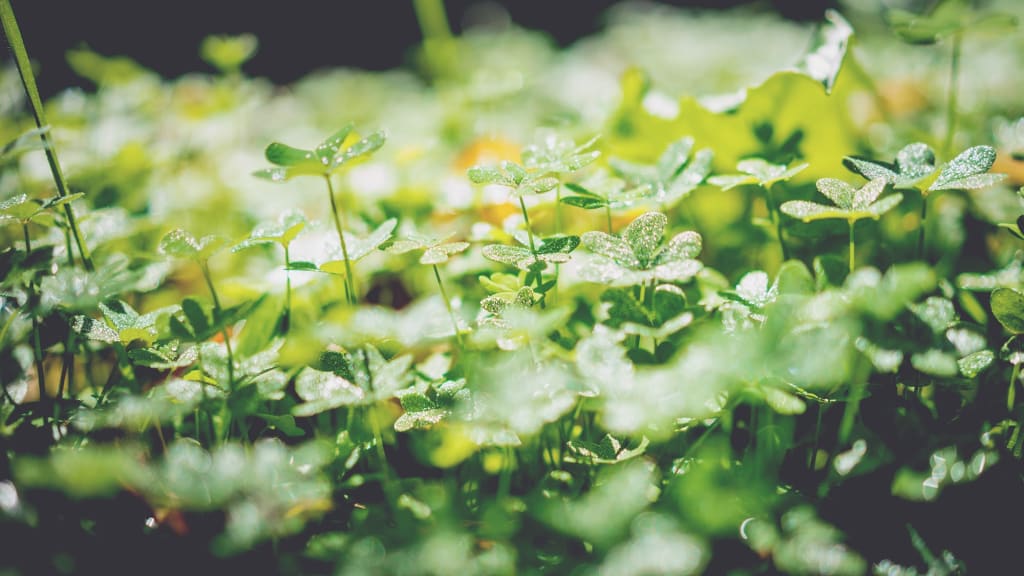
Four-leaf clovers had finally replaced the last of the island’s grass. They blanketed the earth so convincingly now that the old gamekeeper walked barefoot on his rounds, humming old songs, half-remembered.
Today, it rained; the tiny leaves muting the percussion until it formed one droning synchrony.
Like pluvial tinnitus.
The green carpet underfoot was so complete now it kept his bare feet insulated, even from the first frosts of what would’ve been autumn if these clovers ever ceased to grow.
He walked, a grey spectre in the morning, and he wondered.
He wondered at this place – the island he was confined to now – if not by necessity than by inertia, for he knew nowhere else to go.
Being a tidal island, it’d only been a matter of time before the world’s new homogeneity found its way across the forty feet of mud, silt and salt that made up the narrow strait between the mainland and gamekeeper’s isle. When it did, he thought of a joke he’d never have the chance to tell: How lucky is this world we'll leave behind?
The low-lying plants strangled the wildflowers first, then the ferns. Next, it’d keep the trees from reproducing. Though for now, their last generation stood sentry over the earth, whispering on the breeze as they hung over the gamekeeper. He sometimes wondered if their tall, imposing selves knew somehow, in their roots, that it was his stumbling kind, frantic about their feet, that’d be their ending.
But that was just solitude getting the better of him, just as it used to on the forest’s darkest nights.
There were no dark nights anymore.
The gamekeeper missed the bluebells most, though he had to admit he found the incandescent glow that lit the groundcover at night more beautiful than he ought to, given the circumstances.
It was what he called the ‘burning’ – or what he would’ve called it, had he anyone to talk to: the bioluminescent brightness the clovers took on between dawn and dusk, blue as the heart of a candle’s flame.
He’d taken this job, further out in the wilderness than he’d ever been before, after the divorce. They told him when he interviewed there was only a certain kind of person that could hack it – out there on their own for years on end.
And that certain kind of person he was: an astronaut or a submariner, lonely-wandering in amongst the land.
His daughter used to come out and visit every other holiday – get a little time at the cabin, well out of sight of even her great city’s high towers and stakes.
Not anymore, though.
His daughter had already written before it arrived. She let him know the harmless little plants were coming. She expected the luminosity was an artificial marker – a safety precaution to differentiate a CRISPR strain from a wild one.
Not cautious enough, it seemed.
If she was right, man had exceeded itself, succeeding so entirely in the reengineering of a species that clovers now outcompeted not only their wild cousins but their most distant relatives in the plant – and even fungal – kingdoms. They were covering the earth, irrepressible as the tide, until now they were pawing at the roots of even the most ancient trees.
He still held her locket in his palm each morning as he walked – a tacky looking thing too, heart-shaped, hardly-gold. But he couldn’t have found or afforded any better in the nearest town – still two days’ and a backache’s journey off. He bought it for her when he heard about the baby, though he never had the chance to post it.
He’d never opened it. And he never wondered what she might’ve kept inside.
The rain slapped his nose and woke him from the reverie.
Best not think about it; best not even dream.
The gamekeeper considered his little world as he walked, so absent of the rustling in the brush he’d come to expect from thirty-five or so years on the island.
It was the rabbits first – though even then, there was nothing particularly menacing about the change. In the beginning, there was no clear alteration in their reproductive capacity – though that would be obvious much later – and their numbers flourished as they ever had in that first year.
No, it was only at night that the luminous-red shapes could be seen leaping between tufts of blue clover in a scene that had never nor could ever have existed before in the wild.
Early on, when he still hoped he might keep the island relatively clean of such unnatural things, he went out and shot those he could already pick out in the night.
But he needn’t have; their populations collapsed within a few years.
Squirrels, rats and mice were next: all these things that breed like rabbits.
He’d read about a plan to genetically engineer mosquitoes to pass on sterility once – to wipe out malaria once and for all.
Perhaps it was more than clovers that escaped the lab.
Who knows?
Rodents were all but gone now, and with them, most of their predators. He hadn’t heard the cold hoot of an owl in over two years.
He was surprised then when he first came upon the fox.
When he first saw her, the old gamekeeper had been picking oysters on the low tide. He glimpsed a russet coat and ribs he could count out even at a distance – lithe as any of her urban sisters must have been before the burning, though not nearly as filthy.
He wondered how the half-empty city streets would look now – so shattered after the riots, and yet so covered in that incessant clover that not even concrete could keep out.
It took little more than a moment before he decided she would live at any cost. He didn’t have so many days, let alone years, left on this earth and if he could keep her safe just a brief while longer – maybe long enough to find herself a mate and breed one last generation – well then he might’ve done something just a little worthwhile in all his life.
Keeping a species alive.
Due to the nature of the job he had enough canned goods to last near enough a lifetime, and he was happy enough sharing. But he soon found she wouldn’t eat anything he left out.
It was two months now since he first saw her.
God knows how she’d lived so long.
He was going to meet her, now.
Rabbits were one thing, but how anyone might’ve hunted a creature such as her to wear, he couldn’t conceive – especially since they started growing fur coats in labs, before it all went to hell.
Hell and half-back again.
Never thought it’d look like this.
Strange enough hearing it all play out over the radio.
He could still tune in occasionally whenever one of the cruise ships came by. If anyone still fertile radioed in, they’d pick them up and keep them aboard as long as they’d stay.
Keep the species alive.
A little longer at least.
But even if he’d been young and gregarious, he wouldn’t have gone.
He was happy enough, here, and anyone he met would only remind him of all things he didn’t want to talk about.
And those he couldn’t think about.
He looked up – the rain had stopped.
He didn’t see so many birds anymore – an albatross passed by once a few months ago.
That’d been a sight.
Though it might’ve been just another gull, now he thought of it; his eyes weren’t what they used to be.
No. It was an albatross.
The vixen always kept close to the water – searching for crabs or fish that washed up on the shore. Wasn’t long now, before he’d reach her. He still carried canned tuna in his bag, though she never touched anything, even when he left it out overnight.
He still liked doing it – felt like it was helping, even when it wasn’t.
She was lying in the sand when he found her, sleeping – lank as she could ever be. They had enough rapport by now she didn’t mind him being on the beach.
This time, she let him come right by her.
And he saw she wasn’t breathing anymore.
He listened to the water wash up over the sand and waited a while – as if that might make some difference. He watched her body till the tide swelled so high it ran over her fur, washing out the dirt with the sand.
She must be cold.
He carried her body back to the cabin.
He decided he would set the fox in the little rowboat he kept for fishing by the cabin and let her drift out to sea. Seemed better than a burial – to be drawn into the ocean’s tight embrace and sleep forever beneath the waves.
To become a part of something beautiful.
He found himself pausing before he set the little locket on her littler neck, delicately as he could, with as thin and fragile as it was.
The tide took her out.
And he wept.
He was old enough that he’d grown up being taught men shouldn’t cry.
But it was a funeral and he’d cry all he liked because he was finally well and truly alone.
Alone, and old.
His daughter had swum out into a river close to the city when she lost the baby; she’d let the tide carry her out to sea with the swell.
If he’d sent her the locket in time, she would’ve kept a lock of the little one’s hair in it.
He looked out all the rest of that day, waiting for something to happen – as if the trade he had made with the ocean might send his darling back up to breathe the open air again.
But nothing happened.
Not even when the night came, and the water reflected a little of the ultraviolet light that lined the shore.
Until not so far in the distance, he saw them – a pod of dolphins leaping out, alive and surfing on the whitewater.
They played in the swell till the night tumbled in and the world woke after dark, new and beautiful, and dying.
He saw the pod were burning: incandescent, white as phosphorus.
And he wondered.
What a bright carcass this old world leaves,
Where I’d love to turn the light out one last time.
What a wonder is the water with its dark and sheen,
Where I’ll wander to my darling one last time.
About the Creator
James Avery
English graduate from the University of Bristol sending off my first contemporary gothic novel. Otherwise a bookseller writing short stories. Love myths, folklore, wildlife photography and most things dorky whenever I'm not writing.
Keep reading
More stories from writers in Fiction and other communities.
The Missing Ingredient
The first time I saw her, she was wearing a velvety, red ribbon in her hair. She carried a small leather backpack everywhere. She searched the forest by turning stones, checking beneath shrubs, listening to the wind as if it might carry an answer.
By Imola Tóth2 days ago in Fiction
Ghost Kitten Rise
There is another world that exists parallel to our own. It sits right beside us, and above us, and below us, and all around us, yet we never see it, and only very few of us ever sometimes feel it. That feeling may come as a cold chill, or a whisper from an empty room, or a tingle running down the spine, or any of a million other barely noticed disturbances to our ordinary everyday lives. We only notice because the feeling is so non-ordinary, so different from what we expect and are used to. Some people call it the spirit world, or another dimension or heaven or hell, but the name is not important, at least not for purposes of this story. What is important to understand about this other world is that it is inhabited by many creatures, some of which are formerly living beings from our own planet earth. Most people refer to these as ghosts, and they are feared by the still living. Some of these ghosts should be feared, but others are innocent and kind, even helpful to the living. There are other things in that world that are much more fearsome than the former living. They are natives of that world, and it is all they have ever known. However, they also know of the ghosts, and they know they come from another place. They very much desire to know what this other place is, where it is, and how to get there. They wish to conquer that world, our world, and make it their own. The reasons for this are not understood and there may be no reason, at least not one we could ever hope to comprehend. For countless millennia these beings have waited and watched and plotted and planned and made attempt after attempt to breach into our world.
By Everyday Junglist6 days ago in Fiction
Blessed 33
So I woke up on the morning of February 5, 2026 and guess what and you know what I realized? It’s my 33rd birthday. Do you know what that means? Yes, technically I’m getting old, but what I couldn’t have guessed was this would be one of the best days of my life.
By Joe Patterson5 days ago in Confessions


Comments
There are no comments for this story
Be the first to respond and start the conversation.