
The Moment Before Yes
A first night at a new desk, with an old life buzzing at the door.

The first sign wasn’t dramatic. It didn’t come with a bang, or a phone call, or a knock at the door.
It came as a pause in the hallway—Mara’s key hovering in the air, the teeth pointed toward the lock like a question she hadn’t decided to ask.
She stood there longer than made sense, listening to her building breathe. Someone above her dragged a chair across the floor, the squeal of metal on laminate drawn out and irritated. A radiator ticked. Down the corridor, a television laughed at something she couldn’t see.
Her key felt warmed by her palm. The brass had taken on the shape of her thumb over time, a shallow groove she’d never noticed until now.
Mara tried to picture what it would feel like to turn it.
Not what would happen afterward. Just the turning itself. The small, ordinary commitment.
Behind her, the stairwell door clicked shut. Someone had come in—maybe. Or maybe the draft was playing its own game. She didn’t look. She kept her eyes on the lock, the way you look at a line in a book you’ve read before and still can’t quite get through.
Her phone buzzed in her coat pocket. She didn’t pull it out. The vibration went on too long, like the caller had attached it to a heartbeat.
She finally slid the key into the lock, but only halfway. It stuck there at an angle, a tiny refusal. She could’ve wiggled it, forced it, like always. Instead she let it rest, as if the lock deserved time to recognize her.
She exhaled, slow, and watched the tiny fog bloom against her scarf and disappear.
Somewhere in the building, water started running. A sink, a shower. A faucet left open just enough to sound like an answer.
Mara leaned her forehead against the cool door, felt the paint’s faint grit and the outline of old brushstrokes. She remembered, oddly, being eight years old and pressing her face to the freezer door at her grandmother’s house, the cold seeping into her skin while she tried to decide if she wanted vanilla or chocolate. Like the choice mattered. Like the choosing was the thing.
Her phone buzzed again—two short pulses this time.
She pulled it out. The screen showed a name she hadn’t seen in months: Eli.
Underneath it, a message preview: You up?
It was 6:43 p.m.
Mara stared at the words until they blurred into a single gray smear. She wasn’t surprised. That was the problem. Part of her had been walking around with this possibility tucked under her tongue like a pill she refused to swallow.
She opened the message.
You up?
No punctuation. No apology. No explanation. Just those two words, sitting there like a foot in the doorway.
Her thumb hovered over the keyboard. She typed Yes and deleted it. Typed No and deleted it. Typed What do you want? and deleted it. Typed nothing at all, then stared at the empty text field as if it might fill itself.
The hallway seemed to narrow around her.
She let her phone fall back into her palm and slid it into her pocket without replying.
The key was still in the lock, still half-in, still waiting.
Her other hand was on the doorknob. She could feel the metal through her glove, colder than it should’ve been. She didn’t turn it.
Instead, she leaned back and looked down the hallway at the elevator. Its little arrow glowed patiently above the doors. The arrow didn’t care which way you went. It would light up either direction if you pressed the right button.
Mara took her key out of the lock and held it between her fingers. It swung slightly, catching the fluorescent light, making a small, dull flash—like something trying to signal.
She turned away from her apartment.
The carpet in the hallway had a worn path down the center where everyone walked without thinking. She followed it, feeling the strange relief of movement that didn’t require a decision—because she’d already made a smaller one, and that was enough to carry her forward.
At the elevator, she pressed the down button. It lit up at once, obedient.
While she waited, she pulled her phone out again and opened the thread with Eli. Her last message to him sat above his new one, dated November 12.
I’m not doing this anymore.
Three months later, and the little tail of “anymore” still curled like a threat.
The elevator arrived with a soft chime. The doors opened to reveal a woman holding a laundry basket and a toddler gripping the edge of her sweater. The toddler’s cheeks were shiny with something sticky. He stared at Mara with the blunt, unfiltered interest of someone who had no idea what he was supposed to pretend not to notice.
“Coming in?” the woman asked, already stepping out.
Mara blinked as if she’d been caught somewhere private. “Yeah,” she said, and stepped into the elevator.
The doors slid shut. The mirror on the back wall showed her face in a harsh, honest rectangle: pale from winter, hair flattened by a hat, eyes too awake for someone who hadn’t slept properly in a while. Her mouth was set as if she’d been holding something in it.
She pressed the button for the lobby.
The elevator descended. Her stomach followed a beat behind.
The numbers lit up: 4… 3… 2…
On 1, she felt it again—that sense of starting something before knowing what it was. Like stepping onto an escalator while still tying your shoe.
The doors opened to the lobby. The air was warmer here, smelling faintly of the building’s old radiator heat and someone’s perfume. A stack of circular flyers sat on the front table. COMMUNITY POTLUCK, they announced in cheerful font. BRING A DISH. BRING A FRIEND. BRING YOURSELF.
Mara smiled without meaning to, just a twitch. Bring yourself. As if that was as simple as carrying a casserole.
Outside, the evening was turning blue. The sky had that soft, diluted look it got in winter, like it had been washed too many times. The sidewalk was wet from a thaw that hadn’t committed to staying.
She pushed the front door open and stepped out into the cold.
The street was busy with the normal life of the neighborhood: someone walking a dog in a bright yellow jacket, a couple arguing quietly near a bus stop, a delivery driver double-parked with hazard lights blinking like nervous eyes.
Mara stood on the top step and looked both ways without crossing.
Her phone buzzed again.
She took it out, expecting Eli. Instead it was a notification from her calendar:
7:00 p.m. — First shift.
She stared at it. She had set it weeks ago, back when she’d been braver in her head than in her body. The job wasn’t glamorous: evening desk attendant at a small community arts center two blocks away. Sit at the front, check IDs for the studio spaces, answer questions from people who always assumed the receptionist was also the manager and sometimes the therapist.
When she’d applied, it had felt like a tiny rebellion against the stagnation she’d been sleeping in. The idea of leaving her apartment for a purpose—any purpose—had seemed almost romantic.
Now it felt like a coat that didn’t quite fit.
Her phone buzzed again, and this time it was Eli.
Can we talk?
Mara’s breath fogged the screen. The words were crisp and clean, as if he’d typed them with freshly washed hands.
She didn’t answer. Not yet.
A gust of wind pushed at her, urging her off the stoop. She stepped down to the sidewalk and started walking, not toward the arts center immediately, but along the block as if she needed to circle the idea first.
Her boots made small, wet sounds with each step.
At the corner, a coffee shop glowed warm and amber, crowded with people who looked busy in the specific way people looked when they wanted to be seen being busy. Mara paused outside the window. Inside, someone laughed loudly. Someone else leaned in close over a laptop, intense. A barista handed a drink across the counter with both hands like a offering.
Mara watched for a moment as if it were a show.
Then she kept walking.
The city had its own rhythm, a constant starting and stopping. Cars rolled, slowed, turned. People crossed streets and doubled back. An older man on the corner sold flowers from a bucket even though it wasn’t a good season for flowers. The blossoms were tired, petals bruised at the edges, but they were bright in a way the evening wasn’t.
Mara slowed near him. He looked up, his face so weathered it seemed made out of the same material as the sidewalk.
“Evening,” he said, voice rough.
“Evening,” Mara echoed.
He held up a small bouquet of white daisies wrapped in brown paper. “For someone?”
Mara almost said no. The word was already shaped behind her teeth. But then she thought of her apartment door and the key and the lock and the way she had stood there waiting for permission from inanimate objects.
“For… me,” she heard herself say, surprised at how true it sounded.
The man nodded as if that made perfect sense. “Good,” he said. “People forget.”
Mara handed him cash. He gave her the bouquet. The paper was damp at the bottom. The flowers smelled faintly like earth.
She carried them awkwardly, not sure where to put her hand. It made her walk with one arm stiff, like she was transporting something fragile and not entirely allowed.
She turned down the next street toward the arts center.
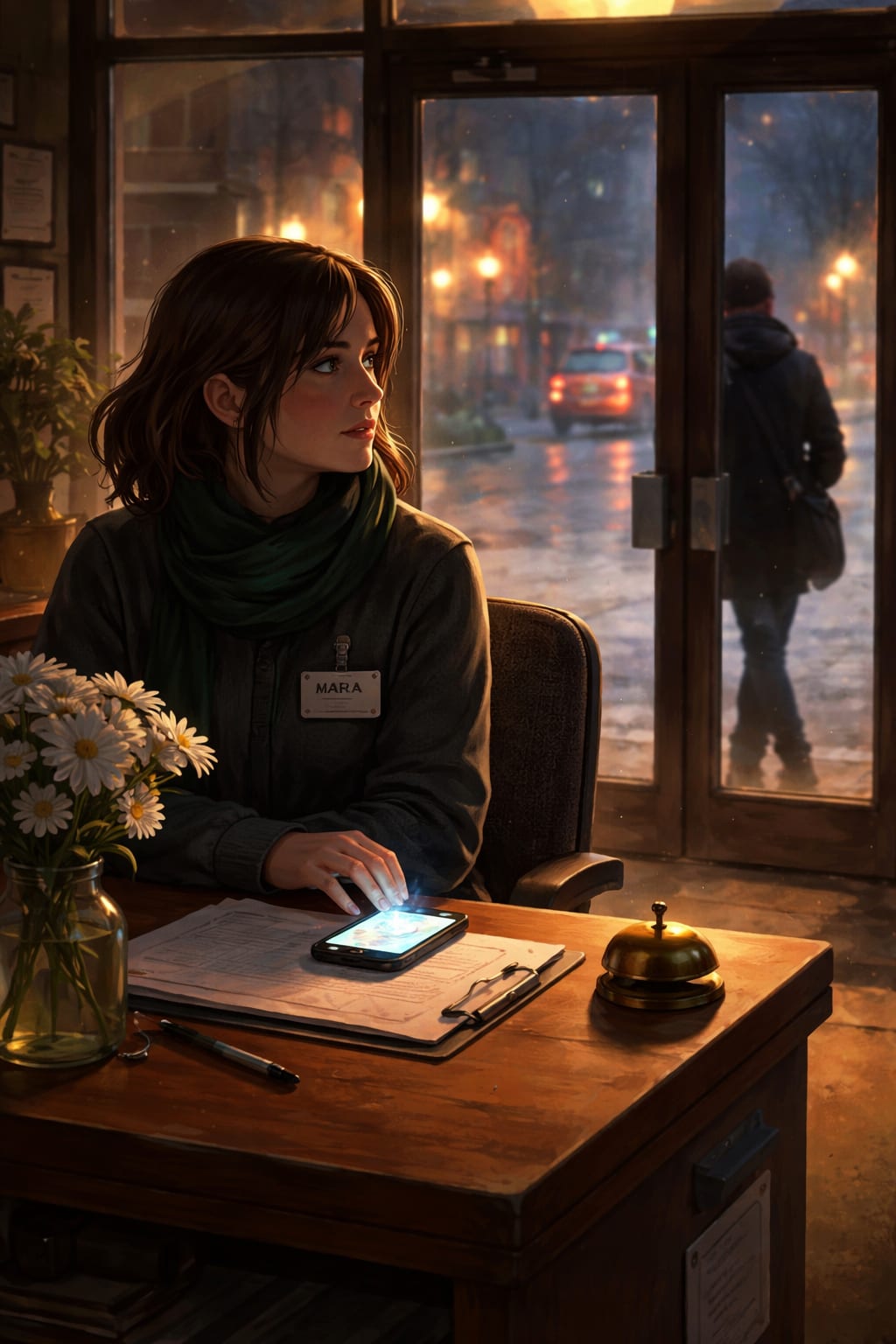
The building was an old converted storefront with tall windows. A sign in the glass read: NORTH AVE ARTS CO-OP. Someone had painted stars around the letters, like a child had insisted on magic.
Mara approached slowly. She could see movement inside: shadows passing, a figure at the front desk.
The closer she got, the more she felt that strange reluctant beginning pull at her. Not fear exactly. More like the body’s suspicion of change, even when the mind has begged for it.
She checked the time.
6:58.
She stood on the sidewalk across the street and watched the door.
A young woman came out carrying a rolled canvas under her arm, paint smudged on her cheek. She looked pleased with herself in a quiet way, like someone who had done what they meant to do. She walked away without looking back.
A man arrived on a bike and leaned it against the railing, locking it with practiced speed. He glanced up at the sign like he was verifying it was real. Then he went inside.
Mara shifted the flowers in her grip.
Her phone buzzed again. Another message from Eli.
I know you said you’re done. I just… I need a minute.
The words looked smaller than they should’ve been. Like he was shrinking himself to fit into her life again, hoping she’d make room.
She put the phone in her pocket without responding.
Then she crossed the street.
Halfway over, she hesitated. Not enough to stop—just enough that her stride became uneven, a tiny hitch. A car honked, not angry, more like a reminder: keep moving.
She did.
At the arts center door, she reached for the handle and felt the cold glass. Through it, she could see the front desk and behind it a wall of flyers: pottery classes, open mic nights, a support group for people who wanted to write but couldn’t start.
That last one made her throat tighten. The flyer read: THE FIRST SENTENCE CLUB. WEDNESDAYS AT 6.
Mara stared at it as if it were speaking directly to her.
Inside, someone looked up—a woman with short hair and a lanyard. She smiled and waved, a small gesture that carried no weight and yet felt like an invitation to a new version of herself.
Mara opened the door.
Warm air spilled out, along with the smell of paint and paper and something sweet baking somewhere in the back. The sound of voices—soft, layered—met her like a gentle collision.
“Hi!” the woman behind the desk said. “You must be Mara. First night, right?”
Mara nodded. The bouquet swung slightly in her hand like a nervous animal.
“Oh my god,” the woman said, eyes lighting on the flowers. “Those are gorgeous. Are those for someone?”
Mara’s mouth opened, and for a moment she didn’t know what would come out. She could’ve lied. She could’ve shrugged. She could’ve said they were a mistake.
“For me,” she said again, and this time it didn’t surprise her. It steadied her.
The woman grinned as if Mara had passed some secret test. “Good,” she said, echoing the flower man’s word without knowing it. “People forget. You can put them in water back here. Come on.”
She led Mara behind the desk toward a tiny break room where a chipped vase sat on a shelf beside a microwave. Mara filled it with water, hands slightly shaking as she arranged the daisies. The petals floated and settled. The vase didn’t look like much, but the flowers made it seem like it belonged there.
Mara stepped back and looked at them. A small bright thing in a plain room.
“Alright,” the woman said, clapping softly. “Let’s get you set up. It’s pretty chill. People will ask you stuff. If you don’t know, you say ‘Let me check.’ Works for everything. I’m Tessa, by the way.”
“Mara,” Mara said automatically, then laughed under her breath. “Right. You know.”
Tessa handed her a lanyard with a plastic badge that read: MARA — FRONT DESK.
The badge felt too official in her hand. Like it belonged to someone who had already arrived.
Mara clipped it on anyway.
Back at the front desk, Tessa showed her the sign-in sheet and the little bell people rang when they needed help. The bell sat perfectly still, innocent.
“You’ll do great,” Tessa said, already stepping toward the door. “I’m off. See you tomorrow.”
“Tomorrow,” Mara repeated, and the word tasted strange and possible.
Tessa left. The door shut. The bell remained silent.
Mara sat down behind the desk.
For a few minutes, nothing happened. The lobby hummed. Somewhere deeper in the building, music started—soft piano scales, someone practicing something they weren’t ready to perform.
Mara looked at the sign-in sheet, the pen, the stack of flyers. She looked at her hands resting on the desk, fingers still wearing the shape of her apartment key.
Her phone buzzed again in her pocket, insistent.
She pulled it out and saw another message from Eli.
I’m outside your building.
Mara stared at the screen until the letters seemed to sink into it.
Outside her building. Not outside here. Not meeting her in this new place. Waiting at the old door, the old lock, the old half-turned key.
Her heart beat faster—not with romance, not with panic exactly, but with the raw fact of being pulled in two directions.
She could imagine him there on the stoop, hands shoved into his pockets, face tilted up toward her window. She could imagine the look he’d wear—half regret, half entitlement, like someone returning to a chair he’d once sat in and assumed would still be empty for him.
Mara’s thumb hovered over the keyboard.
She typed, slowly: I’m not home.
She didn’t send it.
She typed: I’m working.
She didn’t send it.
She typed: Go away.
She didn’t send it.
A shadow moved in the doorway. Someone came in, stamping snow-melt off their shoes. A man in a beanie and a scarf, carrying a case that looked like it held an instrument. He approached the desk with a polite uncertainty.
“Hey,” he said. “Uh, I’m here for Studio B? For the open jam?”
Mara blinked, pulled her attention back like a thread tightening. “Yeah,” she said, voice a little too quiet at first. Then, clearer: “Yeah. Sign in here.”
He smiled, relieved by her certainty. He scribbled his name on the sheet, then looked up. “You new?”
Mara glanced down at her badge as if checking. “First night,” she admitted.
“Nice,” he said. “Good luck. It’s a good place. Changed my life, honestly.”
He said it casually, like a fact about the weather, and then he walked past her down the hallway, disappearing into the building’s deeper rooms where sounds became music and people became silhouettes.
Mara watched him go.
Changed my life. As if life could change in a place like this. As if it could happen without fireworks. Just small decisions stacked on top of each other.
Her phone was still in her hand.
Eli was still outside her building.
The bell on the desk remained silent.
Mara set her phone down face-up. The screen glowed like a small, stubborn moon.
She didn’t know what she would do. Not yet. Not in this minute. She could feel the movement beginning—quiet, partial, reluctant—like the first turn of a key that hadn’t fully committed to becoming an open door.
She took a breath and reached for the pen, straightening the sign-in sheet as if aligning herself with the present.
In the hallway, the piano scales shifted into a melody and then faltered, starting again from the top.
Mara watched the entrance. She listened.
Her phone lit up once more, vibrating against the desk with a soft, urgent tremor—waiting to be answered or ignored, waiting for her to choose a direction.
A new person stepped through the door, bringing a gust of cold air and the smell of outside. Mara lifted her head, ready to ask a question she hadn’t fully learned how to ask yet.
“Hi,” she said, voice steadying as it left her mouth. “Can I help you?”
About the Creator
Lawrence Lease
Alaska born and bred, Washington DC is my home. I'm also a freelance writer. Love politics and history.
Keep reading
More stories from Lawrence Lease and writers in Fiction and other communities.
The Sixth Seed
No one remembers who counted the seeds. They remember the number, of course. They always remember the number. Six. Sometimes four, sometimes seven, depending on who is telling it and how much time has passed since hunger became allegory. But the counting itself—the moment when a mouth closed, when sweetness broke, when something irrevocable happened—that part is never given a witness.
By shallon gregerson2 days ago in Fiction

Comments
There are no comments for this story
Be the first to respond and start the conversation.