
The secret of the crazy killing lake in Africa...
Lake Kivu is located in the African country of Rwanda, where two million people live.

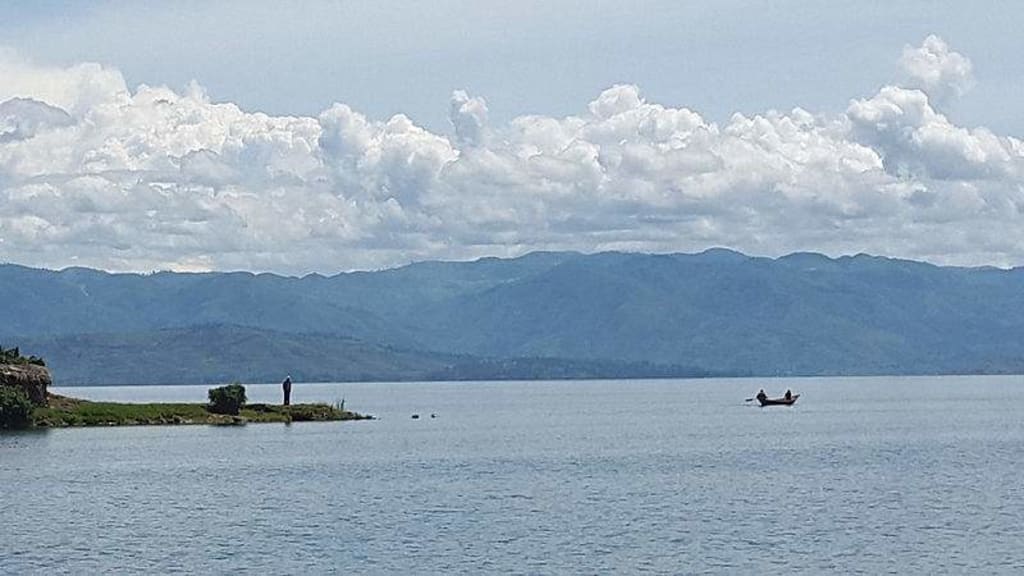
Lake Kivu is located in the African country of Rwanda, where two million people live. Beneath the seemingly peaceful lake, there is an evil and terrifying devil lurking. It has killed people and will continue to kill, even killing millions of people in its own territory. Scientists are in a race against time to stop the serial killer from continuing his bloody attacks.
Just 18 kilometers from Lake Kiu in the African country of Rwanda, is the famous Nila Congo Volcano. On January 17, 2002, Nila Congo Volcano erupted! This is the largest natural disaster to occur since the outbreak of civil war in Rwanda - in one of these eruptions alone, as many as 50 people were killed; in the end, as many as 500,000 people were left homeless by the eruption. While this is undoubtedly a disaster, ironically, scientists believe that the locals are lucky this time, because an even more terrifying catastrophe that can kill hundreds of thousands or even millions of people at a time may still be behind.
Strange disaster
Cameroon, West African country. One morning in 1984, Ahaji Abdul was riding his bicycle to his farm when he found many dead bodies lying on the road. He thought at first that there had been a car accident, then realized that something far more serious must have happened, and even felt that he was dying.
One villager said: "I heard they were massacred, but it didn't look like that. At that time, two people ran up to us and said that there were 12 people in the car in the accident, and 10 people died. We asked these people How did they die, the two said they were sitting on the roof of the minivan, while the rest were sitting in the car. The driver was the first to get out of the car to see why the engine wasn't turning, but he immediately fell to the ground. The people in the back row got out of the car, wondering what happened, how could they all fall to the ground and die." From this point of view, none of these people struggled before they died, as if they all died of some kind of severe infectious disease. Because the disaster happened so suddenly, there were rumors that the dead were attacked by some kind of biological and chemical weapon.
Pierre Zabu was the first doctor to arrive at the scene, and Pierre and others carried the body into a jeep sent by the military without a gas mask or gloves. Minutes later, the body was transported to the hospital. At the same time, the police also arrived and sealed off the hospital.
A few months after the incident, Professor Haradur Sigurson of the University of Rhode Island came to the Morowan Lake area where the accident scene was located. The suspicion of biological and chemical weapons was immediately ruled out because the victims looked more like they died of suffocation. Some say there was a thick white fog at the time of the incident, but it dissipated quickly. Dr. Pierre recalled that when they were about to arrive at the scene of the accident, they encountered a fugitive. The man shouted to them: "Run away, or you will die!" Just then, Pierre smelled an unpleasant smell, like rotten eggs or gunpowder.
Smell and white fog? At first, Sigurson was confused about this, but he immediately got another clue: All 37 people died on their way through the lake. Sigurson was convinced that no matter where the killer came from, it must be related to Lake Morowan. Tremblingly, he got into the dinghy, sailed to the center of the lake, and dropped a water sample extraction bottle to the bottom of the lake. Then, he slowly pulled the sampling bottle up.
When the sampling bottle was about to be lifted to the surface of the lake, he noticed a lot of air bubbles in the bottle, and immediately realized that the deep lake water must be full of gas. What gas is it? He can't see, smell, or taste it. Suddenly he understood at once - it's carbon dioxide! Everyone exhales carbon dioxide, a small amount of carbon dioxide is harmless, but a high concentration of carbon dioxide can suffocate people enough to kill them! Sigussen concluded that carbon dioxide was the culprit behind the tragedy of Lake Morowin.
At this point, another mystery appeared: what caused such a large amount of carbon dioxide to be forced out of the lake? Unfortunately, before Sigussen could find the answer, the mysterious killer took action again.
A greater tragedy
Two years later, in 1986, Cameroon's Lake Neos region once again shocked the world. Reports at the time said a mysterious deadly gas had hit the Lake Neos region, killing at least 1,200 people.
When rescuers arrived at the scene, the killer had disappeared, but left a lot of clues. Witnesses said they saw white fog floating at the time of the incident, but the white fog did not run into the air, but mostly fell to the ground. Others said that after hearing a loud bang, he ran outside the house, only to see that all his cattle were dead. He immediately ran back into the house and found his wife and daughter beside a bucket of water. As in the tragedy at Lake Morowan, someone smelled a pungent odor this time. In addition, there were strange scars on the surface of the survivors' bodies. One witness said: "When I woke up, I found that I had burns on my left arm, but then I didn't feel the pain anymore, maybe even the nerves were burned and numb."
It seems that there is only one phenomenon that can explain all this evidence, because this phenomenon can both cause explosions, produce pungent gases, and of course cause burns, and this phenomenon is volcanic eruption. Indeed, Lake Neos is not an ordinary lake, and like Lake Morovin, it also sits on a crater. In fact, both lakes formed at the top of a chain of volcanoes that includes Mount Cameroon, which is still active today. From this point of view, the culprit of the murder has finally been found, and it is the toxic gas emitted by the underground volcano at the bottom of Lake Neos.
This time, the Americans were among the first to arrive at the scene. For them, what started as a mundane investigation turned into a discovery that would lead to a deeper understanding of the meaning of the phrase "lakes kill people too."
The American scientists who came to investigate this time included George Knin and Bill Evans. Evans said: "When we first came, everything seemed to point to a volcanic eruption. First, Lake Neos was a volcanic lake; second, the scale of the disaster was so large; third, some of the victims had burns."
However, when they got to the top of the crater, they realized that the problem was not that simple. If a volcanic eruption had actually occurred, sediments such as lava flows would have washed up from the bottom of the lake, leaving traces on the top of the crater. The problem is that no such trace has been found on the top of the crater. From this, it can be speculated that there has been no large-scale volcanic eruption. Knin and Evans then felt that the answer still had to be found in the lake.
It's the murderer
At the southernmost tip of Lake Neos, a cliff about 100 meters above the lake made Knin dumbfounded. This cliff, which was densely vegetated a year ago, is now bare, not only the vegetation is gone, but also the soil. It gives the impression that the cliff has just been washed away, and when the water returns to the lake, it takes away grass mats and trees.
At the same time, the cliffs in the northern part of the lake were hardly affected. In other words, the flood seems to be aimed at the southern end of the lake. But from this point of view, it is very consistent with the volcanic activity at the bottom of the lake. So Knin and Evans went to the lake again to look for traces of volcanic eruptions. The first is to measure the water temperature. Since the volcano is so hot, the bottom lake water should still be warm, or even hot. The test results showed that the water temperature was not abnormal. This surprised Knin and Evans, so they repeated the measurement many times, and the result was the same. They then searched the lake for sulfides and chlorides, both common products of volcanic eruptions. But again, the measurements puzzled them - while many survivors reported smelling rotten eggs or gunpowder (typical of sulfides), the lake water had extremely low levels of sulfides and chlorides.
So far, it can be asserted that the culprit of the accident is not a volcano. So, who is the murderer? What else can cause strange smells and burns at the same time? What demons are hidden at the bottom of Lake Neos? No one thought that the first important clue about the murderer would come from another killing lake - the aforementioned Lake Morovan. At that time, Professor Sigurson, who had already returned to the United States, was still analyzing the water samples of Lake Morovan he had retrieved, in order to determine where the carbon dioxide came from. Depending on where it was produced, the gas also has its own unique "fingerprint" (chemical composition). For example, the carbon produced by plants is different from that produced by mountains. After "fingerprint" comparison, Sigusen found that the carbon dioxide in the water at the bottom of Morowan Lake is exactly the same as the carbon dioxide deep below the ground.
This shows that the high concentration of carbon dioxide in the bottom water of Morowen Lake does not come from volcanoes, but from very deep below the ground, and carbon dioxide from very deep below the ground escapes into the lake water through rock cracks in the earth's crust. From this, Sigussen put forward his own explanation for the tragedy of Morowen Lake: Morowen Lake is like a huge bottle of high-pressure soda. Due to the great pressure and pressure in the deep lake water, the carbon dioxide escaping from the cracks in the rock of the earth's crust is dissolved under high pressure. In the lake water, once the high pressure is broken, an extremely large amount of carbon dioxide gas will spew out of the lake like a runaway horse, causing a catastrophe.
Sigussen's theory is so novel that it caused great controversy in the scientific community once it was proposed. After all, lakes can drown people, but who has ever seen an exploding lake? Despite their skepticism, Knin and Evans decided to test Sigussen's theory at Lake Neos. As expected, the bottom water of Lake Neos contains a lot of carbon dioxide. However, another mystery ensued: how did such a large amount of carbon dioxide get into the bottom of the lake? At this time, Knin and Evans heard strange stories from the locals about the magic springs killing frogs, birds and other animals. Locals say that no matter what kind of small animal it is, as soon as it gets close to the magic spring, it will immediately fall to the ground and die, just like the people and animals who died in the tragedy of Lake Neos.
Knin and Evans came to the magic spring and saw that there were many air bubbles in the spring water, which was indeed carbon dioxide after testing. They immediately thought: If there is such a magic spring at the bottom of Lake Neos, it only takes 100 years for the carbon dioxide in the lake water to cause a great tragedy. So, they compared the deep water samples of Lake Neos with the magic spring water samples, and found that the two were completely consistent. From this, it can be concluded that there must be at least one such magic spring at the bottom of Lake Neos, which has been continuously injecting carbon dioxide into the lake. As the concentration of carbon dioxide in the water at the bottom of the lake increases, Lake Neos becomes a giant ticking time bomb, waiting for an event to detonate it. What is the event? Looking at the cliffs around Lake Neos, it is clear that some of the rocks have fallen off. Further investigation revealed that a landslide occurred before the catastrophe, and a large amount of rock fell into the lake. In addition, the slope of Lake Neos was so steep that the rock broke the pressure balance at the bottom of the lake, and the disaster was triggered.
From this, scientists reconstructed the scene of the night of the great tragedy of Lake Neos. Soon at 9 p.m., the villagers were ready to go to bed, or had already gone to bed. Because of the market the next day, the villages around Lake Neos were full of people. What they did not expect was that disaster was imminent. In the far corner of Lake Neos, a landslide caused a large number of rocks to go straight to the bottom of the lake, and the balance at the bottom of the lake was disrupted. A large amount of carbon dioxide pressed on the bottom of the lake "escaped from prison in the chaos", rushed up, and formed a large number of bubbles near the water surface. In the end, a dense cloud of white gas poured down the water outlet towards the village by the lake at a speed of 100 kilometers per hour. People were suffocated to death before they could shout. In the village of Neos, only six people escaped the catastrophe. Then, deadly gas rushed to surrounding villages, eventually killing 1,800 people. This is just a human disaster. At the same time, the exploding lake water also formed a huge column of water dragons, killing all the fish in the lake and climbing over some of the high cliffs by the lake. Some survivors heard the explosion and mistook it for a volcanic eruption. Huge waves of up to 25 meters initialized the rock and brought vegetation from the rock into the lake. At this point, the disaster is over.
However, two major mysteries remain unanswered: where did the mysterious stench come from? What about the burns and blisters on the surface of the victim's body? For the former, the now accepted view is that extremely high concentrations of carbon dioxide can cause hallucinations, including the smell of rotten eggs or gunpowder. For the latter, Peter Buster, a British doctor who participated in the investigation, found after careful investigation that they were not ordinary burns, but they were indeed obvious ulcers and blisters. The question is, how can carbon dioxide "burn" people? Buster immediately thought of another gas that is very similar to carbon dioxide, but can cause blisters in the human body and is more deadly than carbon dioxide - carbon monoxide. Carbon monoxide can make people unconscious and reduce the circulation of bodily fluids in the skin, which can cause blisters on the surface of the human body. He further wondered: Could carbon dioxide also have this effect? After talking to survivors, he was convinced that carbon dioxide mixed with air would have the effect of an anesthetic, causing lethargy. Sleeping for too long without turning over can also cause reduced fluid circulation in the skin, insufficient oxygen supply, and eventually a blister ulcer reaction. From this, it can be concluded that the "burns" on the victims of the Lake Neos tragedy were actually high-pressure blisters, not real burns. At this point, the truth of the Lake Neos tragedy has finally been revealed. But how can the tragedy be prevented from happening again?
Potential crisis
One way to avoid a repeat of the tragedy is to "deflate" - suck the carbon dioxide from the bottom of the lake out of the lake and release it gradually, so as to avoid the accumulation of carbon dioxide at the bottom of the lake, so as to eliminate the hidden danger. The principle of this method is very simple, similar to inserting a straw into a soda bottle, but the exhaust pipe required is high-tech. After years of experimentation, in January 2001, a team of French and Cameroonian scientists inserted an exhaust pipe into the bottom of Lake Neos. As soon as the top seal of the tube was opened, the air pressure ** column into the air, reaching a height of 50 meters.
However, it will take at least 15 years to completely eliminate the hidden dangers with just one exhaust pipe. Therefore, scientists are currently requesting assistance from developed countries around the world, hoping to install a few more expensive exhaust pipes so that this "time bomb" can be eliminated in the shortest possible time. Although the hidden danger has not been eliminated yet, they have finally found a way to subdue the "devil", so the villagers on the shore of Lake Neos have taken a reassurance pill and began to return to their homes. However, Lake Neos is not the only "bomb lake", nor is it even a "big bomb". The real "blockbuster" is Lake Kiu in Rwanda, which is also one of the largest and deepest lakes in Africa, 2,000 times larger than Lake Nios, and far more people live on the shores of the lake. Even more worrying is that people there simply don't believe they are living in the shadow of the "giant bomb" and still take bubble baths in the lakeside hot springs every day. What they also don't believe or don't care about is that these interesting bubbles are the carbon dioxide that could kill them. These natural bathhouse hot springs are "training" Lake Kiu to be a terrible "killer".
About the Creator
Julian
Like to share all kinds of stories, love adventure.
There's A Hole in My Bucket
It’s a well-known fact that Liza Dufresne was always the brains in the family. She was the one who always came up with the brilliant schemes the Dufresne kids carried out when they were younger. Like when they tricked Mrs. Claybourn into paying for a trip to Disney World. Liza convinced her that their parents had been kidnapped and were being held for ransom for the total price of three tickets. In reality, they were away on a weekend getaway for their anniversary. When they returned, Liza told the Claybourns that they did not like to talk about the ordeal. Their parents never found out how they got the money. Mrs. Claybourn never found out that the Dufresne parents were never really in any danger.
By David E. Perry3 days ago in Fiction
Goodbye, Mr. Duvall
It is turning out to be an interesting year. I was in the middle of teaching a class when a pop-up appeared on the screen announcing the death of Mr. Robert Seldon Duvall (yes, that was his full name). I was in the middle of a discussion on the obsession we have with winning when it comes to sports (the Winter Olympics was a theme), and I felt as though things were coming full circle. We had already lost Gene Hackman last year, and along with that titan, it feels though one particular golden age has closed off to be replaced by...?
By Kendall Defoe 5 days ago in Geeks



Comments
There are no comments for this story
Be the first to respond and start the conversation.