
The Third Knock
Each year, they proved their love the same way—until the ritual began answering back.
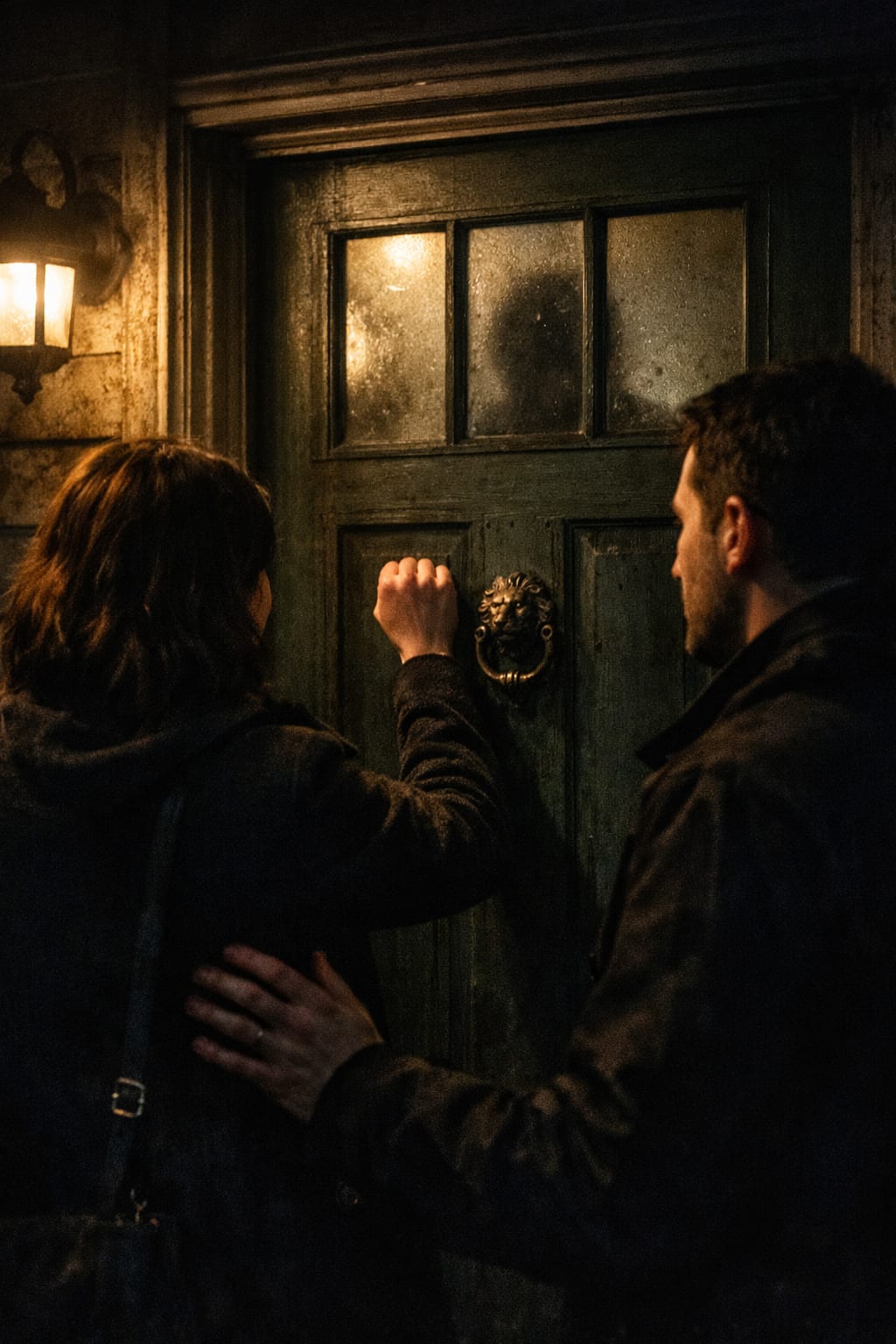
Every year on the night they met, Mara and Julian knocked three times on a stranger’s door.
They did not speak about why three. They did not remember deciding it. The number had arrived the way habits sometimes do—half joke, half dare—then calcified into something that felt older than both of them.
The first year, it had been spontaneous. They were walking home from the restaurant where they’d had their first anniversary dinner, hands brushed red from the cold, wine still warm in their blood. They passed a narrow brick house with a green door and a brass knocker shaped like a lion’s head.
Julian had laughed and said, “What if we just knock and run? Like we’re thirteen?”
“We are not thirteen,” Mara had said.
But she was already smiling.
Three knocks. A pause. Footsteps inside. A shadow swelling under the porch light.
They ran.
They laughed until their lungs burned. It felt reckless and adolescent and harmless. A punctuation mark at the end of a good night.
The second year, they planned it.
They chose a different neighborhood—one with tall hedges and long driveways—and debated the door the way other couples might debate a bottle of wine. Blue with frosted glass? Red with a wreath? They picked a modest beige house with a porch swing and a single lamp burning inside.
Three knocks.
They did not wait for footsteps this time. They did not need to. The ritual had already become about the knocking itself, the sound of knuckles on wood, the brief communion with a life behind the door.
They ran again, but slower. Laughing, but softer.
Afterward, lying in bed, Mara said, “It’s like leaving a fingerprint on the year.”
Julian kissed her shoulder. “Or taking one.”
They did not explain what that meant.
By the third year, they were quieter about it. The night had taken on a density. They ate dinner at home. They dressed in dark coats. They walked with intention.
They chose an apartment building this time, one with a shared hallway and rows of identical doors. The carpet swallowed their steps. The air smelled faintly of cumin and something floral.
“Third floor,” Julian whispered.
They stopped in front of 3C.
Mara knocked.
One.
Two.
Three.
The sound was duller here, absorbed by the corridor. They stood very still.
This time, they did not run.
They waited.
There was a television murmuring inside. A cough. Then the soft scrape of a chair leg.
Mara felt something move inside her chest—not fear exactly, but a tightening, as if a string had been pulled taut from her ribs to the door.
The handle twitched.
They left then, walking calmly down the stairs, hearts pounding not from exertion but from proximity. In the parking lot, Mara grabbed Julian’s hand.
“Did you feel that?” she asked.
He nodded.
They never said what they had felt. It seemed impolite to the ritual to name it too precisely.
—
In the fourth year, they argued before they went out.
It was small. Something about dishes. Something about whose turn it was to call Mara’s sister.
The argument clung to them as they walked, a static charge between their sleeves.
They chose a townhouse at random. The porch light was off.
Mara knocked harder than usual.
One.
Two.
Three.
The sound cracked the quiet street.
They waited.
Nothing.
She knocked again—once, sharply.
Julian touched her wrist. “It’s three.”
“I know.”
He looked at her, searching her face for something he could smooth over, but she was staring at the door as if it had slighted her.
A curtain shifted upstairs.
They walked away without speaking.
At home, they did not laugh. They undressed in separate corners of the room. The ritual had not absorbed the friction the way it usually did. It had not softened them.
In the dark, Mara said, “Maybe we should skip it next year.”
Julian turned toward her. “We don’t skip.”
She did not ask why.
—
The fifth year, they chose a house with no visible lights.
It was near the edge of town, where the streets thinned and the sidewalks dissolved into gravel. The house was small and white, with peeling paint and a single narrow window.
“This feels wrong,” Julian murmured.
Mara nodded, but she stepped onto the porch anyway.
Three knocks.
The sound echoed strangely, as if the space behind the door were larger than the house itself.
They waited.
No footsteps. No television. No shift of shadow.
Just silence, heavy and complete.
Julian reached for her hand.
And then, from somewhere deep inside the house, there came a knock in return.
Three.
Measured. Deliberate.
Mara’s fingers tightened around Julian’s.
They stared at each other.
No one had opened the door. There had been no sound of movement. Only the answering rhythm, as if the house itself had knuckles.
Julian swallowed. “It’s a pipe. Or… something.”
She nodded too quickly.
They did not run this time. They backed away, step by step, as if retreating from a shoreline that had begun to breathe.
They did not speak for the rest of the night.
—
After that, the ritual changed.
They no longer debated the door. The door seemed to choose them.
They would walk without direction, and then, as if tugged by a thread, they would both slow at the same house. Sometimes it was obvious—a door painted the same green as the first year, a lion’s head knocker glinting under the light. Sometimes it was subtle—a particular stillness in the air, a sense of being expected.
They knocked.
Always three.
Sometimes there were footsteps. Sometimes a dog barked. Once, a baby began to cry.
And sometimes, there was an answering knock.
Not every year. Not every house.
But often enough that they stopped trying to explain it.
On those nights, something in their apartment felt rearranged when they returned. A photograph slightly crooked. A window unlatched. A draft where there had been none.
They never found evidence of intrusion. Nothing missing. Nothing broken.
Only a faint impression that the space between them had shifted—tightened or loosened by degrees too small to measure.
—
By the eighth year, their friends had started to ask when they would get married.
Mara would smile and say, “We already have our thing.”
Julian would squeeze her knee under the table.
The ritual had become a boundary. A private liturgy. They did not need rings; they had repetition.
That year, they chose a door at the end of a cul-de-sac. The porch light flickered.
Three knocks.
They waited.
The door opened immediately.
An old woman stood there, small and composed, her hair pinned neatly at the back of her head.
“Yes?” she asked.
Mara’s mouth went dry.
Julian tried to laugh. “Sorry, wrong house.”
The woman looked past them, over their shoulders, into the street behind.
“No,” she said gently. “You’re right on time.”
The words landed without weight, as if they had been waiting for a place to settle.
Mara felt the familiar string pull tight inside her chest.
The woman stepped aside.
The interior of the house looked ordinary—framed photographs, a narrow hallway, a lamp glowing warmly in the corner. Nothing monstrous. Nothing overtly strange.
Julian hesitated.
The woman’s gaze was patient. Not inviting. Not coercive. Simply expectant.
“It’s just part of it,” Mara whispered.
He looked at her. “Part of what?”
But she was already stepping over the threshold.
Inside, the air felt dense, like the moment before a storm. The woman closed the door behind them with a soft click.
“You’ve been very devoted,” she said.
Julian’s heart was pounding so hard he could hear it in his ears. “Devoted to what?”
The woman smiled.
“To keeping the door alive.”
Mara’s fingers brushed the wall beside her, as if confirming its solidity. “We just knock,” she said. “That’s all.”
“Yes,” the woman agreed. “You just knock.”
There was a sound from deeper in the house.
Three knocks.
Not from the door behind them.
From somewhere ahead.
Julian turned toward the hallway. It seemed longer now, the light at its end dimmer than before.
Mara stepped forward.
He caught her wrist. “We don’t know what this is.”
She looked at him with something like tenderness, something like apology.
“It’s ours,” she said.
Another set of knocks.
Three.
Closer.
The woman’s expression did not change. “It persists,” she said. “That’s the important thing.”
Julian felt the thread inside his chest pull—not toward Mara this time, but toward the sound down the hall.
He did not remember deciding to follow her.
He did not remember letting go of her wrist.
He only knew that the hallway seemed to stretch and narrow at once, that the air grew thicker with each step, and that somewhere ahead of them, a door was waiting.
Three knocks echoed again, measured and patient.
Mara reached for the handle.
Julian stood just behind her, the weight of all their years pressed into the small space between their shoulders.
The ritual had never promised safety.
Only return.
Mara turned the handle.
And somewhere, far away—or impossibly close—there came the sound of knuckles against wood.
One.
Two.
Three.
About the Creator
Lawrence Lease
Alaska born and bred, Washington DC is my home. I'm also a freelance writer. Love politics and history.
Keep reading
More stories from Lawrence Lease and writers in Fiction and other communities.
The Moment Before You Finally Move
The first sign wasn’t a sound. It was the way the light behaved. Mara noticed it while she stood in her kitchen with the faucet running too long, her hands held under the stream like she could rinse off a thought. The morning should have been clean and ordinary—gray Dallas daylight, thin and patient, the neighbor’s sprinkler ticking somewhere outside—but the sunlight coming through the blinds didn’t land right. It didn’t stripe the counter in neat bars. It hovered, softened, like it was deciding whether to commit.
By Lawrence Leaseabout 18 hours ago in Fiction
The Missing Ingredient
The first time I saw her, she was wearing a velvety, red ribbon in her hair. She carried a small leather backpack everywhere. She searched the forest by turning stones, checking beneath shrubs, listening to the wind as if it might carry an answer.
By Imola Tótha day ago in Fiction



Comments
There are no comments for this story
Be the first to respond and start the conversation.