
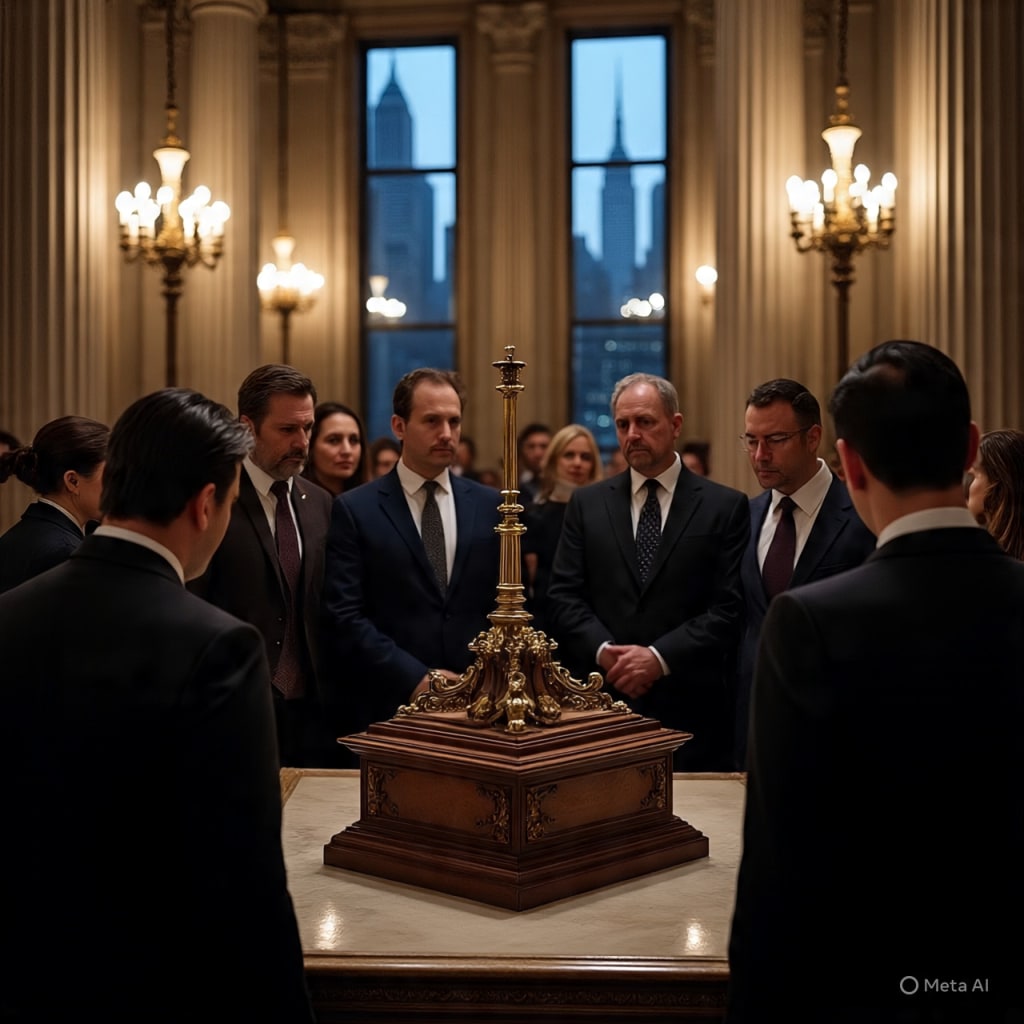
In April 1912, the RMS Titanic set sail from Southampton on her maiden voyage to New York. Among the 2,200 passengers was a young journalist named Eleanor Gray, sent by a London newspaper to cover the story of the “unsinkable ship.” She boarded with a notebook, a small camera, and a heart full of excitement. But what she didn’t know was that the Titanic carried more than passengers and dreams—it carried a secret.
Eleanor had been assigned to write about the luxury, the innovation, and the powerful people aboard. On the first night, as she wandered through the ship’s corridors, she overheard two men whispering in hushed tones near the First-Class Smoking Room.
“The artifact must reach New York unseen,” one said.
“If anyone finds out, it could change history,” replied the other.
Eleanor froze. An artifact? She scribbled a note but decided not to confront them. Curiosity tugged at her, stronger than fear. Over the next few days, she noticed strange things—a locked crate in the cargo hold, men in plain clothes who didn’t appear on the passenger list, and a steward who avoided eye contact whenever she asked questions.
On the third night, she met a kind engineer named Thomas Andrews. He admired her bravery and told her about the ship’s structure. “We built her to be the safest vessel afloat,” he said proudly. “Even God Himself couldn’t sink her.” His confidence made her smile, but something still felt wrong.
That evening, as the passengers dined under crystal chandeliers, Eleanor sneaked down to the lower decks. The air was damp and heavy. She followed the faint sound of voices until she reached the cargo area. There, under a dim lantern, she saw the two men again—opening the mysterious crate. Inside was something wrapped in velvet and glowing faintly golden.
Suddenly, a shadow moved behind her. A hand grabbed her shoulder.
It was Mr. Hargrove, one of the ship’s officers. “You shouldn’t be here, Miss Gray,” he said sharply. But before she could respond, the ship shuddered—a sound like thunder filled the air. The Titanic had struck the iceberg.
Panic erupted across the decks. Alarms rang, passengers screamed, and crew members rushed to lower the lifeboats. Amid the chaos, Eleanor tried to return to her cabin, but the corridors were already flooding. She saw the two men from before running toward the lifeboats with the crate in their arms.
“Stop!” she shouted. “What are you hiding?”
One of them turned to her, his face pale and terrified. “You don’t understand,” he said. “This thing—it shouldn’t have been brought aboard!”
But before Eleanor could question him, the floor tilted sharply, throwing everyone off balance. The crate slipped from their hands, crashing open. Inside was a small golden idol shaped like a woman with wings—a relic, ancient and beautiful. For a moment, it seemed to hum with energy. Then, the light faded.
The men tried to grab it, but a wave of freezing seawater swept through, carrying the idol into the depths. Eleanor clung to a rail as water rose around her. In the chaos, she caught sight of Thomas helping passengers into lifeboats, his face calm even as the ship sank lower.
Eleanor managed to reach the deck. “Get in the boat!” Thomas shouted, pushing her toward safety. “You have to live—to tell the world!”
She hesitated, tears blurring her vision. “What about you?”
He smiled faintly. “Someone has to stay.”
As the lifeboat descended into the black ocean, Eleanor watched the Titanic break apart. The great ship—the pride of mankind—disappeared beneath the icy waves, along with its passengers, secrets, and that mysterious idol.
Hours later, Eleanor and the survivors were rescued. She never saw Thomas again. The world mourned the tragedy, calling it an accident of nature, a result of arrogance and bad luck. But Eleanor knew there was more to the story.
Years later, she returned to journalism, haunted by dreams of that glowing idol. Some said it was a cursed relic stolen from an Egyptian tomb; others believed it was part of a secret experiment meant to harness strange energy. No one ever found the crate—or any trace of it.
In 1985, when explorers finally discovered the Titanic’s wreck, they reported finding personal belongings, china, and pieces of the grand staircase—but deep in the cargo hold, a diver captured something unusual on camera: a faint golden glimmer, pulsing softly in the dark. The image was blurry, but to Eleanor’s granddaughter, who had inherited her journal, it looked eerily familiar—the same winged idol Eleanor had described.
Was it real? Or just a trick of the light?
No one could say for certain.
But the legend lived on: that the Titanic’s fall wasn’t just fate or ice—but something far older and more mysterious, sleeping still beneath the waves.
About the Creator
Dead and Wearing Green
She was wearing that green dress when I first saw her, five years ago to the day. Flowing meadow fabric draped over long legs, thick auburn hair flowing down her back. That smile. Of course, she is still beautiful now. But now she is no longer alive.
By Karen Cave8 days ago in Fiction
Boons and Curses
Before him lay his doom. Exasperated, Imperator Valatious collapsed into his chair. Beyond the hide walls of his tent, the evening air hung disquietingly still. He ran his weathered hands through a grease-stained mane of brown hair, uncut since the campaign began.
By Matthew J. Frommabout 6 hours ago in Fiction




Comments (1)
There’s something in your writing. It’s rare and it pulls the reader in without force.