
The Weight of the Sky
Atlas supports the heavens at twilight

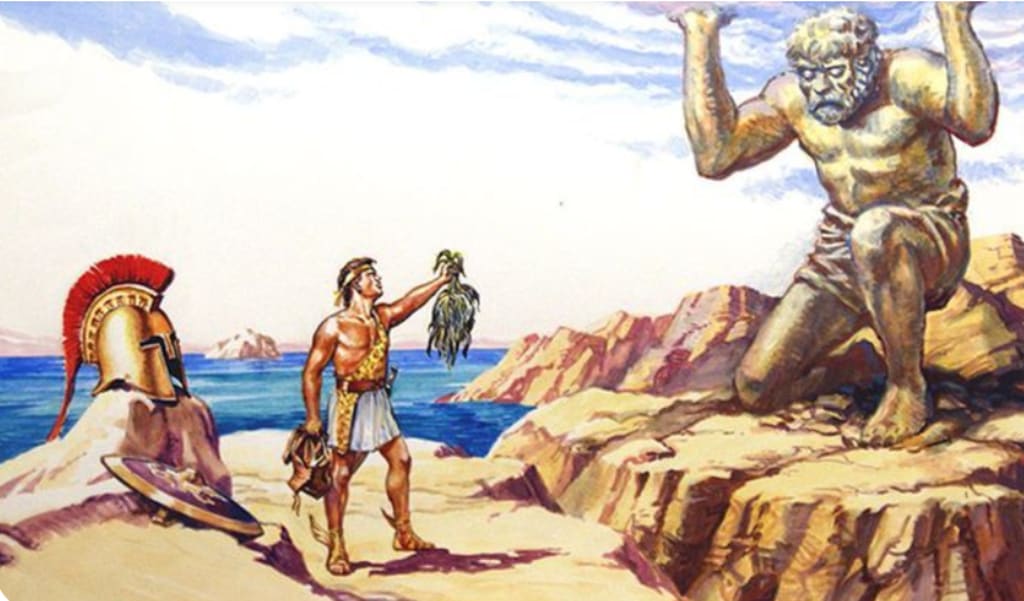
Everyone knows Atlas holds up the sky.
Children draw him in blue crayon: a straining man beneath a round, obedient globe. Teachers say he was punished for defying the gods. Priests say his endurance is noble. Poets say the sky is heavy with stars and fate.
No one asks what the sky is made of.
...
I live at the western edge of the world, where the mountains are said to rise into Atlas’s shoulders. We do not see his face. We see only the underside of what he carries: a faint curvature at the horizon, a trembling seam in the air on windless days.
And sometimes, when the seasons change, we hear him breathe.
The myth smooths this part over. It tells you Atlas is strong enough. That he stands eternally, knees locked, back bowed but unbroken. The sky rests on him like a stone on a pillar.
But the sky is not stone.
It is weather. It is distance. It is pressure. It moves.
...
My father was a mason who repaired the western watchtowers. He taught me that weight is not simply how heavy something is; it is how it shifts. A balanced arch can hold for centuries. An uneven one collapses in a night.
“Stone is honest,” he would say. “It tells you where it will fail.”
The sky does not.
The first time I noticed something wrong, I was ten. The horizon dipped on the left, as though the world were pouring. Our well water sloshed against its rim without wind. The priests declared it a test of faith and sacrificed two white goats. The goats bled neatly; the horizon did not return to level.
Three days later, it corrected itself.
We began keeping records after that.
I apprenticed under my father, and we added marks to the tower walls whenever the sky shifted. A notch for a dip. A longer score for a tilt that lasted more than a day. Over the years, a pattern emerged.
The myth says Atlas stands still.
He does not.
When winter storms gather in the north, the sky grows dense there, swollen with snow. Our horizon lifts slightly, as though Atlas has adjusted his grip. In high summer, when the air over the southern deserts shimmers thin, the sky slackens. We feel it as headaches and cracked plaster.
The priests say this is natural. They say the gods balance it.
But we have heard him.
On certain nights, when the air is clear and the stars sharp, there comes a sound from the west. Not thunder. Not wind. A low exhale that trembles through the rock beneath our feet.
Once, the exhale broke into a groan.
My father set down his tools and did not speak for a long time.
“If he shifts his stance,” he said finally, “it means something up there moved first.”
Up there. As if the sky were a cartload that might slide.
The myth never mentions Atlas’s hands.
In carvings, they are broad and steady, fingers splayed against the firmament. But what if his grip slips? What if the sky is not a sphere but a tension, a fabric drawn tight from horizon to horizon? What if he bears not a globe but the strain of holding it in place?
I began climbing the western peaks when I was sixteen. The air thinned; the seam in the sky sharpened. It looked less like a curve and more like a distortion, a place where the blue thickened as if folded.
I found something else there: dust.
Not earth-dust. Not ash. A fine, glittering powder that settled on the rocks after violent storms. It hummed faintly when held between finger and thumb.
Starfall, the villagers called it. A blessing.
It was heavier than it looked.
We collected it in jars and measured it against known weights. A handful equaled a stone’s mass. Two handfuls bent a copper scale. It was not blessing. It was burden.
“Where does it come from?” I asked the priests.
“From the heavens,” they said, satisfied.
“But how does it fall, if Atlas holds the heavens up?”
They did not like that question.
The pattern in our tower marks grew more urgent as the years passed. The dips became deeper, the corrections slower. Cracks appeared in arches that had stood for generations. My father’s hands began to shake.
“He is tiring,” he said one night, as another groan rolled through the bedrock.
“You’re speaking heresy,” I told him.
“I’m speaking masonry.”
The myth says Atlas’s punishment is eternal. Eternal is a word that refuses arithmetic. It does not ask how long a back can hold, how many shifts a stance can survive before cartilage wears thin.
It does not calculate erosion.
I climbed higher than I had ever dared, past the point where shrubs grow and into the bare stone. The seam in the sky loomed overhead now, not distant but immediate—a faint lattice, like threads drawn too tight.
And there, embedded in the rock, I saw it: a print.
Five grooves, deep and unmistakable. Fingers.
Atlas was not holding the sky from beneath as the carvings claim. He was bracing it against the mountains.
The sky was not a ball on his shoulders. It was a vault, and we were one of its buttresses.
I pressed my palm into the grooves. They were wider than my arm span. The stone around them was ground smooth, as if by repeated adjustment.
He shifts, I thought. He repositions. He leans into us.
The dust began to fall more frequently that year. The priests called for larger sacrifices. They polished their statues of Atlas and told the children he was unshakable.
But in the tower, our marks climbed higher up the wall.
The night the horizon truly tilted, it did not correct itself by morning.
Cups slid from tables. The sea pressed harder against the western cliffs. A fissure split the old road to the market.
And beneath it all, a sound like teeth clenched in effort.
The myth says Atlas is alone.
He is not.
He has been leaning on us for centuries.
I gathered the villagers at the base of the highest peak. I showed them the handprint. I poured star-dust into their palms and let them feel its weight.
“If this is falling,” I said, “then something above is shedding. If he braces here, then we are part of what keeps the sky from slipping.”
The priests accused me of arrogance. “You would share a titan’s burden?” they scoffed.
But the masons understood. So did the fishermen who felt the sea’s new pressure. So did the mothers whose infants would not sleep through the constant tremor.
We began to build.
Not altars.
But supports.
Stone pillars along the ridge, angled into the seam where the sky thickened. We used star-dust in the mortar; it bound tighter than lime. We widened the watchtowers and reinforced the arches.
When the next groan came, it was softer.
The horizon still leaned, but it did not drop further.
The myth will not change. It will continue to say Atlas holds the sky alone, punished and solitary. It will not mention the mountains that bear the transfer of strain, nor the villages that brace their shoulders against stone.
It will not record the way we listen for his breathing.
But on windless nights now, when the stars burn steady and the seam above us hums like a drawn string, I place my hand in the ancient grooves and press back.
The sky is not a globe. It is a balance.
And Atlas, for all his strength, was never meant to carry it without adjustment.
About the Creator
Lori A. A.
Teacher. Writer. Tech Enthusiast.
I write stories, reflections, and insights from a life lived curiously; sharing the lessons, the chaos, and the light in between.
Keep reading
More stories from Lori A. A. and writers in Fiction and other communities.
Lighted
The first spark appeared beneath her heel. Lina almost missed it. She had been walking home the same way she always did—head down, earbuds in, the long gravel path cutting between the dark field and the empty parking lot. It was late, but not dangerously so. The sky held that deep blue that feels suspended, as if night hasn’t fully claimed it yet.
By Lori A. A.9 days ago in Fiction
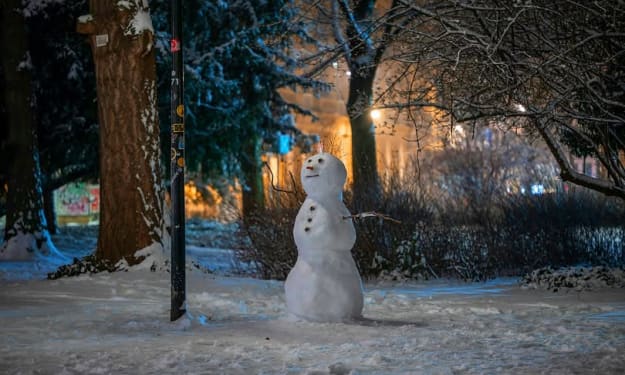
Winterthorne
Winterthorne stood alone at the edge of the park. The beautiful snow that had surrounded him was all trampled now, from the feet of all of the children who had built him. He missed the sparkly clean snow blanket, but he was happy that so many children had come out to make him.
By Laura DePace3 days ago in Fiction


Comments (1)
What a wonderful take on this myth, and the lesson to us about balance and the need for readjustment 👏