
This Is Not a Poem About Love
It’s about what remains after love leaves.

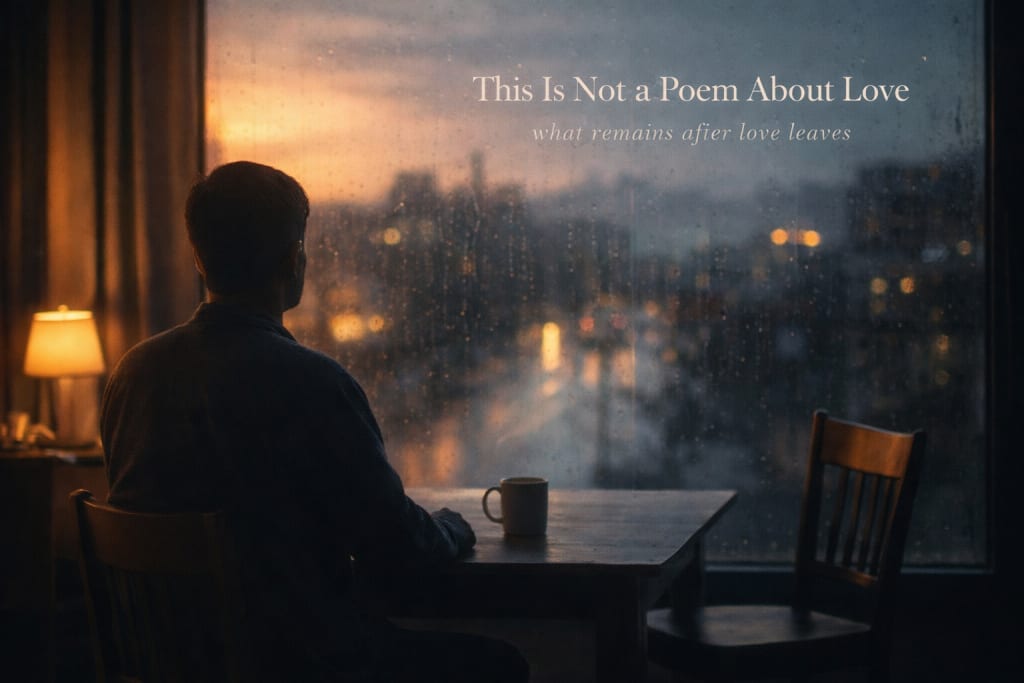
I used to think love ended loudly.
I imagined slammed doors, dramatic goodbyes, tears falling onto unfinished sentences. Movies taught me that heartbreak arrives like a storm — sudden, violent, impossible to ignore.
But that’s not how it happened.
Love didn’t leave my life with noise.
It left quietly, like someone turning off a light in another room while you’re still talking.
And you don’t notice the darkness until much later.
This is not a poem about love.
It’s about what stayed behind after it was gone.
At first, nothing looked different. We still said good morning. We still shared meals. We still asked each other how the day went. From the outside, everything seemed intact — two people continuing a story already written.
But something small had shifted.
Conversations became shorter. Laughter arrived slower. Silence grew comfortable in a way that felt unfamiliar, almost heavy. Not peaceful silence — the kind filled with things neither person knew how to say anymore.
I remember the exact moment I realized something was wrong.
We were sitting together, both looking at our phones. Not arguing. Not upset. Just… existing beside each other.
And I felt alone.
Not physically alone — emotionally alone. The kind of loneliness that appears even when someone is inches away.
That scared me more than any fight ever could.
People think heartbreak happens when love disappears overnight. The truth is harder: love often fades gradually, so slowly you adjust without noticing.
You stop sharing small details about your day.
You stop reaching for their hand automatically.
You stop expecting to be understood.
And one day, you realize you’ve already learned how to live without them — even though they’re still there.
Love doesn’t always end with anger. Sometimes it ends with exhaustion.
Not the exhaustion of fighting, but the exhaustion of trying to feel what once came naturally.
After it ended, everyone asked the same question.
“Are you okay?”
I didn’t know how to answer.
Because nothing dramatic had happened. No betrayal. No betrayal story people could easily understand. Just two people slowly becoming strangers who remembered everything about each other.
How do you explain grief when there’s no clear moment to blame?
The hardest part wasn’t missing them.
It was missing the version of myself that existed when love felt easy.
I missed laughing without thinking. I missed believing the future had already chosen its shape. I missed the quiet confidence of being someone’s home.
When love leaves, it takes certainty with it.
The days afterward were strangely ordinary.
I still woke up early. Coffee still tasted the same. The world continued moving as if nothing important had changed. People talked, buses arrived, notifications buzzed.
But inside, everything felt rearranged.
I noticed small absences everywhere.
Songs sounded different.
Evenings felt longer.
Jokes stayed unfinished because there was no one who understood why they were funny.
I learned something unexpected during that time: heartbreak isn’t always pain. Sometimes it’s emptiness — a space where emotion used to live.
And emptiness is confusing because you keep waiting to feel something stronger.
Healing didn’t arrive as a sudden realization.
It came quietly.
One day I laughed at something random and didn’t think about sharing it. Another day I walked past a place full of memories and felt… neutral. Not sad, not happy — just calm.
At first, that calm felt like betrayal. As if moving forward meant forgetting.
But it doesn’t.
You don’t forget love. You simply stop carrying its weight every minute.
What remains after love leaves isn’t only sadness.
It’s understanding.
You begin to see yourself more clearly — your fears, your habits, the ways you held on too tightly or stayed silent too long. You recognize how much of your identity was built around being part of “us.”
And slowly, gently, you learn how to be “me” again.
I used to believe love defined happiness.
Now I think love reveals it.
It shows you what connection feels like so that even after it ends, you know what warmth exists in the world. The memory becomes proof that your heart is capable of depth, even if the story didn’t last forever.
And strangely, that realization brings peace.
Because love leaving doesn’t mean love failed.
Sometimes it simply finished teaching you what you needed to learn.
This is not a poem about love.
It’s about the quiet mornings afterward.
The empty spaces that slowly become yours again.
The way pain softens into memory, and memory softens into gratitude.
It’s about surviving the absence and discovering that you are still whole — even without the person you once thought you couldn’t live without.
Love left.
But I didn’t disappear with it.
And maybe that’s the real ending no one talks about:
after love leaves, you remain.
Still breathing.
Still becoming.
Still capable of beginning again.
About the Creator
LegacyWords
"Words have a Legancy all their own—I'm here to capture that flow. As a writer, I explore the melody of language, weaving stories, poetry, and insights that resonate. Join me as we discover the beats of life, one word at a time.
Keep reading
More stories from LegacyWords and writers in Fiction and other communities.
The Moment Before You Finally Move
The first sign wasn’t a sound. It was the way the light behaved. Mara noticed it while she stood in her kitchen with the faucet running too long, her hands held under the stream like she could rinse off a thought. The morning should have been clean and ordinary—gray Dallas daylight, thin and patient, the neighbor’s sprinkler ticking somewhere outside—but the sunlight coming through the blinds didn’t land right. It didn’t stripe the counter in neat bars. It hovered, softened, like it was deciding whether to commit.
By Lawrence Leasea day ago in Fiction




Comments
There are no comments for this story
Be the first to respond and start the conversation.