
When Lightning Stops Striking
The Unluckiest Man in America

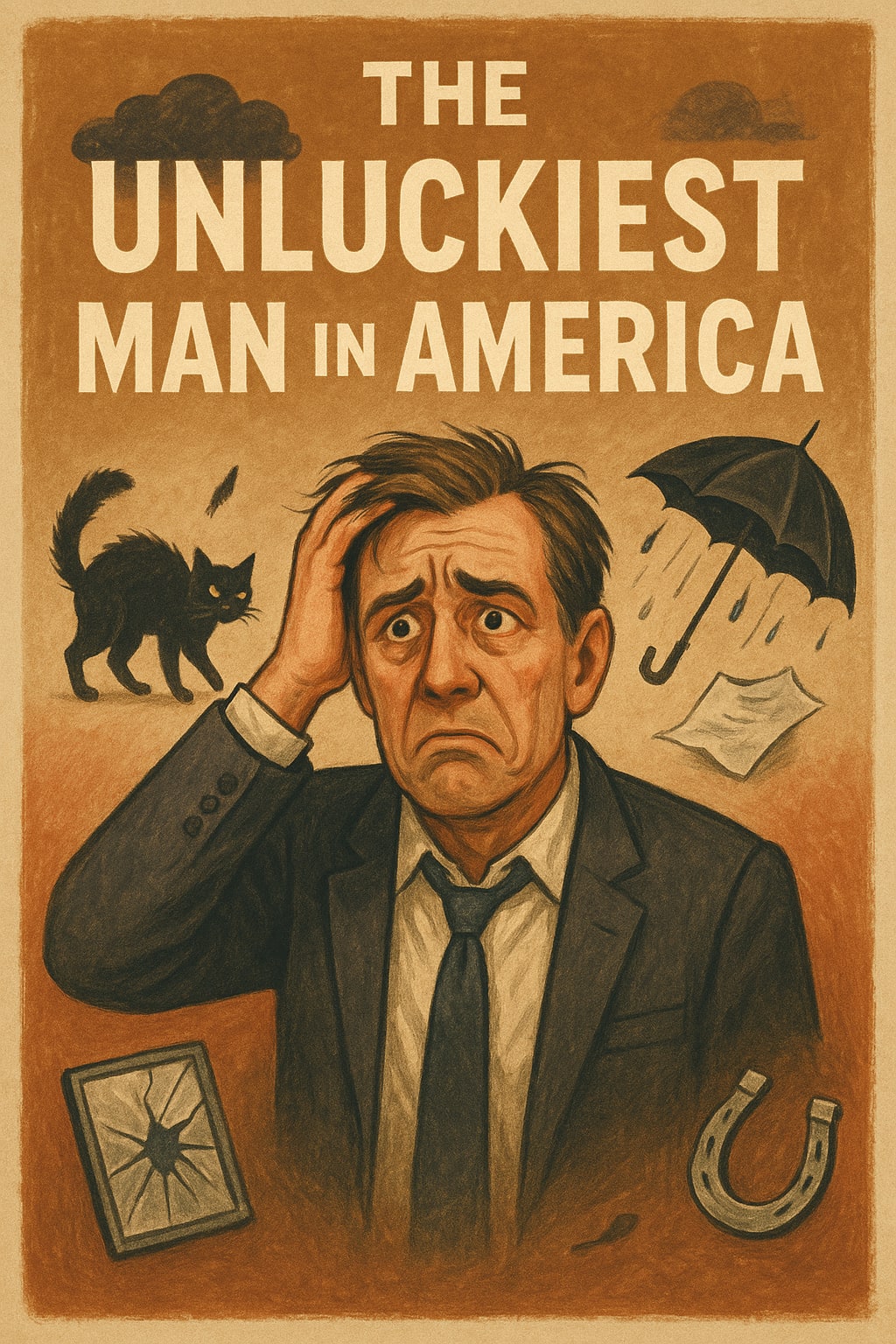
Marcus Holloway was born on Friday the 13th during a solar eclipse, and somehow the universe never let him forget it.
At three months old, he'd been the only baby in the maternity ward to catch chicken pox. At five, he was the kid who found the one rotten egg during the Easter hunt. By twelve, he'd set three Guinness World Records for "most consecutive lottery tickets without winning," "most job rejections in a single day," and "most times struck by bird droppings in one afternoon."
The records brought him no joy. They only served as official documentation of his cosmic joke of an existence.
Now, at thirty-two, Marcus sat in his efficiency apartment—the fourth one this year, after the previous three had suffered mysterious water damage, electrical fires, and a sinkhole respectively, staring at the letter in his trembling hands. The paper was still damp from the surprise thunderstorm that had erupted the moment he'd stepped outside to check his mailbox, despite the weather forecast calling for clear skies.
"Dear Mr. Holloway," the letter began, "We regret to inform you that Pinnacle Solutions Inc. will be ceasing operations effective immediately due to unforeseen circumstances..."
He'd been hired exactly six hours ago. Six hours. It had to be some kind of record.
Marcus crumpled the letter and threw it toward the wastebasket. It bounced off the rim, naturally, and landed in the bowl of cereal he'd abandoned that morning when a bee, the only bee in a three-mile radius, according to his later research; had somehow found its way into his apartment and stung him on the eyelid.
The bee had died, of course. Even nature's creatures seemed to suffer bad luck in his vicinity.
His phone buzzed. A text from his sister Sarah: "How'd the first day go?? So excited for you! 🎉"
Marcus stared at the message, his thumb hovering over the keyboard. How could he explain? How could he tell her that his new boss had been arrested for embezzlement during the lunch break? That the company's main client had pulled out while he was still filling out his W-4? That the building's elevator had broken down with him inside, and he'd spent two hours trapped with a claustrophobic accountant who'd vomited on his new shoes?
He turned off his phone instead.
The pattern had been established early. In kindergarten, Marcus was the child who brought homemade cookies for the class party, only to discover that three kids had developed sudden, severe peanut allergies overnight. The school banned his cookies and sent him home with a lecture about "food safety awareness."
In high school, he'd finally worked up the courage to ask Jessica Martinez to prom. She'd said yes, beaming, and Marcus had felt something foreign and wonderful bloom in his chest, hope. Two days later, Jessica's family moved to Oregon. Her father had been transferred, she explained tearfully, and there was nothing anyone could do.
Marcus went to prom alone. The limo he'd rented broke down. His tuxedo ripped when he tried to help push it. It rained. The gymnasium's roof leaked directly onto his table.
College had been more of the same. Every class he registered for was canceled due to "low enrollment." Every dorm room he was assigned had mysterious plumbing issues. His freshman year roommate turned out to be a compulsive kleptomaniac who stole Marcus's textbooks and sold them back to the campus bookstore.
But Marcus had persevered, driven by an stubborn belief that if he just tried hard enough, cared enough, wanted it badly enough, his luck would eventually turn. He developed elaborate rituals: knocking on wood, throwing salt over his shoulder, carrying a rabbit's foot (which he'd found run over on the highway), avoiding black cats, ladders, and mirrors.
Nothing worked. If anything, his concentrated effort to change his fortune seemed to make things worse.
The job hunt after college had been particularly brutal. Marcus would spend hours crafting the perfect resume, researching companies, writing thoughtful cover letters. He'd arrive early to interviews, impeccably dressed, thoroughly prepared.
The results were always the same. The interviewer would get called away for an "emergency." The company would suddenly implement a hiring freeze. Once, the building was evacuated due to a gas leak that started mysteriously five minutes after Marcus entered.
He'd tried everything. Therapy, meditation, positive thinking seminars, crystals, prayer, even a session with a psychic who'd taken one look at him and refunded his money without explanation.
"Maybe you're trying too hard," his therapist, Dr. Reeves, had suggested during their last session. "Sometimes when we're desperately attached to an outcome, we create the very resistance we're trying to overcome."
Marcus had nodded politely, paid his copay, and walked outside directly into a parade of street performers who somehow managed to completely drench him with confetti cannons and silly string. The dry cleaner had ruined his jacket trying to get the stains out.
He'd stopped seeing Dr. Reeves after that.
Now, sitting in his damp apartment with a job termination letter floating in his cereal bowl, Marcus felt something inside him crack. Not break—crack. Like an egg that's been tapped once too often.
He laughed. It started as a chuckle, then grew into something deeper, more manic. He laughed until tears streamed down his face, until his sides ached, until he couldn't breathe.
When the laughter finally subsided, Marcus felt empty. Hollow. The desperate, clawing hope that had sustained him for thirty-two years was gone, leaving behind a strange, weightless sensation.
He looked around his apartment, at the water stains on the ceiling, the broken air conditioner, the wilting plants that died despite his careful attention, and felt nothing. No disappointment. No frustration. No desperate need to fix anything.
"Fine," he said aloud to the universe. "You win. I don't care anymore."
And for the first time in his life, he meant it.
The change wasn't immediate. For the first week, Marcus simply existed. He didn't look for new jobs. He didn't check his horoscope. He didn't avoid cracks in the sidewalk or worry about black cats. When his unemployment check was delayed due to a "computer error," he just shrugged. When his neighbor's dog got loose and trampled his small herb garden, he watched with mild interest and went back inside.
It was during the second week that things began to shift.
Marcus had been standing in line at the coffee shop, not particularly caring whether he got served or not, when the person in front of him started arguing loudly with the barista about their order. The man stormed out, leaving behind a winning scratch-off lottery ticket worth fifty dollars that he'd apparently forgotten about.
"Excuse me," the barista called to Marcus, "that customer left this behind, but he's gone. You want it?"
Marcus looked at the ticket with complete indifference. "Sure, whatever."
Fifty dollars. He pocketed it without excitement and used it to buy groceries, noting with detached interest that it was the first windfall he'd ever received.
Three days later, a telemarketer called offering him a credit card with an impossibly low interest rate. Normally, Marcus would have hung up immediately or politely declined. Instead, he found himself saying, "I literally do not care what you're selling," and starting to hang up.
"Wait!" the caller said quickly. "Actually, sir, I'm calling because our system flagged your account for a customer service credit. We owe you $200 for a billing error from 2019."
Marcus had never had an account with their company. He told them as much.
"That's... strange. But the credit is definitely in your name and social security number. Would you like us to mail you a check?"
He gave them his address without enthusiasm and forgot about it until the check arrived.
The following week, Marcus's landlord knocked on his door. Marcus opened it expecting an eviction notice, the building had been having pest problems, and he'd assumed they'd blame him somehow.
Instead, his landlord looked embarrassed. "Listen, Marcus, I need to apologize. My nephew has been helping me with the books, and we just discovered he's been overcharging you for rent. For the past eight months. We owe you a pretty substantial refund."
Marcus accepted the check with the same emotional investment he'd give to receiving a grocery store flyer. "Okay."
"You're not... upset about the error?"
"Nope."
His landlord seemed unsettled by his lack of reaction. "We're also going to renovate your unit next month. New appliances, fresh paint, the works. No charge, obviously."
"If you want."
It continued like this. The less Marcus cared, the more positive things seemed to happen around him. A restaurant accidentally gave him someone else's expensive order and told him to keep it when they realized their mistake. He won a radio contest he didn't remember entering. His ancient laptop, which had been dying for months, suddenly started running perfectly after a mysterious software update.
The most significant change came a month after his breakdown. Marcus had been wandering through the airport, killing time before a flight to visit his sister. He wasn't particularly excited about the trip—he wasn't particularly excited about anything anymore, but Sarah had been worried about him and he'd agreed to visit purely to stop her from calling every day.
At the gate, a frazzled airline employee announced that they were looking for volunteers to take a later flight due to overbooking. They were offering a $500 voucher plus accommodations.
Normally, Marcus would have stayed put, worried that switching flights would somehow result in catastrophe. But now, the idea of sitting in an airport hotel room for twelve hours seemed just as appealing as sitting in an airplane. Less appealing, actually, since it required less effort on his part.
"I'll take it," he said, not bothering to get up from his seat.
"Really? You're sure? It means you won't get there until tomorrow evening."
"I don't care."
He called Sarah to let her know he'd be late, packed his carry-on, and settled into the airport hotel with a book he'd grabbed from the terminal gift shop. He fell asleep to the sound of rain pattering against the window.
He woke up to seventeen missed calls.
The first voicemail was from Sarah, sobbing. "Marcus, oh my God, Marcus, please call me back, I just saw the news..."
He sat up slowly, his stomach beginning to knot with the first real emotion he'd felt in weeks.
The second voicemail was from his mother. "Baby, please tell me you weren't on that flight, please call me back..."
Marcus turned on the hotel room television with hands that had begun to shake.
The news anchor was professional but visibly shaken: "Flight 447 from Chicago to Portland crashed during landing last night in severe weather conditions. All 127 passengers and crew members aboard were killed. The FAA has launched a full investigation..."
Marcus stared at the screen. Flight 447. His flight. The flight he'd given up without a second thought because he'd stopped caring about where he was or when he got there.
He called Sarah back with fingers that barely worked.
"Marcus?" She was crying so hard he could barely understand her. "Marcus, is that really you?"
"I'm okay," he said. "I'm fine. I took a different flight."
The silence stretched long enough that he thought the call had dropped.
"Why?" she whispered finally. "You never change plans. You're always so careful about everything."
Marcus looked at himself in the hotel room mirror. His reflection looked back with eyes that held something new—not hope, exactly, but a kind of wondering recognition.
"I stopped caring," he said.
The revelation hit him gradually over the following days. It wasn't that the universe had suddenly decided to favor him. It was that his desperate attachment to outcomes had been poisoning every situation he encountered. His anxiety, his frantic need for things to go right, his hypervigilant anticipation of disaster—all of it had created a kind of energetic static that seemed to attract exactly what he was trying to avoid.
When he stopped caring so intensely about results, he'd started making different choices. Natural choices. He'd taken the voucher because it genuinely seemed easier, not because he was trying to manipulate fate. He'd accepted the lottery ticket because refusing would have required more energy than accepting.
Dr. Reeves had been right, in a way. Marcus had been trying too hard. But it was deeper than that. He'd been caring too hard, with a desperation that had turned every interaction into a high-stakes gamble with the universe.
Now, moving through the world with what he was beginning to think of as "active indifference," Marcus found that life became... easier. Not perfect—he wasn't deluded enough to think he'd unlocked some cosmic cheat code. But easier.
When he applied for jobs now, he did so without attachment to the outcome. If they hired him, fine. If they didn't, also fine. This attitude seemed to make interviews flow more naturally. He answered questions honestly rather than frantically trying to say what he thought they wanted to hear. He asked questions that actually interested him rather than ones calculated to impress.
He got three job offers in two weeks.
He accepted the one that required the least commute, not because he'd carefully weighed the pros and cons of each position, but because he genuinely didn't care enough to spend time comparing benefits packages. The job turned out to be perfect for him, challenging enough to be interesting, relaxed enough to be sustainable, with colleagues who appreciated his straightforward, undemanding presence.
His love life, which had been a series of disasters and near-misses, began to shift as well. When he stopped desperately wanting to find someone, he started actually seeing the people around him. His neighbor, Elena, who'd been trying to get his attention for months with small gestures, homemade cookies, offers to water his plants when he traveled, invitations to community events; suddenly became visible to him.
Not because he was looking for love, but because she was simply there, being kind, without wanting anything from him in return.
Their first conversation happened by accident. Marcus had been carrying groceries up the stairs when one of his bags split. Cans rolled everywhere, and Elena appeared to help him collect them.
"Thanks," he said, meaning it but not meaning anything beyond it.
"No problem. How's the new job going?"
He looked at her with surprise. "How did you know I had a new job?"
She laughed. "You've been leaving in business clothes for the past month. Before that, you mostly left in pajamas."
"Fair point." He paused, studying her face. She had kind eyes and laugh lines and flour in her hair. "Do you want to get coffee sometime?"
"I'd like that."
They went to coffee the next day. Marcus found himself talking to Elena the way he'd never talked to anyone; without trying to impress her, without calculating what effect his words might have, without worrying about whether he was saying the right thing. He told her about his terrible luck, about his breakthrough, about his new philosophy of strategic indifference.
"So you just... stopped caring?" she asked.
"Not about everything. I still care about people getting hurt, or being kind, or doing good work. But I stopped caring about whether the universe likes me. I stopped trying to force outcomes."
Elena nodded slowly. "It's like you stopped fighting the current and started floating instead."
"Yes. Exactly like that."
They'd been together for six months now. Not because Marcus had been trying to find a girlfriend, but because spending time with Elena felt natural and easy and required no effort to maintain. She seemed to appreciate his honesty, his lack of agenda, his newfound ability to be present without constantly scanning for disaster.
One evening, as they sat on his newly renovated apartment balcony watching the sunset, Elena asked him something that made him pause.
"Do you miss it sometimes? The intensity of caring so much?"
Marcus considered the question seriously. "Sometimes I wonder if I've gone too far in the other direction. Like, maybe there's a middle ground between desperate attachment and complete indifference."
"What would that look like?"
He was quiet for a long time, watching the light fade from the sky. "I think... maybe caring deeply about things that actually matter, while staying detached from outcomes I can't control. Caring about being a good person, but not caring whether the universe rewards me for it. Caring about people I love, but not trying to force them to love me back."
Elena reached over and took his hand. "That sounds like wisdom."
"Does it? I'm not sure I know the difference between wisdom and just being tired."
She laughed. "Maybe they're the same thing sometimes."
That night, Marcus lay awake thinking about his journey. He'd spent thirty-two years desperately swimming against a riptide, exhausting himself in the fight against forces he couldn't see or understand. When he'd finally stopped struggling, he'd discovered that the current he'd been fighting wasn't actually trying to drown him, it was trying to carry him somewhere he couldn't have imagined going on his own.
He still wasn't sure he believed in luck, good or bad. But he was beginning to believe in the power of letting go, of moving through the world with open hands instead of clenched fists.
His phone buzzed with a text from Sarah: "How are you doing, big brother?"
Marcus smiled and typed back: "I'm good. Really good. How are you?"
"Happy to hear it. Love you."
"Love you too."
He put the phone away and closed his eyes, feeling something that might have been gratitude settling over him like a warm blanket. Not gratitude for his improved circumstances, though those were nice—but gratitude for the strange gift of not needing things to be different than they were.
For the first time in his life, Marcus Holloway fell asleep easily, without worrying about what tomorrow might bring.
Outside his window, it began to rain, a gentle, steady shower that would water Elena's garden and help her tomatoes grow.
About the Creator
Christopher Hodgson
Author/Philosopher: #history #politics #law #ethics Harvard Political Philosophy✒
Poetry - Romance - Opinion pieces
Keep reading
More stories from Christopher Hodgson and writers in Fiction and other communities.
Midnight Sun
In the heart of the city that never sleeps, there existed a man who knew the night intimately. Ethan's life was a dance with insomnia, his mind a whirlwind of thoughts that refused to let him rest. Night after night, he wandered the streets, seeking solace in the quiet solitude of the early hours.
By Christopher Hodgson2 years ago in Fiction
Writing About Writing: The Rainbow Trap
The good thing about living in modern times is that LGBTQ representation in media is increasing. Not just in niche and Independant media, either, but also in mainstream media. Books, movies, TV shows, comics... they're finally catching on that LGBTQ+ people form a significant part of their audience, and deserve to see themselves on screen and in fiction, not just as victims in documentaries and true crime shows.
By Natasja Roseabout 15 hours ago in Writers



Comments
There are no comments for this story
Be the first to respond and start the conversation.